 Skagit County
 Roof Replacement Built for Sedro-Woolley's Climate
Sedro-Woolley sits in the Skagit Valley, tucked between farmland and the foothills of the North Cascades, and that location shapes what a roof has to survive here. Skagit County as a whole deals with a marine-influenced climate that brings long stretches of driving rain, humid air off the surrounding water and lowlands, and heavy tree cover that keeps roofs shaded and damp for much of the year. That combination adds up to a long moss season — often eight months or more where conditions favor growth — and roofs that rarely get a full day to dry out between storms.
None of that is a reason to panic about your roof. It's a reason to make sure a replacement is done with this specific climate in mind, not with a one-size-fits-all approach that might work fine in a drier part of the state. A roof installed correctly for Sedro-Woolley's conditions should shed water fast, resist moss colonization for years rather than months, and keep moisture out of the attic where it can rot decking from the inside without ever showing up as a visible leak.
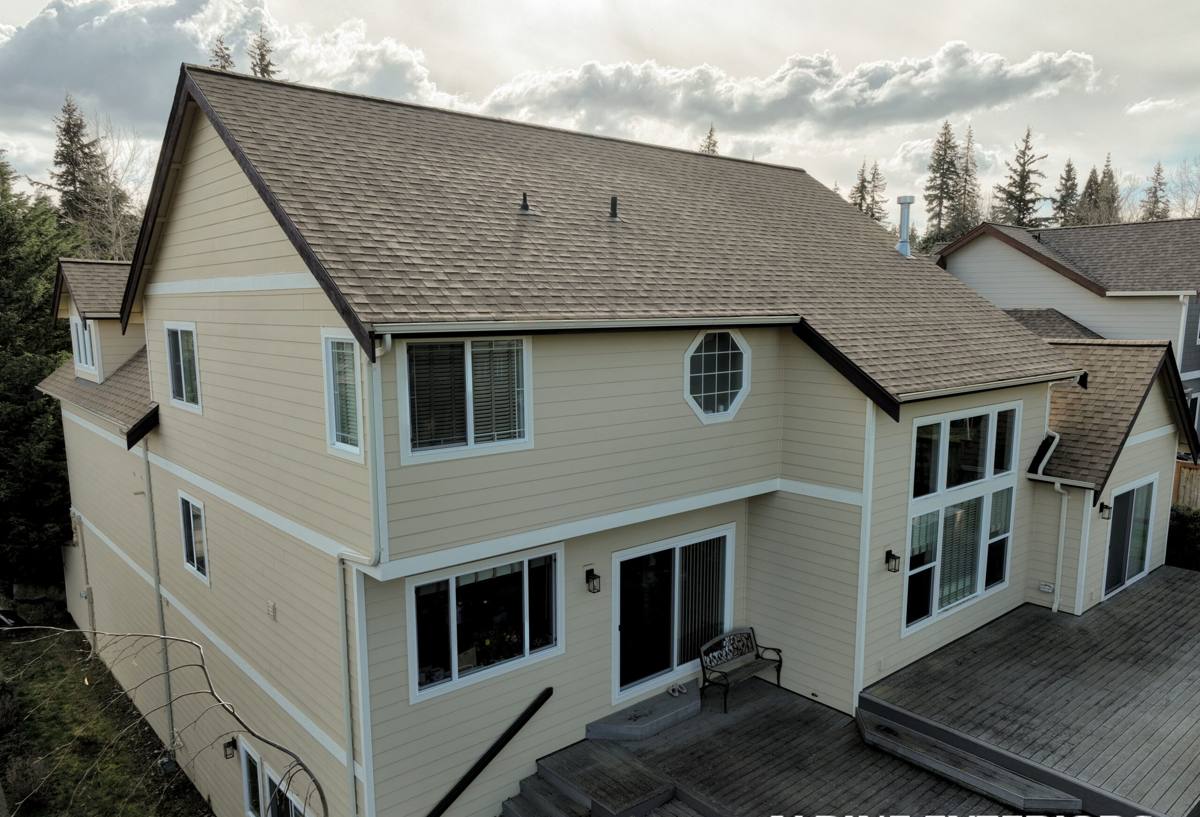
Signs Your Roof Needs Replacement, Not Just a Repair
Repairs make sense when the underlying roof is still sound and the problem is isolated — a damaged vent boot, a section of flashing, a few blown-off shingles after a windstorm. Replacement becomes the honest recommendation when the roofing material itself is failing across the whole surface. Here's what we look for during an inspection:
- Shingles that are curling, cupping, or losing granules in patches larger than a single repair area
- Moss growth thick enough to hold water against the shingle surface rather than just staining it
- Daylight visible through the roof deck from inside the attic, or damp insulation under the decking
- Soft or spongy spots when walking the roof, which usually means the decking underneath has started to rot
- A roof approaching or past 20–25 years old (for asphalt composition) with no major upgrades since installation
- Repeated leaks in different spots each winter, rather than one recurring trouble area
- Sagging rooflines, which can indicate structural or long-term moisture damage, not just a cosmetic issue
If only one or two of these apply and the roof is under 15 years old, a targeted repair is often the right call. When several apply at once, patching becomes a short-term fix on a roof that's already failing underneath.
Choosing a Roofing Material That Holds Up in Skagit County
Material choice matters more here than in drier climates, because a roof that handles moss and moisture poorly won't just look bad sooner — it will need earlier repairs and eventually earlier replacement. There's no single "best" option for every home; it depends on your budget, your roof's slope and tree exposure, and how long you plan to stay in the house.
| Material | Typical Lifespan | Moss & Moisture Behavior | Maintenance |
|---|---|---|---|
| Standard 3-tab asphalt shingle | 15–20 years | More vulnerable to moss and algae staining; granule loss speeds up in shaded, damp areas | Periodic moss removal and gutter cleaning recommended |
| Architectural (laminate) shingle | 25–30 years | Thicker profile sheds water better and resists algae streaking with algae-resistant granules | Lower maintenance than 3-tab, still benefits from moss treatment in heavy shade |
| Standing seam metal | 40–50+ years | Sheds water and moss very effectively due to smooth, sloped surface; minimal organic buildup | Very low; occasional gutter and fastener check |
| Synthetic/composite shingle | 30–40 years | Resists moisture absorption well; performance varies by manufacturer | Low, similar to architectural shingle |
For most homes in and around Sedro-Woolley, architectural shingle is the practical middle ground — a meaningful upgrade over 3-tab in both lifespan and moss resistance without the higher upfront cost of metal. Where a home has heavy tree cover or a low-slope section that stays wet longer, metal is worth pricing out even if it costs more up front, because the reduced moss and moisture exposure can mean decades of avoided maintenance.
What a Correct Roof Replacement Actually Involves
Full Tear-Off, Not an Overlay
We don't install new shingles over old ones. An overlay hides the condition of the decking, traps moisture between layers, and voids most manufacturer warranties. A full tear-off lets us see the deck itself — every rafter and sheet of plywood or OSB — before anything new goes down.
Decking Inspection and Repair
This is the step that gets skipped by crews trying to move fast. Any decking that's soft, delaminated, or water-stained gets replaced before underlayment goes on. Installing a new roof over compromised decking just guarantees a problem resurfaces within a few years, usually as a soft spot or a leak that seems to come from nowhere.
Ice and Water Shield at Vulnerable Points
Given how much sustained rain this region gets, we pay particular attention to eaves, valleys, and any roof penetration — chimneys, vent stacks, skylights. A self-adhering waterproof membrane goes down at these points before the main underlayment, because that's where wind-driven rain is most likely to work its way backward under a shingle edge.
Flashing Done Right
Flashing failure is one of the most common causes of roof leaks that have nothing to do with the shingles themselves. Step flashing at walls, counter-flashing at chimneys, and properly lapped valley flashing all need to be installed correctly, not just caulked over. Caulk is a stopgap, not a flashing system.
Matching Fasteners and Materials to the Climate
Corrosion-resistant fasteners and properly rated underlayment matter in a region that stays damp for long stretches of the year. Cutting corners on hardware is invisible on installation day and expensive five years later.
Ventilation: The Part of a Roof Replacement Homeowners Never See
A roof isn't just the shingles — it's a system that includes how air moves through the attic. Balanced intake (soffit vents) and exhaust (ridge vents) ventilation keeps warm, moist attic air from condensing against the underside of the decking. In a climate with long damp stretches like Skagit County's, poor ventilation is one of the leading causes of premature deck rot and shingle failure from below, not above.
During a replacement, we check whether existing ventilation is adequate for the roof's square footage and correct it if it's not — adding soffit vents, upgrading to a continuous ridge vent, or addressing insulation that's blocking airflow at the eaves. Skipping this step is one of the most common reasons a "new" roof develops problems well before it should.
Moss, Algae, and Long-Term Roof Care
Moss doesn't just look bad — it holds moisture against the roof surface, lifts shingle edges as it grows, and accelerates granule loss. In a region with a moss season that can run most of the year, prevention matters more than periodic cleaning.
Zinc or copper strips installed near the ridge are a proven, low-maintenance way to inhibit new moss growth as rainwater carries trace metal ions down the roof slope. They don't eliminate the need for occasional moss removal on heavily shaded sections, but they meaningfully slow regrowth compared to a roof with no treatment at all. We also make sure gutters and downspouts are clear and properly pitched at the end of a replacement, since clogged gutters are one of the most common (and most avoidable) causes of moss taking hold at the eaves first.
Our Roof Replacement Process
- On-site inspection — we walk the roof and check the attic, not just look from the ground, and document decking condition, ventilation, and problem areas
- Written estimate — clear scope, material options, and pricing with no vague allowances hidden in the fine print
- Permitting — we handle the permit application with the county so you don't have to track it down yourself
- Scheduling around weather — we plan tear-off days around dry windows whenever possible, since an open roof deck and Skagit County rain don't mix
- Tear-off and decking repair — old material removed, deck inspected and repaired as needed
- Underlayment, flashing, and ventilation correction — the waterproofing and airflow work that determines how the roof performs for the next 20-plus years
- Final installation — shingles or metal panels installed to manufacturer spec, including proper nailing patterns and exposure
- Cleanup and walkthrough — job site cleared, magnetic sweep for stray fasteners, and a final review of the finished roof with you
Why a Crew That Already Works Sedro-Woolley Matters
Roofing crews unfamiliar with this specific area sometimes underestimate how much moss and moisture matter here, or plan installation timing the way they would for a drier region. A crew that already works Sedro-Woolley and the surrounding Skagit County communities knows the local permitting process, has a realistic sense of which weeks tend to offer usable dry stretches, and has seen firsthand which details — ventilation, flashing, moss prevention — actually hold up here versus which ones look fine on installation day and fail within a few winters. That local track record shows up in fewer callbacks and roofs that perform the way they're supposed to for their full expected lifespan.
What Affects the Cost of a Roof Replacement
| Factor | Why It Matters |
|---|---|
| Roof size and pitch | Steeper roofs take longer to work safely and require more material overlap |
| Number of layers to remove | Tearing off multiple existing layers adds labor and disposal cost |
| Decking condition | Rotted sheathing found during tear-off means replacement boards, which isn't always visible until the old roofing is off |
| Material selection | Standard asphalt, architectural shingle, and metal carry different material and labor costs |
| Roof complexity | Valleys, dormers, skylights, and multiple penetrations all add flashing work |
| Ventilation upgrades | Adding or correcting soffit and ridge venting is a smaller add-on cost with a large long-term payoff |
We give a firm, itemized number after inspecting the actual roof — not a phone estimate — because decking condition and complexity genuinely can't be judged accurately from the ground or from photos.
If your roof is showing its age or you just want an honest read on how many years it has left, we're glad to come take a look. The estimate is free, there's no pressure attached to it, and you'll get a straight answer about whether you need a full replacement or just a repair — use the form below to get started.