 Skagit County
 Burlington's Exterior Climate: What Skagit County Throws at a House
Burlington sits in the Skagit Valley, close enough to the Salish Sea and the tidal reaches of the Skagit River delta that homes here deal with a specific mix of weather stress most siding products were never designed to handle well long-term. It isn't one dramatic event that wears down an exterior in this part of Skagit County — it's the accumulation of a wet, mild, marine-influenced climate working on a house twelve months a year.
Three factors matter most for exterior materials in Burlington and the surrounding valley: persistent moisture, salt-tinged marine air moving in off the Sound and delta, and long stretches of shade and dampness that let moss and algae take hold on north- and west-facing walls. None of these are exotic problems. They're just relentless, and relentless is what breaks down inferior siding.
Rain That Doesn't Let Up
Skagit County gets a long, drizzly wet season rather than short heavy downpours. That matters more than people expect. A material that can shed a hard rain but slowly wicks moisture during weeks of steady drizzle and high humidity will fail differently than one exposed to occasional storms. Siding in Burlington needs to manage sustained dampness at seams, laps, and butt joints — not just resist a single soaking.
Salt Air and Marine Moisture
Burlington isn't oceanfront, but it's close enough to tidal water and the Sound that homes here get periodic exposure to salt-laden air, especially with onshore wind patterns. Salt air accelerates corrosion of fasteners and trim hardware and can be tough on paint films and caulking over time. It's a slower effect than what you'd see right on the coast, but it's a real factor a generic siding warranty written for a dry inland climate doesn't account for.
Moss, Algae, and Shade
Between tree cover, cloud cover, and damp ground, a lot of Skagit Valley properties have at least one wall that rarely gets direct sun. Moss and algae growth on siding isn't just cosmetic — it holds moisture against the surface and, on materials that aren't dimensionally stable or well-sealed, that trapped moisture is where rot and delamination start.
Why This Climate Is Hard on the Wrong Siding Choices
A lot of siding products perform fine in a lab or in a dry climate and then struggle in a place like Burlington, where the exterior almost never fully dries out for months at a stretch. We've built our business around one material for a reason, and it comes down to how different products actually behave here, not on a spec sheet.
Vinyl
Vinyl siding is affordable and low-maintenance in the sense that it doesn't need repainting, but it's a poor fit for a wet, temperature-swinging climate over the long haul. It expands and contracts with temperature, which opens gaps at seams over time, and it can warp or become brittle. In a climate with this much sustained moisture, those gaps are an invitation for water intrusion behind the panel where you can't see it happening.
Engineered Wood (LP SmartSide and similar)
Engineered wood siding has improved a lot over the decades, but it's still a wood-based product, and wood-based products are moisture-sensitive by nature. In a climate where a wall can stay damp for weeks, any breach in the factory coating — a scratch, a poorly sealed cut edge, a nail hole — becomes a point where moisture gets into the substrate. Once that happens, swelling and eventual rot follow, and it's often not visible until it's advanced.
Cedar and Primed Spruce
Real wood siding has genuine appeal, but it demands a maintenance commitment that most homeowners underestimate — recoating on a cycle, careful caulking, and vigilance about the shaded, damp sides of the house where moss loves to grow. In Burlington's climate, that maintenance cycle tends to be more frequent than owners expect, and skipping a cycle here or there is exactly how wood siding starts to fail.
Other Fiber Cement Brands (Cemplank, Allura)
Other fiber cement products share the core material science of Hardie's boards — cement, sand, and cellulose fiber — but we've standardized on James Hardie specifically for its factory-applied ColorPlus finish, its climate-engineered HZ5 product line built for the Pacific Northwest's wet cycle, and the depth of installation documentation and warranty backing behind it. Consistency in the product we install matters as much as the material category.
Why We Install Only James Hardie Fiber Cement Siding
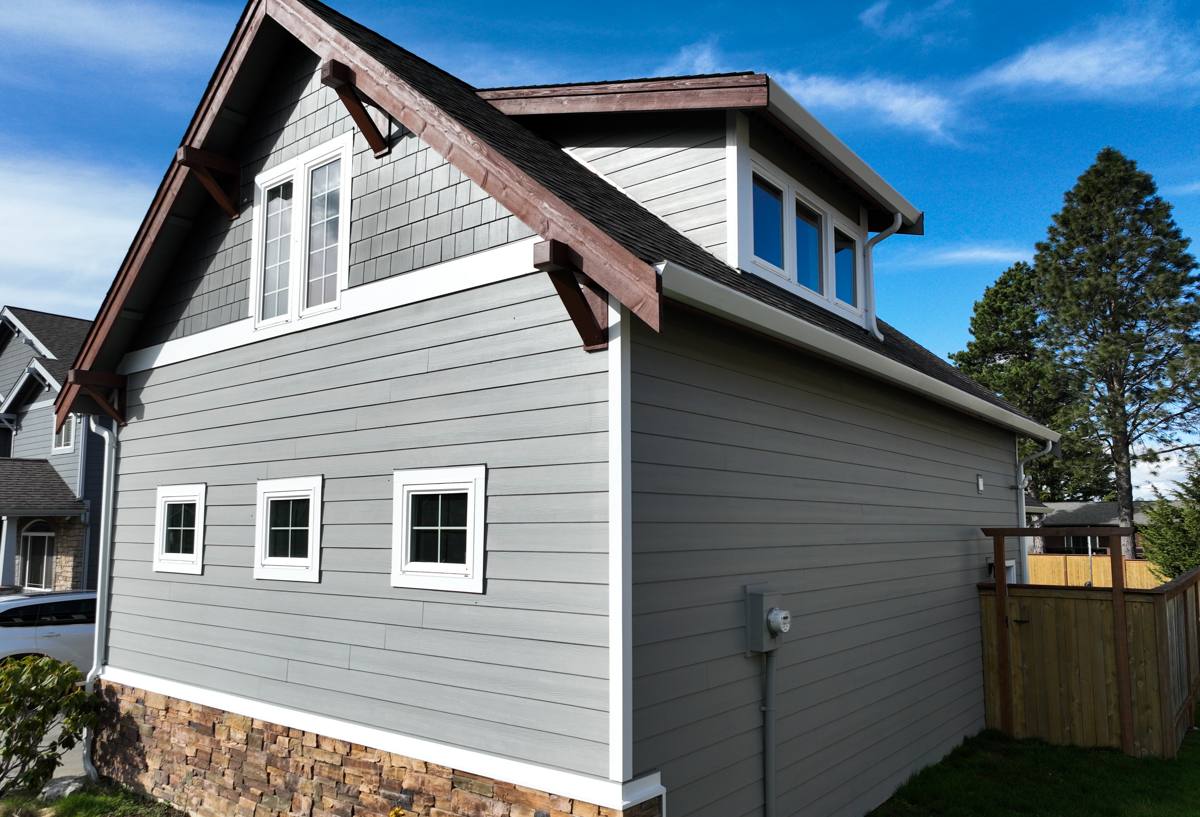
James Hardie siding is non-combustible fiber cement — a mix of cement, sand, and cellulose fibers engineered to resist moisture, hold paint, and stay dimensionally stable through wet-dry cycles far better than wood-based or vinyl alternatives. For Skagit County specifically, a few features matter most:
- HZ5 climate engineering — Hardie's HZ product lines are formulated for specific climate zones, and the HZ5 designation covers regions like ours with significant moisture exposure and freeze-thaw cycling.
- ColorPlus factory finish — a baked-on finish applied under controlled conditions, which holds up better against UV and moisture than field-applied paint and resists the fading and chalking that shows up fastest on shaded, damp walls.
- Non-combustible material — fiber cement doesn't feed a fire the way wood-based siding can, which matters for insurance considerations as much as safety.
- Dimensional stability — Hardie board doesn't swell and contract the way wood and some engineered products do, so seams and caulk lines stay tighter through Skagit's wet season.
- Transferable warranty — a real, documented warranty that can matter at resale, not just a marketing claim.
None of this means Hardie is maintenance-free. It still needs to be installed correctly, caulked and flashed properly at penetrations and trim, and kept clear of standing moss and vegetation contact. What it means is that the material itself is working with you in this climate instead of against you.
How We Approach Siding Installation in Burlington
Correct installation matters as much as product choice, maybe more. A lot of the siding failures we get called out to inspect in Skagit County aren't a material problem — they're a flashing, clearance, or fastening problem that let water in behind a perfectly good product.
What We Pay Attention To On Every Job
- Proper water-resistive barrier and flashing details at windows, doors, and roof-to-wall intersections
- Correct fastener spacing and type, accounting for the salt-air exposure common in this area
- Adequate clearance between siding and grade, decks, and roof lines to reduce splashback and standing moisture
- Caulking and sealing details at butt joints and trim, following Hardie's published installation specs
- Ventilation behind the cladding so the wall assembly can dry when it does get wet
These details are exactly where installation quality separates a siding job that lasts decades from one that needs attention again in five or six years — especially in a climate that rarely gives a wall a long dry stretch to recover from a mistake.
Roofing, Windows, and Decks: The Rest of the Exterior Envelope
Siding doesn't work in isolation. In Burlington's climate, the roof, windows, and any deck structures interact directly with how well the siding performs. A roof with poor drip-edge or valley flashing dumps extra water onto walls below. Windows without proper flashing integration create a direct path for water behind the siding regardless of how good the siding itself is. Decks attached to the house need proper ledger flashing so the connection point doesn't become a chronic moisture trap.
We handle siding, roofing, windows, and decks as one exterior envelope rather than separate trades, because in a wet climate like Skagit County's, the weak point is usually where two systems meet — not in the middle of a wall or roof field.
Comparing Siding Options for Skagit County Homes
| Material | Moisture Resistance | Maintenance | Typical Lifespan Here | Our Take |
|---|---|---|---|---|
| Vinyl | Moderate; seams can open with temperature swings | Low, but can't be repainted easily | 15-25 years | Budget-friendly but a poor long-term fit for this climate |
| Engineered Wood | Vulnerable at breaches in factory coating | Moderate to high | 15-25 years | Coating integrity is everything; hard to guarantee over decades |
| Cedar | Poor without diligent upkeep | High; regular recoating required | Highly variable | Beautiful, but maintenance cycle rarely matches homeowner reality |
| James Hardie Fiber Cement | Strong; HZ5-engineered | Low; occasional wash and caulk check | 30-50+ years with correct install | What we install and stand behind |
Signs Your Current Siding May Be Struggling in This Climate
If you're not sure whether your Burlington home's siding is holding up, a few warning signs are common in this climate specifically:
- Persistent moss or dark streaking on shaded walls that keeps returning after cleaning
- Soft spots, bubbling, or visible swelling near the bottom edges of boards or at seams
- Paint that's chalking, peeling, or fading noticeably faster on one side of the house
- Gaps opening at butt joints or around trim that weren't there a few years ago
- Any musty smell or visible staining on interior walls that share an exterior wall
None of these automatically mean a full replacement is needed, but they're worth a professional look before they become a bigger repair.
Why a Local Crew Matters in Skagit County
A contractor working across the whole Skagit Valley sees the same patterns repeat house after house — which walls in a given neighborhood tend to hold moss, how a particular street's tree canopy affects drying time, what wind exposure does to homes near open farmland versus more sheltered lots. That pattern recognition is worth something. It's the difference between a generic installation and one that accounts for how a specific property in Burlington actually experiences the weather, not just how the manufacturer's spec sheet describes an average climate zone.
Local presence also matters after the job is done. Warranty service, a caulking touch-up years down the line, or a quick look at a concern doesn't require finding a contractor from scratch — it's a call to a crew that's still working in the area and stands behind the install.
If you're weighing siding options for a home in Burlington or elsewhere in Skagit County, we're happy to take a look and talk through what we're seeing on your specific property. Reach out for a free, no-pressure estimate — there's no obligation, and it's a useful starting point even if you're just gathering information.