 Skagit County
 Why "Cost Per Square Foot" Doesn't Tell You Much
Most homeowners start researching siding replacement by looking for a number — a price per square foot they can multiply by their home's size and get an answer. It doesn't work that way, and any contractor who quotes you a firm number over the phone without seeing your house is guessing. Siding cost is really the sum of several separate decisions: what's being torn off, what condition is underneath it, what material you're putting up, and how much labor your specific house requires to do it correctly.
Two homes of the same square footage in Mount Vernon or Anacortes can come in thousands of dollars apart once you account for wall complexity, trim detail, rot repair, and the number of stories a crew has to work around. This page walks through the real cost drivers so you can read a quote and understand what you're actually paying for.
The Big Four Cost Drivers
1. Tear-Off and What's Underneath
Removing the old siding is rarely the expensive part. What's expensive is what you find once it's off. Sheathing that's been absorbing moisture for years, window and door framing that's gone soft, or a house wrap that failed a decade ago all turn into repair line items that weren't — and couldn't have been — priced into the original estimate. This is the single biggest source of "why did my quote change" conversations in this trade, and it's not a bait-and-switch. It's the nature of not being able to see through walls.
2. Material Choice
This is the single largest cost variable a homeowner actually controls. Vinyl, engineered wood, fiber cement, and cedar all carry different material costs, different installation labor, and — just as important — different long-term maintenance costs that don't show up on the initial invoice but show up over the next fifteen years.
3. Labor and Wall Complexity
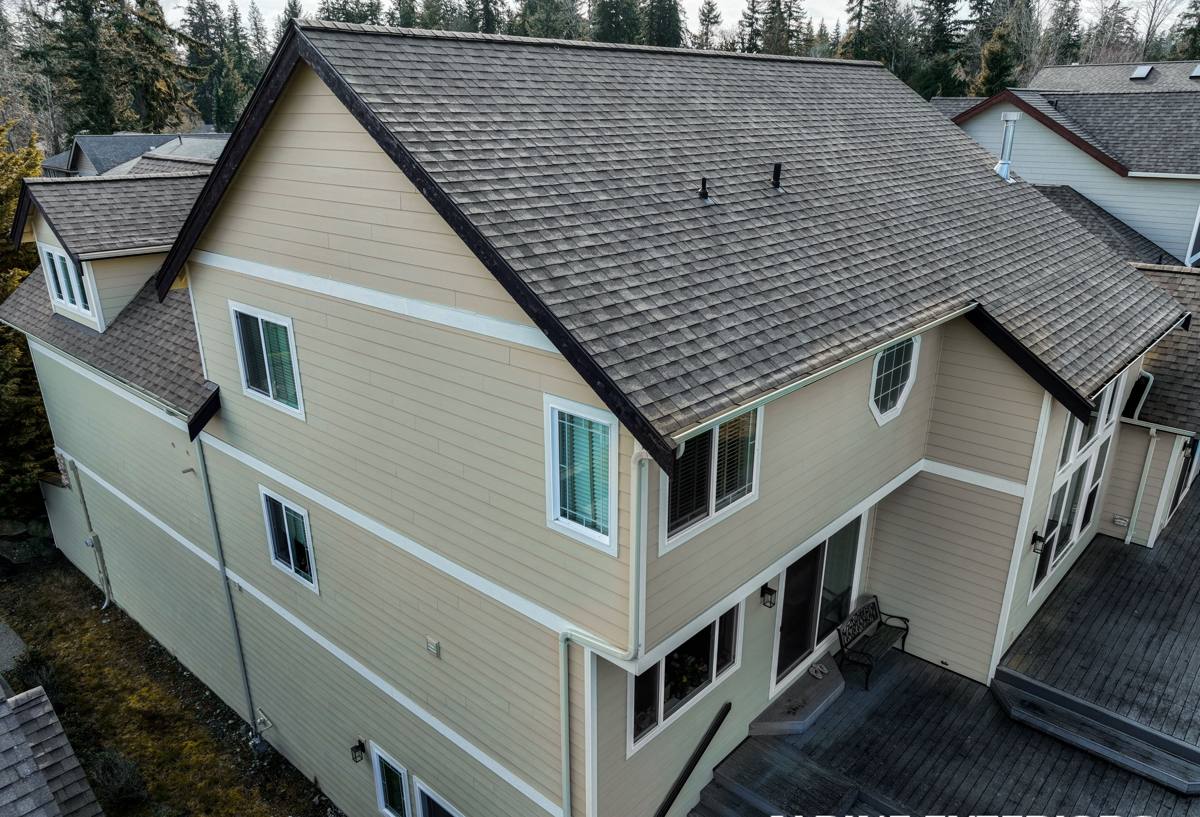
A simple rectangular ranch home is far cheaper to side than a home with lots of gables, dormers, bump-outs, and trim detail. Labor is priced by time, and complex cutting, fitting, and flashing around every window, corner, and roofline takes real hours. Two-story and multi-story homes also add scaffolding or lift costs that single-story homes don't carry.
4. Regional Climate Requirements
This is the factor homeowners outside the Pacific Northwest don't have to think about, and it's a real one here. Skagit County sits close enough to Puget Sound and the Salish Sea that salt-laden air is part of daily weather, especially for homes toward Anacortes and the water. Add driving rain that comes in sideways during fall and winter storms, plus a moss season that runs long on north-facing walls and shaded lots, and you have three separate forces working against a wall assembly year-round. Correctly installed siding here means proper rainscreen gaps, careful flashing at every penetration, and a moisture-tolerant material — all of which take more installation time than a "nail it up and caulk the gaps" job, and all of which are worth paying for.
Rough Cost Ranges by Material
These are broad, honest ranges reflecting material and typical installation costs in this region — not a quote. Every home is different, and the only way to get a real number is a walk-around estimate.
| Material | Relative Material Cost | Installation Sensitivity | Typical Lifespan Before Major Issues |
|---|---|---|---|
| Vinyl | Lowest | Low — fast to install | Can fade, warp, or crack; varies widely |
| Engineered wood (LP-type) | Moderate | High — edge sealing and flashing are critical | Moisture-sensitive if any detail is missed |
| Fiber cement (James Hardie) | Moderate to higher | Moderate — requires correct fastening and clearances | Long-term when installed to spec; factory finish resists fade |
| Cedar | Highest (material) | High — needs regular refinishing to perform | Depends heavily on ongoing maintenance |
Vinyl looks like the budget winner on day one, but it's also the least forgiving of our climate over time — it can't be painted to refresh it, and UV plus temperature swings can cause visible warping over the years. Engineered wood products need every cut edge sealed and every flashing detail done right, because they're wood-based and moisture is the one thing they can't tolerate; a single missed detail during install can cause problems that don't show up for a few winters. Cedar is beautiful but needs a homeowner committed to refinishing on a schedule, which is its own recurring cost that never stops.
Why We Only Install James Hardie Fiber Cement
We made a decision a while back to stop installing several products we used to offer, and it comes down to what actually holds up against salt air, driving rain, and a wet, mossy climate without asking the homeowner to babysit it. James Hardie fiber cement is non-combustible, holds paint and its factory ColorPlus finish far longer than wood-based alternatives, and Hardie makes climate-engineered HZ product lines specifically for moisture-heavy regions like ours. It also carries a strong transferable warranty, which matters if you ever sell the house.
None of this means fiber cement is the cheapest option on the shelf — it usually isn't. It means that when you add up the real cost of siding a home in Skagit County, which includes what you'll spend on repainting, caulking, board replacement, and rot repair over the next fifteen years, fiber cement installed correctly tends to be the more honest total cost, not just the lowest sticker price.
The Hidden Line Items Homeowners Forget to Ask About
- Trim and fascia: Old trim boards are often as weathered as the siding itself and get replaced at the same time.
- House wrap / weather-resistive barrier: A tear-off is the one chance to replace the moisture barrier behind the siding — skipping this to save money undermines everything installed over it.
- Window and door flashing: Correcting improperly flashed openings found during tear-off is common and worth doing right rather than residing over it.
- Gutter and downspout interaction: Poor drainage at rooflines drives water directly onto walls; sometimes minor gutter work belongs in the same project.
- Disposal and permitting: Tear-off debris hauling and any required permits are real costs that belong in a complete estimate.
- Paint or color upcharges: Custom or premium ColorPlus finishes may carry a modest premium over standard color offerings.
A quote that doesn't address these items isn't necessarily cheaper — it's often just incomplete, and they tend to surface as change orders once work begins.
What Drives Cost Up vs. Down on a Typical Skagit County Home
| Drives cost up | Drives cost down |
|---|---|
| Multiple stories requiring scaffolding or lifts | Single-story, simple footprint |
| Extensive rot found at tear-off | Well-maintained walls with an intact moisture barrier |
| Complex rooflines, dormers, many corners | Rectangular or minimally detailed walls |
| Custom trim or accent details | Standard trim profiles |
| North-facing or heavily shaded walls needing extra moss/moisture prep | Sun-exposed walls with good drainage away from foundation |
How to Read a Siding Quote Without Getting Burned
A vague, low quote is more expensive to accept than a detailed, higher one — because the vague one is where the surprise change orders live. Before you sign anything, make sure the estimate spells out the material and product line by name, whether the house wrap is being replaced, how much of the estimate is contingency for hidden rot versus known scope, and what the payment schedule looks like tied to actual project milestones.
- Does the quote name the exact siding product and manufacturer, not just "fiber cement" or "vinyl"?
- Is house wrap / weather barrier replacement included or excluded?
- Is there a stated process for pricing rot repair if it's found during tear-off?
- Are trim, fascia, and flashing work spelled out separately or bundled vaguely?
- Is the crew insured and is the manufacturer's warranty transferable if you sell the home?
- Does the payment schedule track actual progress rather than front-loading cash before work starts?
Timing and Seasonal Considerations
Siding can be installed in Skagit County for most of the year, but scheduling around our wetter months does matter for tear-off timing — a house with its weather barrier exposed during a stretch of driving rain is a real risk, not just an inconvenience. A contractor who plans tear-off sections to limit exposed wall time, rather than opening up an entire house at once, is managing that risk correctly. It's a fair question to ask any contractor how they sequence a tear-off during our rainy season.
Getting an Accurate Number for Your Home
The only way to get a real cost figure — not a range, not a guess — is to have someone walk the exterior, check the condition of what's underneath where it's accessible, measure wall complexity, and talk through material choice with you directly. If you'd like a free, no-pressure estimate for your home, the form below gets that conversation started.