 Skagit County
 Concrete's Climate Puts Real Demands on Exterior Siding
Concrete sits up the Skagit River valley, tucked against the foothills of the North Cascades, and that location shapes what siding on a home there actually has to survive. This isn't the salt-air exposure you get closer to Anacortes and the coastline, but it's its own kind of hard on a house. The valley traps moisture. Rain rolls in off the mountains and lingers under tree cover longer than it does out on the flats. Homes tucked against timber or set back from full sun stay damp for days after a storm passes, and that dampness is exactly what feeds the long moss and algae season Skagit County is known for.
Add in the temperature swings that come with elevation and proximity to the Cascades — colder snaps, occasional snow load, and freeze-thaw cycles that coastal Skagit towns rarely see — and you've got a climate that's genuinely tough on lower-grade siding materials. Wood siding without a rigorous repaint schedule checks and cups. Vinyl gets brittle in cold snaps and can warp where afternoon sun hits it directly. Anything with exposed seams or a weak moisture barrier eventually lets water behind the cladding, and once that happens in a shaded, damp river valley, it doesn't dry out quickly.
Why Driving Rain and Shade Are a Combination Worth Planning For
It's the combination that matters more than either factor alone. A house that gets driving rain but also full sun dries out between storms. A house in a shaded pocket near Concrete with the same rain exposure can stay wet at the wall assembly far longer, which is exactly the condition that lets moss take hold, lets paint fail early, and lets moisture work its way into seams and fastener points. Siding decisions for homes in this part of Skagit County should start with an honest look at how much sun exposure and airflow a given wall actually gets, not just what the neighborhood average looks like.
Why a Local Crew Matters More Than It Sounds Like It Should
Concrete is a small community, and homes here vary — older farmhouses, river-valley cabins, newer builds set back into the trees. A crew that only works in flatter, drier parts of Skagit County can miss details that matter here: how far to hold trim off a shaded foundation, where to expect standing moisture after a heavy rain event, which walls need extra attention to flashing and water management because they simply don't get enough sun to dry fast. We work across Skagit County, and part of that is recognizing that Concrete's conditions aren't the same as a house two exits down the highway toward the valley floor.
Local also means accountability. We're not a crew that flies in for a job and disappears. If a detail needs revisiting after a wet winter, we're still the same company down the road.
What We Do for Concrete Homeowners
We're a full exterior contractor, not a siding-only outfit, which matters because siding rarely fails in isolation from the rest of the building envelope.
Siding
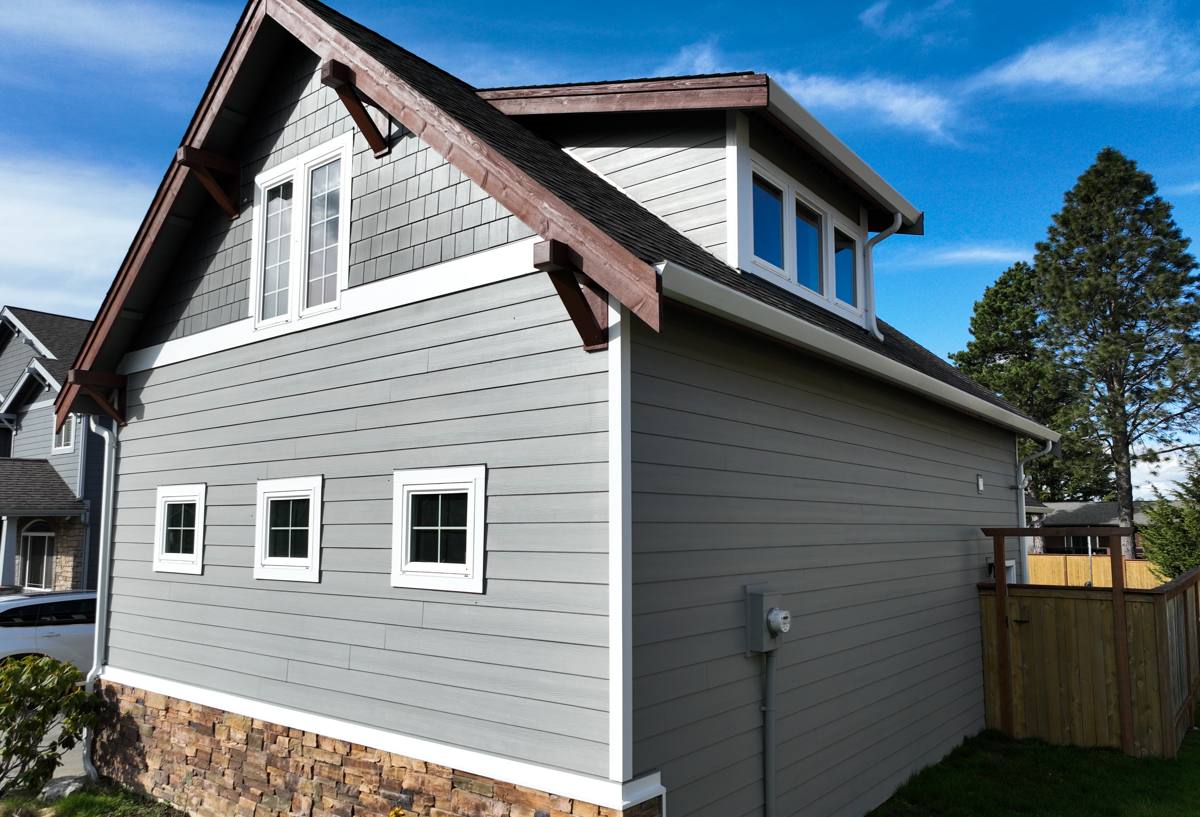
Our siding work is James Hardie fiber cement, exclusively — more on why below. This covers full replacements, additions, and matching existing Hardie installations.
Roofing
Roof and siding failures are often connected. A roof that's shedding water incorrectly, or has failing flashing at a wall intersection, will soak the siding right below it no matter how good that siding is. We look at both together.
Windows
Window replacement is frequently bundled with siding work because the flashing and integration details around window openings are where most water intrusion actually starts. Doing both at once means one continuous, correctly flashed water management plan instead of two separate systems trying to meet in the middle.
Decks
Outdoor living structures in a shaded, damp climate like Concrete's face the same moss, rot, and moisture challenges as siding. We build and repair decks with the same climate-first approach.
Why James Hardie Is the Only Siding We Install
This is a deliberate standard, not a default. We used to see the range of what happens to different siding materials in exactly this kind of damp, shaded, temperature-swinging climate, and we made a decision: we only install James Hardie fiber cement.
What Hardie Gets Right for This Climate
- Non-combustible material — fiber cement doesn't burn, which matters for homes near forested land close to the Cascades.
- Engineered for Pacific Northwest moisture — Hardie's HZ10 product line is specifically formulated for climates with sustained damp and moderate freeze-thaw exposure, which describes Concrete well.
- Factory-applied ColorPlus finish — the color and protective coating are baked on at the factory under controlled conditions, not brushed on in the field where humidity and temperature affect cure quality.
- Doesn't feed moss and mildew the way wood substrates can — it won't rot, and it holds up under sustained shade-driven dampness far better than wood-based products.
- Strong transferable warranty — backed by a large, established manufacturer, which matters for resale in a market where buyers ask about exterior condition.
Why We Don't Install the Alternatives
We don't install LP SmartSide, vinyl, Cemplank, Allura, primed spruce, or raw cedar, and we're upfront about why. These aren't bad products across the board — but each comes with a trade-off we're not willing to put our name behind in a climate like this one:
- Vinyl gets brittle in cold snaps, can warp in direct sun, and its seams are a long-term weak point for water intrusion.
- Wood-based composites (LP SmartSide) depend on an intact factory coating; once that's breached by an impact or poor installation, the wood-strand core is vulnerable to the exact moisture conditions Concrete has plenty of.
- Primed spruce and raw cedar require a disciplined repaint and maintenance schedule that most homeowners underestimate — skip a cycle in a damp, shaded valley and the wood pays for it.
- Other fiber cement brands (Cemplank, Allura) are legitimate competitors to Hardie technically, but we've standardized our crews, training, and warranty relationships around one system so we can guarantee installation quality — not spread expertise thin across products.
Choosing one product line lets our crews install it correctly every time, which matters more to long-term performance than the product spec sheet alone.
Signs a Concrete Home Needs Siding Attention
Because of the shade and moisture pattern common here, watch for:
- Moss or algae streaking that comes back within weeks of being cleaned
- Soft spots or visible rot near ground level or under roof overhangs
- Paint that's peeling or bubbling rather than just fading
- Warping, cupping, or visible seams pulling apart
- Water staining on interior walls near exterior corners, often the first sign of a hidden problem
How a Siding Replacement Project Works
We start with a walk-around inspection that looks at the whole exterior envelope — siding, trim, flashing, roof-wall intersections, and window openings — not just the surface condition of the current siding. From there:
- We assess moisture damage to sheathing behind the existing siding, which is common on shaded walls that have been wet longer than they should be.
- We plan water management details — flashing, kick-out flashing at roof lines, proper clearance at grade — before a single new board goes up.
- We install James Hardie panels or lap siding to manufacturer spec, including fastening patterns and joint treatment that hold up to Skagit County's rain and temperature swings.
- We coordinate with any roofing or window work happening at the same time so the whole envelope is addressed together, not in disconnected phases.
What Affects Cost on a Concrete Siding Project
| Factor | Why It Matters |
|---|---|
| Home size and wall complexity | More corners, dormers, and trim details mean more labor and material cuts |
| Existing damage found underneath | Rotted sheathing found once old siding comes off adds repair scope |
| Siding profile (lap vs. panel vs. shingle) | Different Hardie profiles carry different material and labor costs |
| Access and site conditions | Slopes, tree cover, and tight setbacks common on river-valley lots affect staging and time |
| Bundled work | Combining siding with roofing, windows, or trim can reduce redundant setup costs |
We give straightforward, written estimates after a physical inspection — not a phone-quoted number based on square footage alone, since the condition underneath the existing siding is often the biggest variable.
Maintaining Hardie Siding in Concrete's Climate
- Rinse siding annually, focusing on shaded sides where moss builds up fastest
- Keep gutters clear so overflow doesn't run down and saturate wall sections below
- Trim back vegetation and tree cover that keeps walls damp longer than necessary
- Recaulk trim joints periodically — caulk is the maintenance item most likely to be overlooked
- Have flashing at roof-wall intersections checked during any roof work, since this is where most hidden leaks originate
If you're weighing a siding, roofing, window, or deck project on a home in Concrete, we're glad to walk the property, look at the specific conditions your walls actually face, and put together a straightforward, no-pressure estimate. There's a form below to get that started.