 Skagit County
 Burlington's Roof Climate: Salt Air, Driving Rain, and a Long Moss Season
Roofs in Burlington don't fail the way roofs do in drier parts of the country. Skagit County sits in a marine climate zone, and that means three things are working against your roof almost year-round: salt-tinged air moving in off the Sound and surrounding waterways, wind-driven rain that gets pushed sideways under flashing and shingle edges, and a moss season that can run from fall through late spring in a typical year. None of these three things by themselves is dramatic. Together, over years, they're what turns a small roof problem into a bigger one.
Salt air accelerates corrosion on exposed metal — nail heads, drip edge, step flashing, and vent boots age faster here than they would inland. Driving rain doesn't need a big hole to get inside; it just needs a gap, a lifted shingle tab, or a nail that's backed out a quarter inch. And moss doesn't just look bad — it holds water against the roofing material long after a storm has passed, which is exactly the kind of prolonged moisture exposure that rots sheathing and breaks down shingle granules.
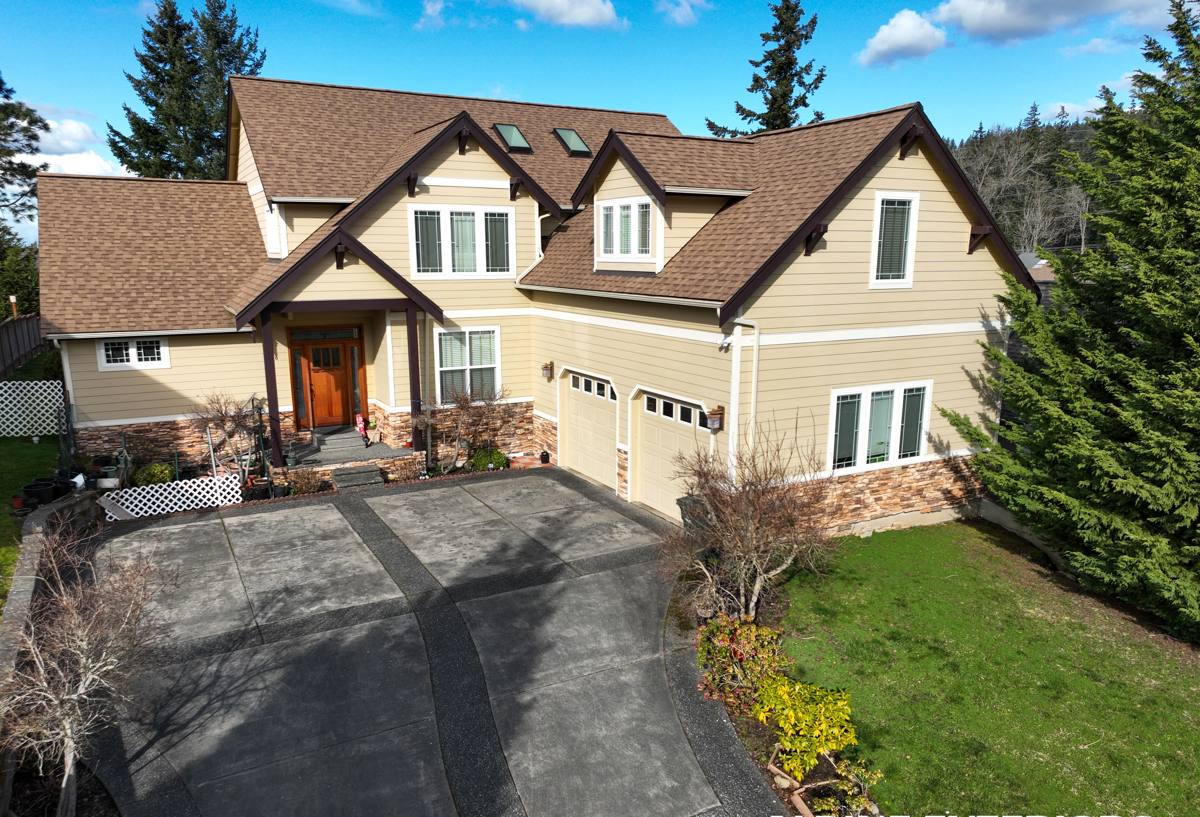
Common Roof Repair Issues We See in Burlington
Moss and Organic Growth
Moss thrives on north-facing slopes and shaded sections of roof that don't get much direct sun — common on lots with mature trees, which describes a lot of Skagit County properties. Left alone, moss lifts shingle edges as it grows, which opens a path for water to get underneath. By the time you can see moss from the ground, it's usually already established under the shingle tabs, not just sitting on top of them.
Flashing and Valley Leaks
Most of the leaks we get called out for aren't from a failed shingle in the middle of a roof plane — they're from flashing. Step flashing along walls and chimneys, valley metal where two roof planes meet, and the flashing around vent pipes are the highest-failure points on any roof, and driving rain finds those weak spots faster than it finds anything else.
Wind and Storm Damage
Winter storms moving through the county can lift shingle tabs, crack ridge caps, or tear off a section of roofing outright. Sometimes the damage is obvious. More often it's a handful of shingles with broken seals that aren't leaking yet but will be the next time wind-driven rain hits them at the right angle.
Attic Moisture and Ventilation Problems
A roof can be doing its job on the outside and still have a moisture problem underneath if the attic isn't ventilating properly. Condensation from poor airflow looks a lot like a roof leak from the inside — water staining on sheathing, mildew smell, damp insulation — but the fix is airflow, not shingles.
What a Correct Roof Repair Actually Involves
A roof repair done right starts with figuring out where the water is actually getting in, not just where it's showing up inside the house. Water travels along the roof deck before it drips through the ceiling, so the stain on your drywall is often several feet from the real entry point. Skipping that diagnosis step is the single biggest reason repairs fail to hold.
Once we know where the problem is, a proper repair means:
- Removing enough surrounding material to see the full extent of the damage, not just patching over the visible spot
- Replacing damaged decking if the sheathing has softened or delaminated from prolonged moisture
- Installing new underlayment in the repaired section so the water barrier is continuous, not just the top layer
- Matching shingle or roofing material as closely as possible in style, color, and exposure
- Rebuilding flashing details — step flashing, valley metal, vent boots — rather than caulking over old, corroded flashing
- Checking and clearing gutters and downspouts in the repair area so water actually drains away from the fix
Caulk and roof cement have a place in roofing, but they're a short-term patch, not a repair. If a crew's plan for a leak is mostly sealant, that's a sign the actual cause hasn't been identified yet.
Repair vs. Replacement: How We Help You Decide
Not every roof problem needs a full replacement, and not every leak can be permanently solved with a repair. The honest answer depends on the age of the roof, how much of it is affected, and what's underneath the shingles. Here's roughly how we think through it:
| Situation | Repair Usually Makes Sense | Replacement Usually Makes Sense |
|---|---|---|
| Roof age | Under 15–20 years, in otherwise good condition | Nearing or past the material's expected service life |
| Extent of damage | Isolated to one section, flashing point, or storm event | Multiple areas failing, or granule loss across large sections |
| Decking condition | Solid, dry sheathing under the damaged area | Soft, delaminated, or repeatedly wet decking |
| Leak history | First occurrence or a clearly identified single cause | Recurring leaks in different spots over time |
| Moss and staining | Surface growth without shingle degradation | Moss has been established long enough to compromise the material |
We'll give you a straight answer either way. If a repair will genuinely hold, we'll tell you that instead of pushing a replacement you don't need yet.
Our Roof Repair Process
- Inspection. We get on the roof (not just look from the ground) and check the suspected area plus flashing points, valleys, and vent penetrations nearby, since problems in one spot often point to a related issue close by.
- Diagnosis and estimate. We explain what we found, what's causing it, and what it will take to fix — in plain language, with a written estimate before any work starts.
- Repair work. We remove and replace only what needs it, rebuild flashing and underlayment properly, and match materials as closely as the market allows.
- Cleanup and check. Job site debris, old nails, and moss/gutter debris removed as part of the visit, not left for you to deal with.
- Follow-up. If a repair doesn't fully resolve the issue — which does happen with older roofs that have more than one failure point — we come back and address it.
Roofing Materials and Repair Compatibility in This Climate
Most homes in Burlington and across Skagit County are roofed in asphalt composition shingles, with some older homes still carrying original cedar shake or newer homes with metal roofing. Repair work needs to respect what's already on the roof.
Asphalt shingles are the most straightforward to repair and the easiest to match, especially if the roof is under 10–15 years old and the shingle line is still in production. Older or discontinued shingle profiles are harder to match exactly, and we'll be upfront if a perfect color match isn't realistic.
Cedar shake requires more care in a wet, moss-prone climate — it needs airflow underneath to dry out between rain events, and repairs done without attention to that ventilation tend to fail again within a few years. We'll always explain the moisture and maintenance trade-offs of shake honestly rather than just patching it and moving on.
Metal roofing repairs are usually about fastener backout, sealant failure at penetrations, or panel damage from a falling limb — different techniques than shingle repair, but the same principle applies: fix the actual failure point, not just the symptom.
Cost Factors for Roof Repair in Burlington
Roof repair costs vary a lot based on what's actually wrong, so we won't quote a number without seeing the roof. What we can tell you is what tends to move the price up or down:
| Factor | Why It Matters |
|---|---|
| Roof pitch and access | Steep or high roofs take longer and require more safety setup |
| Extent of decking damage | Rotted sheathing means more demo and rebuild, not just surface work |
| Material match availability | Discontinued shingle lines or specialty materials can add cost and lead time |
| Number of flashing points involved | Chimneys, skylights, and multiple valleys each add labor |
| Moss and debris removal needed | Heavy buildup requires clearing before the actual repair can start |
As a very rough range, small isolated repairs (a section of flashing, a handful of shingles) often land in the low hundreds to around a thousand dollars, while larger repairs involving decking replacement or multiple problem areas can run several thousand. The only way to know for sure is a hands-on inspection.
Why a Local Skagit County Crew Matters
Roofing crews who work Burlington regularly know how this climate treats a roof differently than a crew that mostly works drier inland regions. That shows up in small but real ways — knowing to check valley flashing before anything else after a windstorm, knowing which shingle lines hold up to the moss and moisture cycle here, and being close enough to get to you quickly when a leak shows up during a storm instead of days later.
Local also means accountability. A contractor working the same towns year after year has a reason to do the job right the first time and stand behind it — reputation in a county this size travels. That's worth more than a lower bid from a crew passing through.
Simple Maintenance That Extends the Life of a Repair
A good repair lasts longer when the rest of the roof is kept up. Between service visits, this short checklist covers the basics:
- Clear gutters and downspouts at least twice a year, more often under overhanging trees
- Have moss treated or removed before it spreads across a full slope, not after
- Trim back branches that overhang the roof to reduce shade, debris, and physical damage risk
- Check the attic after heavy storms for new water staining or damp insulation
- Have the roof looked at after any significant windstorm, even if nothing looks obviously wrong from the ground
None of this replaces a professional inspection, but it does reduce how often you need one.
If you're dealing with a leak, storm damage, or just want an honest opinion on the condition of your roof, we're glad to take a look. The estimate is free, there's no pressure to move forward, and you'll get a straight answer about what your roof actually needs — use the form below to get started.