 Skagit County
 Edison's Climate Puts Real Stress on Exterior Walls
Edison sits close enough to Skagit County's saltwater to catch salt-laden air off and on through the year, and that air does something ordinary siding was never built to handle. Salt carried on wind and fog settles on exterior surfaces, holds moisture against the wall longer than plain rain would, and slowly breaks down paint films, caulk joints, and any material that isn't dimensionally stable. Add in the driving, wind-blown rain that comes through this part of Skagit County in the fall and winter, and you've got a wall assembly that's wet more often than it's dry for months at a stretch.
Then there's moss. Skagit County's mild, damp climate gives moss and algae a long growing season — longer than most siding manufacturers design around. Moss doesn't just look bad; it holds water against a surface, and on the wrong siding material that trapped moisture is exactly what leads to swelling, soft spots, and paint failure over time. A siding choice that works fine in a dry inland climate can struggle here, and a lot of the premature siding failures we get called out to inspect in this area trace back to a product or an installation that wasn't matched to what Edison's weather actually does.
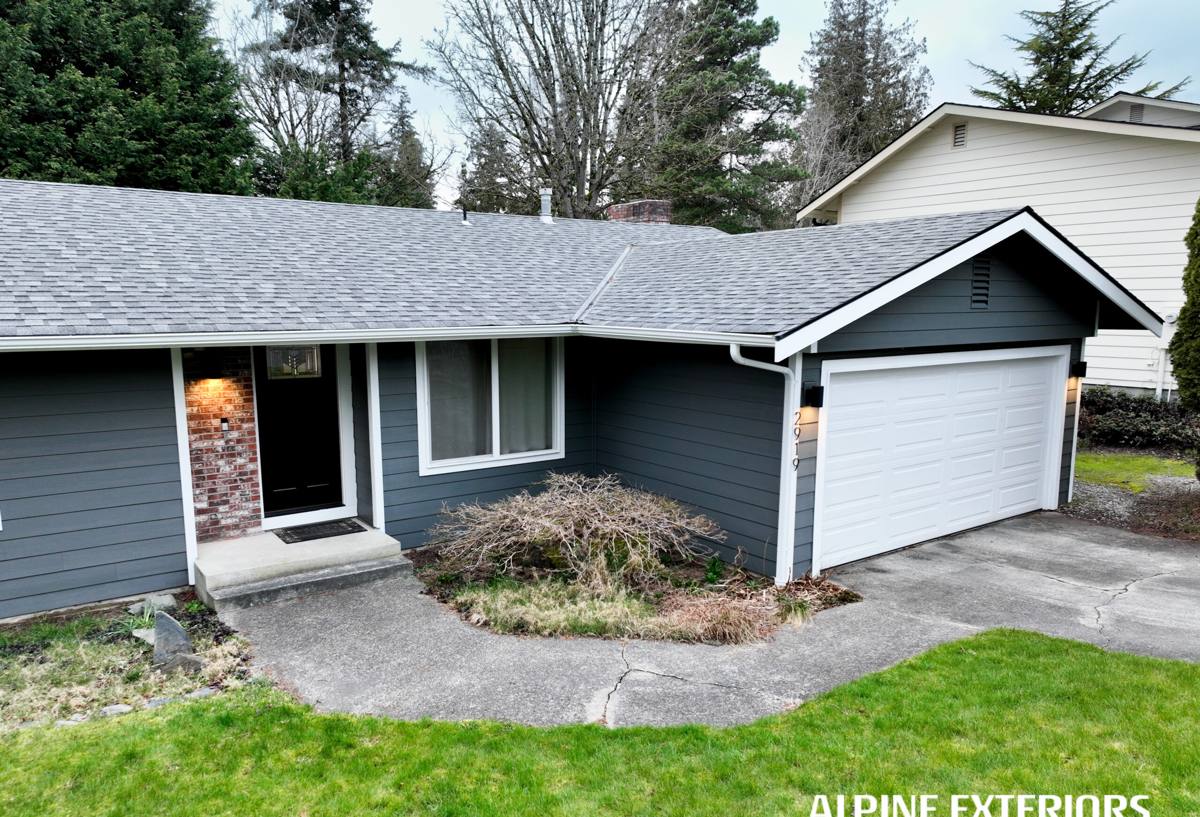
Why James Hardie Fits This Specific Environment
James Hardie fiber cement is a cement-and-cellulose composite, not wood and not vinyl. That matters here for a few concrete reasons. It doesn't rot, it isn't a food source for the mold and mildew that moss seasons encourage, and it doesn't expand and contract with moisture the way wood-based products do. Hardie also builds its HZ5 product line specifically for climate zones that see a lot of moisture cycling — the Pacific Northwest is one of the regions that line is engineered around, which is a big part of why we install it here rather than a general-purpose product.
The factory-applied ColorPlus finish is the other piece. It's baked on in a controlled environment rather than brushed or sprayed on site, which gives it better adhesion and UV resistance than field-applied paint — and it comes with its own finish warranty separate from the substrate warranty. In a salt-air environment where paint film is under constant attack, that's a meaningful difference over the life of the siding, not just a marketing point.
Non-Combustible Is a Real Benefit, Not a Slogan
Fiber cement doesn't contribute fuel to a fire the way wood-based sidings can. That's not specific to Edison's coastal exposure, but it's part of why we standardized on Hardie across every job we take — one product, one set of installation standards, and no compromises tied to whichever material a given job happens to call for.
What a Correct Installation Actually Involves
Hardie siding performs the way it's supposed to only when it's installed to the manufacturer's specifications, and in a wet climate like this one, the details that get skipped are exactly the details that cause problems five or ten years down the road.
- Proper clearances: siding held off decks, patios, and grade by the specified gap so water has somewhere to go instead of wicking up into the bottom edge of the boards.
- Correct flashing and weather barrier: a drainage plane behind the siding so any moisture that gets past the surface has a path back out, rather than sitting against the sheathing.
- Fastener placement and type: corrosion-resistant fasteners set per Hardie's schedule — under- or over-driving fasteners is one of the most common causes of siding call-backs.
- Joint and butt-seam treatment: caulked and painted per spec, or shadow-lined where the design calls for it, so seams don't become entry points for driving rain.
- Trim and penetration detailing: windows, vents, and utility penetrations sealed correctly the first time, since these are the spots where wind-driven rain finds its way in.
None of this is exotic. It's just disciplined, unglamorous installation work — and it's the difference between siding that looks good for 30-plus years and siding that needs attention in year eight.
Our Process for an Edison Job
1. On-Site Assessment
We walk the home, check the condition of the existing siding and any water damage at grade, trim, and penetrations, and talk through what your home's exposure looks like — a wall that takes the brunt of prevailing wind and rain gets treated differently in the detailing than a more sheltered elevation.
2. Removal and Sheathing Check
Old siding comes off and we inspect the sheathing underneath before anything new goes up. If there's hidden moisture damage from a prior installation, we address it before covering it back up — closing over a problem doesn't fix it.
3. Weather Barrier and Flashing
This is the step that determines how the wall performs for the next few decades, and it's the one that's easiest to shortcut if a crew is moving fast. We don't shortcut it.
4. Installation to Spec
Panels, planks, or shingle siding go up per Hardie's fastening and clearance requirements, with joints and penetrations sealed as we go rather than caulked over at the end.
5. Final Walkthrough
We go over the finished job with you, point out anything you should know about caring for the specific product installed, and make sure everything lines up with what was quoted.
What Drives Cost on a Job Like This
Every Edison home is different, so we don't quote off a flat per-square-foot number without seeing the house. The factors below are the ones that actually move a project's cost up or down.
| Factor | Why It Matters |
|---|---|
| Removal of existing siding | Layers of old material, or siding installed over rot, add labor before new siding can go up |
| Sheathing repair | Moisture damage found during tear-off has to be fixed before installation continues |
| Home size and stories | More wall area and more scaffolding/staging on multi-story homes both add time |
| Trim and architectural detail | Dormers, bump-outs, and multiple roof lines multiply the number of flashing and joint details |
| Product line and profile | Plank width, shingle-style siding, and panel systems each carry different material and labor costs |
| Color approach | Factory ColorPlus finish versus a site-painted finish affects both material cost and long-term upkeep |
Living With Hardie Siding Through Edison's Moss Season
Correctly installed Hardie siding is low-maintenance, not zero-maintenance. A little seasonal attention keeps it looking right and keeps small issues from becoming bigger ones in a climate that stays damp as long as this one does.
- Rinse siding down once or twice a year with a garden hose to clear off salt residue, pollen, and organic buildup before it has a chance to feed moss or algae.
- Keep gutters clear so overflow doesn't run down the wall face during heavy rain events.
- Trim back vegetation and tree cover that keeps a wall section shaded and damp longer than the rest of the house.
- Check caulked joints around trim and penetrations every year or two and have any that have opened up resealed.
- Watch north-facing and shaded walls specifically — they're the sections most prone to moss growth in this climate.
- Address any moss or algae growth with a gentle wash rather than a high-pressure blast, which can force water behind the siding at joints and edges.
Why a Crew That Already Works This Area Matters
Skagit County isn't uniform — a home near Edison's tidal flats and open farmland deals with a different moisture load than a home further inland, and detailing that's fine in a drier microclimate can fall short here. A crew that installs siding across this county regularly knows which elevations tend to take the worst of the weather, how local moss growth behaves through the wet months, and where the common trouble spots are on homes of the age and construction style common in this area. That's knowledge you don't get from a general contractor who does a siding job once in a while — it comes from doing this work, in this climate, on a regular basis.
We also only install one product system, which means our crews aren't switching installation standards from job to job. Every Edison home we side gets the same disciplined process, the same attention to flashing and clearances, and the same product line engineered for this kind of climate.
Get a Straightforward Estimate
If your Edison home's siding is showing its age, holding moss longer than it should, or you're planning ahead for a replacement, we're happy to take a look and walk you through what we'd recommend and why. Fill out the form below for a free, no-pressure estimate.