 Skagit County
 What Alger Homes Are Up Against
Alger sits in a tucked-away pocket of Skagit County where three things converge on a house's exterior at once: salt-laden air drifting up from the bay and sound, driving rain that comes in sideways off winter storms, and a tree canopy dense enough to keep siding shaded and damp for weeks at a stretch. Any one of those is manageable. All three together is why siding in this part of Skagit County ages differently than siding forty miles inland.
Salt air is corrosive to fasteners and hard on paint film, softening it faster than it would soften in a dry climate. Driving rain doesn't just wet the face of a wall — wind-driven moisture finds its way behind trim, into butt joints, and under poorly lapped courses if the installation wasn't done with that wind direction in mind. And the moss season, which in this part of Washington can run eight or nine months out of the year on shaded north and west walls, keeps organic growth sitting against the siding surface long after a storm has passed, holding moisture right where you don't want it.
None of this means siding fails fast in Alger. It means the margin for a sloppy installation is thinner here than it is in a lot of places, and it means the choice of material and the quality of the install matter more than they would somewhere drier and more open.
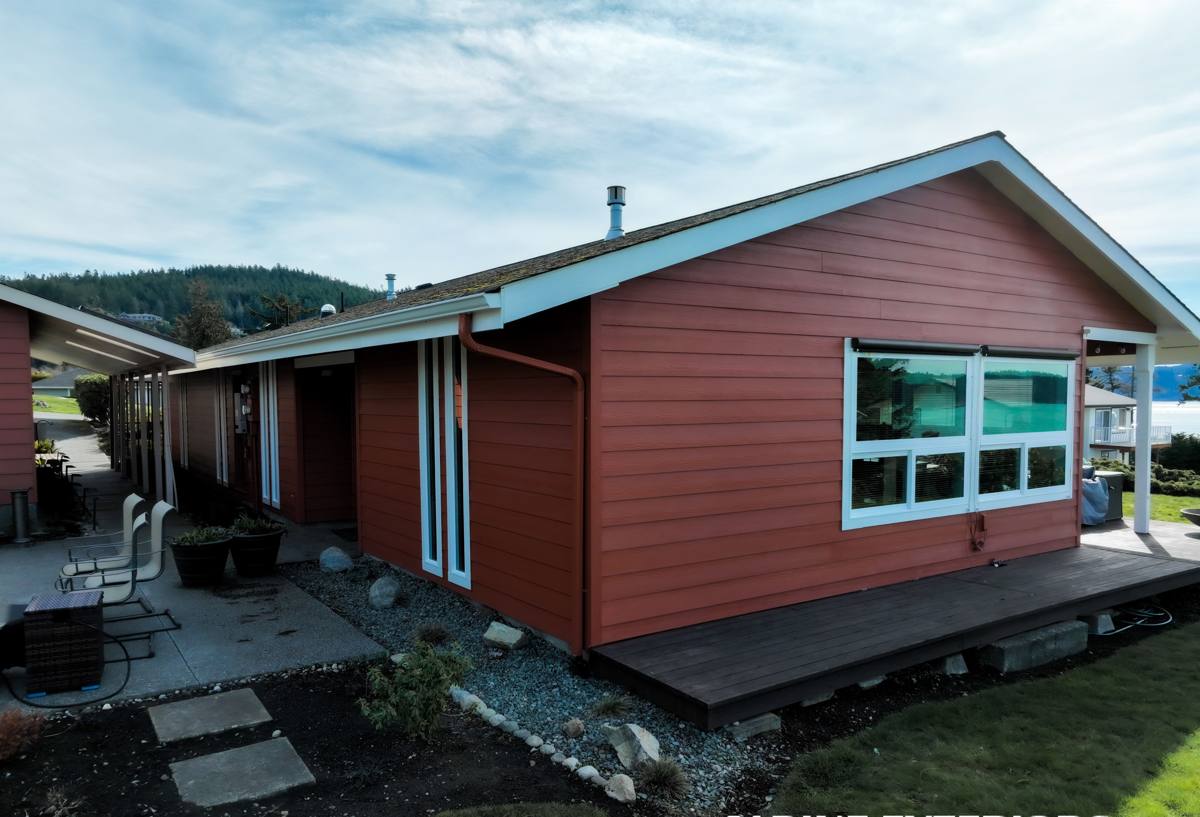
What a Correct Siding Installation Actually Involves
Siding installation is not just cutting boards to length and nailing them to the wall. On a home exposed to the kind of weather Alger sees, the parts nobody notices from the curb are the parts that determine whether the wall stays dry for the next 30 years.
The Weather-Resistive Barrier
Everything starts with the water and air barrier underneath the siding. It has to be installed shingle-style — upper layers overlapping lower layers — so any water that gets past the siding face runs down and out instead of soaking into the sheathing. Every penetration, seam, and window opening gets flashed and taped so the barrier is actually continuous, not just present.
Flashing and Drainage
Window and door heads need proper drip-cap flashing. Butt joints between siding pieces need to be flashed or backed, not just caulked and left to hope. Bottom edges — at foundations, decks, and roof-to-wall transitions — need a way for water to get out from behind the siding rather than pooling. A rainscreen gap (a thin ventilated space between the siding and the wall) is worth the extra step on homes that see heavy, sustained rain, because it lets any moisture that does get through dry out instead of sitting against the sheathing.
Fastening and Clearances
Fastener spacing, type, and depth all affect how the siding performs over time — overdriven nails crack fiber cement and create entry points for water; underdriven nails leave boards loose and rattling in wind. Manufacturer-specified clearances at grade, roof lines, and decks keep the bottom edge of the siding out of standing water and splash-back.
Caulking — Used Correctly, Not Everywhere
Caulk is a maintenance item, not a waterproofing strategy. A correct installation uses it at specific transitions called for by the manufacturer and relies on flashing and lapping for the actual water management. Homes where caulk is doing the structural work of keeping water out are homes where the installer skipped steps.
Why We Install Only James Hardie Fiber Cement
We get asked fairly often why we don't offer vinyl, LP SmartSide, or one of the other fiber cement brands on the market. The honest answer is that we standardized on James Hardie because of how it holds up specifically in the kind of weather Alger and the rest of Skagit County deal with.
Vinyl siding is affordable and low-maintenance in mild climates, but it's a petroleum-based product that expands and contracts with temperature swings, can warp or crack in sustained cold snaps, and — because it's installed with a loose-hanging fit rather than a rigid fastened one — doesn't manage wind-driven rain as predictably as a nailed-flat fiber cement board. Engineered wood products like LP SmartSide perform well when kept dry, but wood-based cores are more sensitive to sustained moisture exposure than a cement-based product, which matters on walls that stay damp under moss and shade for months at a time. Other fiber cement brands compete reasonably on price, but James Hardie backs its products with the ColorPlus factory finish and a materials warranty that's proven out over more installations, in more climates, than most competitors can point to.
James Hardie's HZ5 product line is engineered specifically for the freeze-thaw, high-moisture Pacific Northwest climate zone that Skagit County sits in. It's non-combustible fiber cement, so it doesn't feed a wildfire the way some claddings do, and the ColorPlus finish is baked on at the factory under conditions a field-applied paint job can't replicate — which matters when the siding is going to sit under intermittent salt air and shade-driven damp for most of the year.
None of this means the other products are bad. It means that after years of installing exteriors in this specific climate, Hardie is the one we're willing to put our name behind.
Quick Comparison
| Factor | Vinyl | Engineered Wood | James Hardie Fiber Cement |
|---|---|---|---|
| Moisture tolerance | Good, but seams can trap water | Fair — core is wood-based | Strong — cement-based, doesn't rot |
| Fire resistance | Melts/deforms under heat | Combustible | Non-combustible |
| Finish durability | Fades over time | Depends on paint/primer job | Factory-baked ColorPlus finish |
| Performance in driving rain | Loose-hung fit | Good if flashed and sealed well | Rigid, flat-nailed installation |
| Typical warranty | Varies by manufacturer | 5-year limited common | 30-year non-prorated limited, transferable |
Our Installation Process
- On-site walkthrough: We look at your current siding, wall assembly where accessible, drainage, and shade/moss exposure before quoting anything.
- Tear-off or overlay assessment: If your sheathing is sound, we discuss whether existing siding needs full removal or can be built over correctly — this depends heavily on what's underneath, not just what's visible.
- Weather barrier and flashing: New or repaired water-resistive barrier, window and door flashing, and rainscreen gap where appropriate for the wall's rain exposure.
- Hardie installation to spec: Fastener pattern, clearances, and lap dimensions installed to James Hardie's published requirements — not shortcuts that would void the warranty.
- Trim, caulk, and paint touch-up: Final detailing at the transitions where caulk belongs, and any factory-finish touch-up needed after fastening.
- Final walkthrough: We go over the finished job with you before calling it done.
Signs Alger Homeowners Should Watch For
If you're deciding whether it's time to replace siding rather than patch it, these are the signs we see most often on homes in this area:
- Dark streaking or green film on north- and west-facing walls that returns within weeks of cleaning — a sign moss and moisture are sitting against the siding rather than draining off it
- Soft or spongy spots when you press on the siding near the bottom courses, especially near grade or under decks
- Paint that's chalking, peeling, or bubbling faster on the side of the house that takes the most wind-driven rain
- Visible gaps opening up at butt joints or around window trim
- Fastener heads popping or rust-staining showing through the finish, a common sign of salt-air corrosion on older fastener types
- A musty smell in an interior room that backs onto an exterior wall with no other obvious source
Cost Factors for a Siding Installation Project
Every home is different, but the factors that move the price on a siding installation in Alger tend to be the same handful of things:
| Factor | Why it matters |
|---|---|
| Tear-off vs. overlay | Full removal costs more upfront but lets us inspect and repair sheathing and the weather barrier underneath |
| Wall complexity | Dormers, multiple gables, and lots of trim take more labor per square foot than a simple rectangular wall |
| Siding profile | Lap siding, board-and-batten, and shingle-style Hardie products differ in material and labor cost |
| Underlying repairs | Rotted sheathing or framing found during tear-off needs to be addressed before new siding goes on |
| Rainscreen detailing | Adding a ventilated drainage gap is an extra step that pays off on heavily rain-exposed walls |
| Site access | Steep lots, dense trees, or tight setbacks common in this area can add time for scaffolding and material staging |
We give a written estimate that breaks these out so you can see what you're paying for, rather than a single lump number.
Maintenance That Actually Matters in Moss Season
Even a correctly installed Hardie exterior benefits from a little seasonal attention in a climate like this one. Keep branches trimmed back from the siding so walls get some airflow and sun during the drier months. A soft wash — not a high-pressure blast that can force water behind laps and trim — once a year keeps moss and mildew from building up on shaded walls. Check caulked transitions annually for cracking, since caulk is a maintenance item that eventually needs to be refreshed even when everything behind it is sound. None of this is heavy lifting, but skipping it is how a well-installed exterior starts looking tired years before it should.
Why Hiring a Crew That Already Works in Skagit County Matters
Installation instructions from a manufacturer are written for a general climate. Knowing which side of an Alger home takes the worst wind-driven rain, how long moss really takes to build up on a shaded wall in this part of Washington, and where salt air does the most damage to fasteners and trim is something you learn from doing the work here repeatedly, not from a spec sheet. A crew that's already installed siding across Skagit County has made the adjustments — extra flashing on the exposed side, a rainscreen gap where it's warranted, fastener choices that hold up to the salt air — before they ever start on your house.
Before hiring anyone for a siding project, it's worth asking a few direct questions:
- Are they licensed and bonded to do exterior work in Washington, and can they show proof
- Do they carry manufacturer certification for the specific siding product they're installing
- Will they give you a written scope that spells out tear-off vs. overlay, flashing details, and fastening method — not just a total price
- Do they pull the required local building permit rather than asking you to skip it
- Can they explain, specifically, how their installation plan accounts for wind-driven rain on the exposed side of your home
- What does their workmanship warranty cover, separate from the manufacturer's material warranty
Get an Estimate for Your Alger Home
If your siding is showing its age or you're planning ahead of a problem rather than reacting to one, we're glad to come take a look. The estimate is free, there's no pressure attached to it, and you'll get a straight answer about what your home actually needs — not an upsell. Fill out the form below and we'll get in touch to schedule a time to come out.