 Skagit County
 Why Decks in Edison Wear Out Faster Than the Manuals Say
Edison sits close enough to tidal water and open farmland that its decks take a different kind of beating than a deck fifteen miles inland. Salt-laden air off the bay and the sloughs works into fastener heads, hinges, and any exposed metal, and it doesn't need direct ocean spray to do it — a steady humid breeze is enough over a few seasons. Add in Skagit County's long wet stretch, roughly October through April, where boards rarely get a full dry-out period, and you've got the two biggest enemies of an outdoor structure working at the same time: corrosion and moisture retention.
Then there's moss. Anything shaded by a house, a fence line, or the tree cover common around Edison properties will grow moss and algae on horizontal wood surfaces almost year-round. Moss holds water against the board long after a sunny afternoon would have dried it out, and it's slick and dangerous underfoot on stairs and landings. A deck that looks fine from a distance can have soft joists, rusted fasteners, or a rotted ledger board hiding under a layer of green.
None of this means a deck can't last in this area — plenty do, for decades. It means the materials, the fasteners, and the details at ground contact and the house connection have to be chosen for this climate specifically, not for a national average.
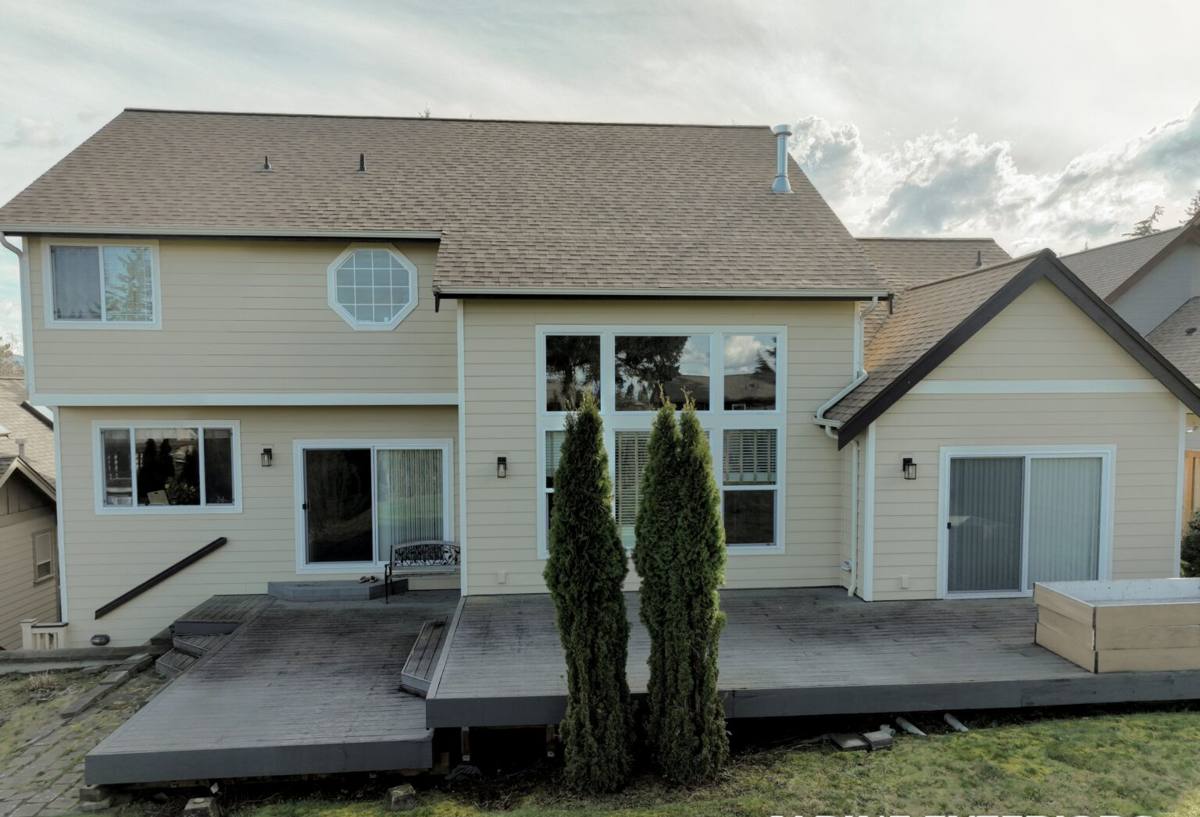
Signs a Deck Needs Replacement, Not Just Repair
We get calls for "a few boards" that turn into a full rebuild once we're underneath the deck, and calls for "the whole thing" where the frame is actually fine and only the surface needs attention. Here's how to tell which situation you're in before you call anyone:
- Boards feel spongy or flex noticeably when you walk across them, especially near the house
- You can push a screwdriver into the wood at the ledger board or post bases with little resistance
- Nails or screw heads are rusted, popped up, or streaking rust down the board
- The deck feels loose or bounces where it meets the house — often a sign the ledger connection has failed
- Persistent moss or black staining returns within weeks of cleaning, no matter how often it's scrubbed
- Stair stringers or railing posts wobble under normal use
- The deck is older than 20 years and has never had the structural components inspected
Surface graying, minor board cupping, or a couple of loose screws are repair territory. Soft framing, a failing ledger connection, or rot at multiple posts usually means replacement is the more honest answer — patching those issues buys a season or two at most.
What's Usually Hiding Underneath
On older Edison decks we most often find the problem isn't the decking boards at all — it's the ledger board (where the deck attaches to the house), which was under-flashed or not flashed at all when it was built. Water has been running behind it for years, which is a structural safety issue, not just a cosmetic one. We check this on every inspection before quoting anything.
Choosing the Right Decking Material for This Climate
There's no single "best" decking material — there's the right trade-off for your budget, your maintenance appetite, and how much shade and moisture your particular lot gets. Here's how the common options actually perform in a Skagit County setting:
| Material | How It Handles Local Climate | Maintenance | Typical Lifespan |
|---|---|---|---|
| Pressure-treated wood | Affordable, but needs regular sealing to resist moss and moisture absorption | Annual cleaning + sealing every 1-2 years | 10-15 years with upkeep |
| Cedar | Naturally rot-resistant and handles damp shade well, but softer and shows wear faster in high-traffic spots | Sealing/staining every 2-3 years | 15-20 years with upkeep |
| Composite decking | Resists moisture absorption and doesn't need sealing; some early-generation boards trapped moisture and grew mold, newer capped composites handle this much better | Periodic washing, no sealing | 25-30 years |
| PVC decking | Fully synthetic, sheds water and resists moss growth the best of any option here | Occasional washing | 25-30+ years |
Our default recommendation for a shaded or low-airflow Edison lot is a capped composite or PVC board, specifically because moss and mildew get a foothold on natural wood faster in those spots. On open, sunny sites with good airflow, a well-maintained cedar deck still has a real place — it's a matter of being honest with you about which upkeep schedule you're signing up for.
What a Correct Deck Replacement Actually Involves
A deck replacement is a structural project, not a materials swap. Doing it right means addressing everything the old deck's problems point back to:
Ledger and House Connection
The ledger board attachment is the single most common failure point we find, and it's also the connection most responsible for keeping the deck attached to your house if things go wrong. We install proper flashing that directs water away from the house sheathing, not just a bead of caulk over the old connection.
Framing and Footings
Joists, beams, and posts get inspected and replaced where they've softened. In our wet climate we favor treated framing lumber and, where budget allows, composite or coated joist tape over the tops of joists to keep water from sitting on end grain.
Fasteners and Hardware
This matters more here than in drier regions. Stainless steel or high-grade coated fasteners resist the corrosion that plain galvanized hardware picks up from salt-laden air over time. Mismatched or cheap fasteners are one of the fastest ways a new deck starts showing rust streaks within a year or two.
Ground Contact and Airflow
Post bases get set above grade and off standing water, and where a deck sits low or in a shaded footprint, we look at ways to improve airflow underneath — that's often the difference between a deck that stays dry between rains and one that never really dries out from October to April.
Stairs and Railings
Stair stringers take the most direct weather exposure of any part of a deck and are a common spot for hidden rot. Railings get checked for post attachment strength, not just cosmetic wobble.
Our Deck Replacement Process
- On-site inspection. We get under and around the existing deck to check framing, ledger condition, and post bases before quoting anything — not just look at the surface boards.
- Honest scope and estimate. You get a clear breakdown of what's structural, what's cosmetic, and what your material options cost, in writing.
- Removal. Old decking, and any framing that doesn't pass inspection, comes out and is hauled away.
- Structural rebuild. Ledger flashing, framing, footings, and fasteners are addressed to current best practice for this climate, not just matched to what was there before.
- Decking, stairs, and railing installation. Your chosen material goes down with attention to drainage gaps and fastening patterns that reduce future moss and water retention.
- Final walkthrough. We go over the finished deck with you, including what maintenance (if any) your material choice needs going forward.
Permits and Local Considerations
Deck replacements that involve structural changes — new footings, a larger footprint, or work near property lines — typically require a permit through Skagit County. We handle that conversation as part of the project rather than leaving it on your plate, and we build to the load and railing requirements that apply here, which matter more than people expect once you're dealing with stairs or a deck more than a couple feet off grade.
What Deck Replacement Costs and What Drives the Price
Every deck is different, but the factors that move the price are consistent. We'll always give you a firm number after inspection — this is just to help you think about where your money goes:
| Cost Factor | Why It Matters |
|---|---|
| Decking material | Treated wood is the low end; PVC and premium composites cost more upfront but need less upkeep over time |
| Framing condition | A deck needing full joist and post replacement costs more than one where the frame is sound |
| Deck size and shape | Multi-level decks, curves, and built-in features add labor beyond simple square footage |
| Stairs and railings | Each set of stairs and each linear foot of railing adds material and labor |
| Ledger and flashing repair | Fixing water damage at the house connection is essential work, even though it's invisible once finished |
| Site access | Decks with tight access or that require material to be carried in add labor time |
Keeping a New Deck Healthy in Edison's Climate
Whatever material you choose, a few habits go a long way toward getting the full lifespan out of a new deck here:
- Sweep leaves and debris off the deck regularly, especially in fall — trapped organic matter feeds moss growth
- Rinse or wash the deck surface a couple of times a year to knock back algae and moss before it takes hold
- Trim back overhanging branches and vegetation to improve airflow and sunlight where possible
- Check and re-seal wood decking on the schedule appropriate for that material — don't let it go past due
- Keep gutters and downspouts near the deck clear so runoff isn't draining directly onto or under it
- Have the structure looked at every few years, even if the surface looks fine
Why It Matters That We Already Work in Edison
A crew that only occasionally works this stretch of Skagit County will often default to generic specs — standard galvanized fasteners, standard flashing details, a decking recommendation that ignores how shaded or exposed your particular lot is. We build decks here regularly enough to know which details actually matter for this weather: where moss takes hold first, which ledger connections tend to have failed on homes of a certain age, and which materials hold up versus which ones look good on day one and struggle by year five. That's not a marketing line — it's the difference between a deck that needs attention again in five years and one that doesn't.
If your deck is showing its age, or you're just not sure whether you're looking at a repair or a replacement, we're happy to take a look and give you a straight answer. Reach out for a free, no-pressure estimate using the form below.