 Skagit County
 Why Cedardale Decks Wear Differently Than Decks Inland
Cedardale sits close to the saltwater and tidal sloughs on the western side of Skagit County, and that location shapes everything about how a deck ages here. Salt-laden air moves through the trees and settles on every exposed surface — fasteners, flashing, railing hardware, and the end grain of the decking boards themselves. Add in the driving rain that comes off the water during fall and winter storms, plus a moss season that can run six months or longer in shaded, tree-covered yards, and you have a set of conditions that punishes shortcuts. A deck built or repaired without those three factors in mind will show problems years before it should.
We're not describing anything unusual to homeowners who've lived in Cedardale a while — most people here already know their outdoor structures need more attention than a deck in a drier, inland part of the state. What we want to lay out is what that actually means for a repair: which parts of a deck fail first in this climate, what a correct fix looks like, and how to tell a real repair from one that's just cosmetic.
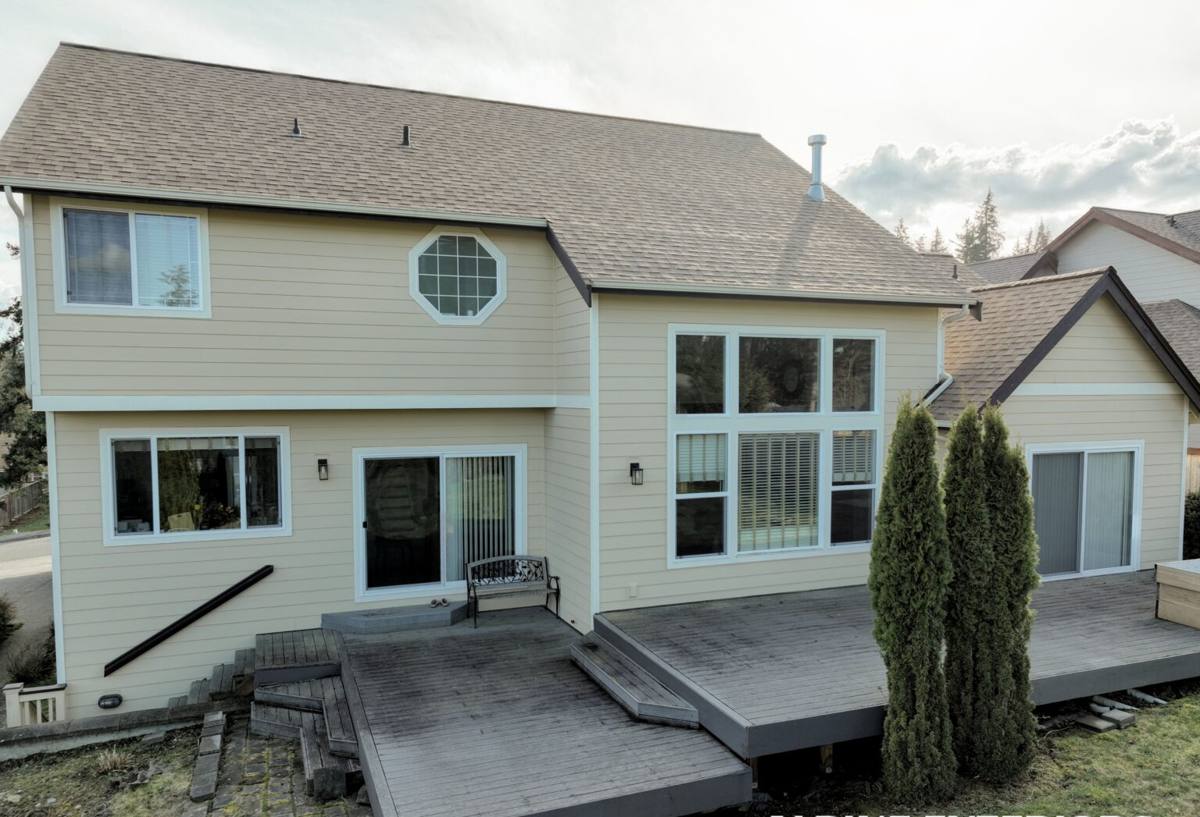
Signs Your Deck Needs Repair, Not Just Cleaning
A lot of deck problems in this area start out looking like surface issues — dark staining, a slick green film, a board that feels a little soft underfoot. Some of that is genuinely cosmetic. Some of it is the first visible sign of something structural underneath. Before you decide whether you're looking at a cleaning job or a repair job, walk the deck and check for these:
- Boards that flex, bounce, or feel spongy when you walk across them, especially near the house
- Any spot where a screwdriver or awl sinks into the wood without much resistance — a sign of rot, not just weathering
- Rust streaks running down from screws, nails, or metal connectors
- Gaps opening up where the deck ledger board meets the house siding or band joist
- Railings or posts that wiggle more than they did a year or two ago
- Persistent moss or algae growth in the same spots even after cleaning, which usually means that area stays wet longer than the rest of the deck
- Visible daylight or water staining underneath the deck where flashing or joist hangers should be sealed
If you're only seeing surface discoloration on wood that's otherwise solid, a cleaning and re-sealing may be all that's needed. Once you start seeing soft spots, movement, or corrosion, you're into repair territory, and the sooner it's addressed the smaller the job stays.
The Ledger Board Is Where Most Serious Damage Starts
The ledger board — the piece that attaches the deck directly to the house — is the single most common failure point on decks in wet climates, and Cedardale's rain pattern makes it worse. Water that isn't properly flashed and diverted at this connection gets trapped between the ledger and the siding, where it can't dry out between storms. By the time it's visible from underneath, the damage has often been developing for a while. This is also the connection point that matters most for safety, since it carries a large share of the deck's structural load.
What a Correct Deck Repair Actually Involves
A proper repair isn't just swapping out the boards that look bad. It starts with an honest structural check, because replacing decking on top of a compromised frame just hides the real problem for another season. Here's what we look at on every Cedardale repair call:
- Framing and ledger connection — checking joists, the ledger board, and flashing for rot, corrosion, or improper attachment
- Fasteners and hardware — joist hangers, structural screws, and post connectors, since the wrong grade of hardware corrodes fast in salt air
- Decking surface — identifying which boards are cosmetically weathered versus structurally compromised
- Railings and stairs — post attachment and railing stability, which are code-relevant and safety-relevant
- Drainage and airflow underneath — whether the deck is sitting low to grade or trapping moisture with poor ventilation, which accelerates every problem above
Skipping any of these steps is how a homeowner ends up paying for the same repair twice. A deck that gets new boards over rotten joists, or new joists with the wrong hardware, is a deck that will need attention again in a few years instead of a decade or more.
Repair or Replace? What Actually Drives That Decision
This is the question we get asked most on-site, and the honest answer depends on how far the damage has spread and where it's located. A localized ledger or joist repair is a very different job than a deck that needs to come down and be rebuilt.
| Factor | Leans Toward Repair | Leans Toward Replacement |
|---|---|---|
| Extent of rot/damage | Isolated to a few boards or one framing section | Spread across multiple joists, the ledger, and the surface |
| Age of structure | Under 10-15 years, built to a reasonable standard | Older deck near or past typical service life |
| Framing condition | Frame is sound, only surface or connector issues | Structural members are soft, cracked, or corroded |
| Code/safety items | Minor railing or fastener updates needed | Footings, spans, or attachment don't meet current code |
| Budget goals | Extend usable life at lower cost | Want a design change or long-term reset |
As a general rule, if the framing is sound and the damage is contained, repair is the more cost-effective path and usually the right one. If the ledger, multiple joists, and the decking are all failing at once, we'll say so plainly rather than patch a deck that's on borrowed time — that's a disservice to a homeowner's money, not a favor.
Materials That Hold Up Against Salt Air and Standing Moisture
Material choice matters more here than in drier parts of the state, and it's worth understanding the trade-offs rather than just picking whatever's cheapest at the moment.
Pressure-Treated Lumber
Still a solid, economical choice for framing and even decking when it's properly maintained. The trade-off is that it requires regular sealing and cleaning to perform well long-term — in a climate with a long moss season, that maintenance schedule is not optional, it's part of owning the material. Skipped maintenance is the single biggest reason pressure-treated decks fail early here.
Composite and Capped Decking
Composite decking reduces the surface maintenance burden significantly and resists moisture absorption better than raw wood, which is genuinely useful given how much rain this area sees. The trade-offs are a higher upfront cost and the fact that the framing underneath still needs to be wood or steel that's properly protected — composite only solves the surface problem, not the structural one underneath it.
Fasteners and Hardware
This is where we don't cut corners, regardless of what decking material is chosen. Salt air corrodes standard hardware faster than most homeowners expect, so we standardize on stainless or heavily coated structural fasteners and connectors rated for exterior, coastal-adjacent use. Using a bargain-grade screw or hanger here is a false economy — it's a small cost difference on the invoice and a large difference in how long the repair actually lasts.
Our Process for a Cedardale Repair Call
We keep the process straightforward because homeowners deserve a clear answer, not a sales pitch:
- On-site inspection — we walk the full deck, check underneath, and test suspect boards and connections directly rather than guessing from the surface
- Honest scope and estimate — you get a plain explanation of what's cosmetic, what's structural, and what your real options are, including repair-versus-replace if that's genuinely a close call
- Repair work — framing and hardware first, then decking surface, then railings and stairs, using materials matched to this climate
- Final check — we confirm the repair is solid, properly fastened, and draining correctly before we call the job done
We don't upsell a full rebuild when a targeted repair will genuinely hold up, and we don't recommend a patch job when the framing tells us otherwise. That's the standard we hold every job to, whether it's a small railing fix or a larger structural repair.
Keeping a Repaired Deck in Good Shape Afterward
A good repair buys you years, but Cedardale's climate means a deck still needs seasonal attention to get the full value out of that work:
- Clean moss and algae off the surface before it has a chance to hold moisture against the wood, especially in shaded areas of the yard
- Check and clear debris from any drainage gaps or gutters that direct water away from the deck structure
- Re-seal or re-stain wood decking on the schedule the product calls for — skipping a cycle in this climate shows up faster than it would inland
- Look underneath once or twice a year for early signs of moisture, corrosion, or movement at the ledger and joists
- Address small issues, like a loose baluster or a popped fastener, before winter rains arrive rather than after
Why It Matters to Hire a Crew That Already Works This Area
Deck repair done right in Cedardale isn't a generic checklist — it's shaped by conditions specific to this part of Skagit County. A crew that regularly works in this area already knows which framing details tend to fail first near the water, which fastener grades actually hold up, and how much moss and moisture drainage matter to the lifespan of the repair. That's the difference between a repair that looks finished on handoff and one that's actually built to last through another wet season. We also carry the trade knowledge to spot when a repair is the right call versus when it isn't, and we'll tell you the truth either way instead of steering the answer toward the bigger job.
If you're dealing with a soft board, a shaky railing, or a deck that just doesn't feel as solid as it used to, we're happy to take a look and give you a straight answer. Reach out for a free, no-pressure estimate using the form below — we'll walk the deck with you and tell you exactly what we find.