 Skagit County
 Building Decks for Big Lake's Damp, Shaded Conditions
Big Lake sits in a part of Skagit County where tree cover, standing water, and marine-influenced air all work against an outdoor structure at the same time. Homes here are often tucked under fir and cedar canopy just steps from the water, which means decks spend a lot of the year in shade, catching runoff from the roofline and trapping moisture underneath instead of drying out between storms. Add in the driving rain that comes through the county most of the fall and winter, and a deck built to a generic spec sheet is going to show problems years before it should.
We've built and repaired decks all over this part of the county long enough to know which details matter here specifically: how the substructure breathes, how water is shed away from the house, and how a deck surface stays safe underfoot when it's damp more often than it's dry. This page is about what that actually looks like for a Big Lake property, not a generic overview of deck building.
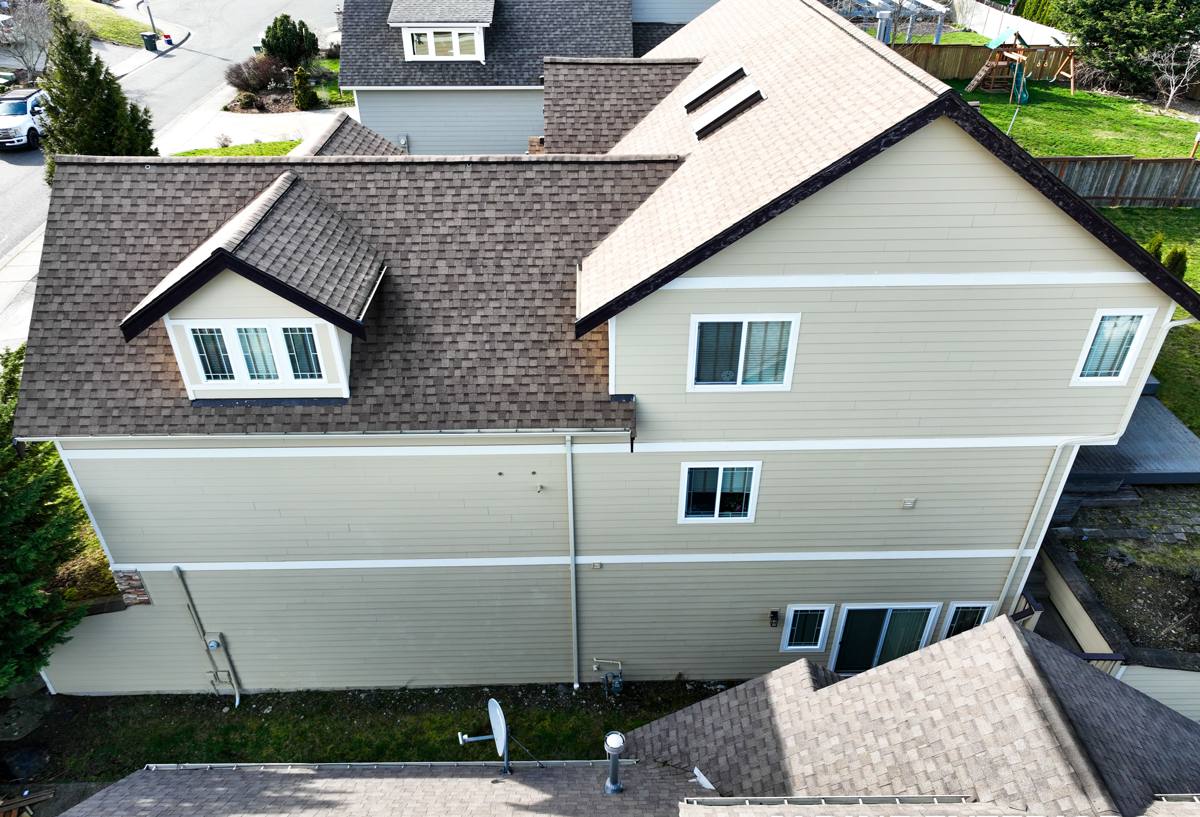
What a Big Lake Deck Is Actually Up Against
Shade and slow drying
A deck surrounded by mature trees dries much slower than one in full sun, even after a light rain. That extended damp period is what lets moss, algae, and mildew get a foothold on decking boards and, more importantly, on the framing underneath where you can't see it happening.
Moisture load from the lake and the ground
Proximity to water raises ambient humidity and keeps soil around footings wetter longer into the season. That matters for post bases, ledger connections, and any wood-to-concrete contact point, all of which need real separation from standing moisture, not just a coat of paint.
Marine air and hardware
Skagit County's air carries a fair amount of salt-tinged moisture in off the Sound, even away from the immediate shoreline. Over years, that air accelerates corrosion in anything less than a properly rated fastener or connector, which is a big part of why we don't cut corners on hardware specs on any deck we build in this area.
Choosing Decking Material for This Environment
There's no single "best" decking material — there's a best fit for how much sun a deck gets, how much upkeep the homeowner wants to do, and what the budget allows. Here's how the common options actually perform in a shaded, moisture-heavy setting like Big Lake:
| Material | Upfront Cost | Maintenance Needed | Behavior in Shade/Moisture |
|---|---|---|---|
| Pressure-treated fir/pine | Lowest | Annual cleaning, periodic sealing/staining | Prone to moss and mildew if not cleaned and sealed on schedule |
| Cedar | Moderate | Regular sealing to hold color and resist rot | Naturally rot-resistant but still needs airflow underneath and routine sealing |
| Composite (uncapped) | Moderate-High | Low; occasional washing | Can hold moisture at the surface longer in deep shade; needs proper gapping |
| Capped composite / PVC | Highest | Lowest; soap-and-water cleaning | Best resistance to moss staining and moisture absorption; sheds water well |
For heavily shaded Big Lake lots, we lean homeowners toward capped composite or PVC when the budget allows, because the surface doesn't absorb water the way raw wood or uncapped composite can, which cuts down on the moss and algae film that forms fastest where sun never fully reaches. That said, plenty of well-built cedar and pressure-treated decks hold up fine here too — it comes down to whether the owner is willing to keep up with cleaning and sealing on a real schedule, not just when it starts looking bad.
Framing and Substructure: Where Decks Actually Fail
Almost every deck failure we get called out to repair started below the visible surface, not on top of it. In a wet, shaded environment like Big Lake, three things determine whether framing lasts:
Ledger flashing
Where a deck attaches to the house is the single most common source of hidden rot. Correct flashing — installed so water is directed out and away from the house wall, not just caulked and hoped for — is non-negotiable on every attached deck we build.
Joist protection and airflow
Joist tape or an equivalent moisture barrier on top of framing members, combined with enough clearance underneath the deck for air to actually move, keeps framing from sitting damp for weeks at a time under tree cover.
Footings and post bases
Post bases need to hold the post above grade and above standing water, not buried or sitting in a wet depression. On lots near Big Lake where soil stays saturated longer into spring, footing depth and drainage around the base both matter more than they would on a well-drained, sunnier lot.
Moss, Algae, and Slip Resistance
Skagit County's moss season runs long — realistically much of the fall through spring on a shaded deck — and it's not just a cosmetic issue. A moss- or algae-covered deck surface gets slick fast, and it's one of the more common safety complaints we hear from homeowners with older decks near the water.
A correctly built deck reduces this problem in a few concrete ways: proper board spacing so water actually drains through instead of pooling, a decking material suited to the amount of shade the site gets, and, where a homeowner wants it, a surface texture or finish chosen specifically for slip resistance rather than pure looks. No deck in this climate stays moss-free without some homeowner maintenance, but the build itself can make that maintenance a once- or twice-a-year task instead of a constant fight.
Our Deck-Building Process for Big Lake Properties
- Site visit and assessment — we look at sun exposure, tree cover, drainage patterns, and existing structure (for replacements) before talking materials or design.
- Design and material selection — sized and specified to the site conditions and the owner's maintenance preference and budget, not a one-size-fits-all package.
- Permitting — Skagit County and local jurisdiction requirements are handled as part of the project, not left for the homeowner to sort out separately.
- Framing and flashing — built to the moisture-management standards above, including ledger flashing and joist protection.
- Decking, railing, and finish work — installed to manufacturer spacing specs so the deck can actually shed water and dry between storms.
- Final walkthrough — we go over care and maintenance specific to the material chosen so the deck performs the way it's supposed to for years, not just for the first season.
Railings, Fasteners, and Hardware for This Climate
Hardware is an easy place to cut costs and a hard place to recover from a bad decision later, since most of it is buried in the structure once the deck is finished. We spec fasteners and structural connectors rated for the moisture and corrosion exposure this area sees — not just because it's better practice everywhere, but because marine-influenced air moving through Skagit County genuinely shortens the life of undersized or mismatched hardware. The same logic applies to railing systems: cable, wood, composite, or metal railings all have different maintenance and corrosion profiles, and we walk owners through those trade-offs before, not after, installation.
Maintenance Checklist for Big Lake Deck Owners
Whatever material you choose, a little seasonal attention goes a long way in this climate. A reasonable annual routine looks like:
- Clear leaves and debris from between boards and off ledger flashing before the fall rains set in
- Wash the surface to remove early moss and algae growth before it stains or gets slick
- Check and clear gaps between boards so water keeps draining through properly
- Inspect railings and stair connections for movement or corrosion at fastener points
- Reseal wood decking on the schedule the product calls for — don't wait until it looks dry and gray
- Confirm under-deck airflow isn't blocked by stored items, plants, or debris buildup
Why Hire a Crew That Already Works Big Lake
A deck built to a generic regional standard can still fail early in a spot like Big Lake if the crew doesn't already understand how shade, lake humidity, and long wet stretches interact with framing and decking choices. We work throughout Skagit County and see the same conditions repeatedly — which ledger details fail first, which materials actually hold up under tree cover, and which shortcuts show up as callbacks two or three winters later. That local pattern recognition is worth more than a lower bid from a crew building to a one-climate-fits-all spec.
If you're planning a new deck or replacing one that's showing its age, we're happy to take a look and put together a straightforward estimate — no pressure, no obligation. Use the form below to get started.