 Skagit County
 Composite Decking in Alger: Built for What This Climate Actually Does to a Deck
Alger sits close enough to the water and the marine air pattern that runs up through Skagit County that decks here take a different kind of beating than decks fifty miles inland. It's not one big storm that wrecks a deck out here — it's the steady combination of salt-tinged air, driving rain that comes in sideways off the water, and a moss season that can run from late fall through spring. A deck built without those three things in mind will look fine for a year or two and then start showing problems: dark streaking, soft spots at the fastener lines, moss creeping into every shaded seam. Composite decking, installed correctly, handles this environment better than wood — but "correctly" is doing a lot of work in that sentence, and it's where a lot of decking jobs in this area go wrong.
We're a Skagit County siding and exteriors crew that also handles composite decking, and we treat decking the same way we treat siding: it's a system, not just a surface material. The boards matter, but the framing, drainage, fastening, and ventilation underneath them matter just as much — arguably more, since that's the part nobody checks again once the boards are down.
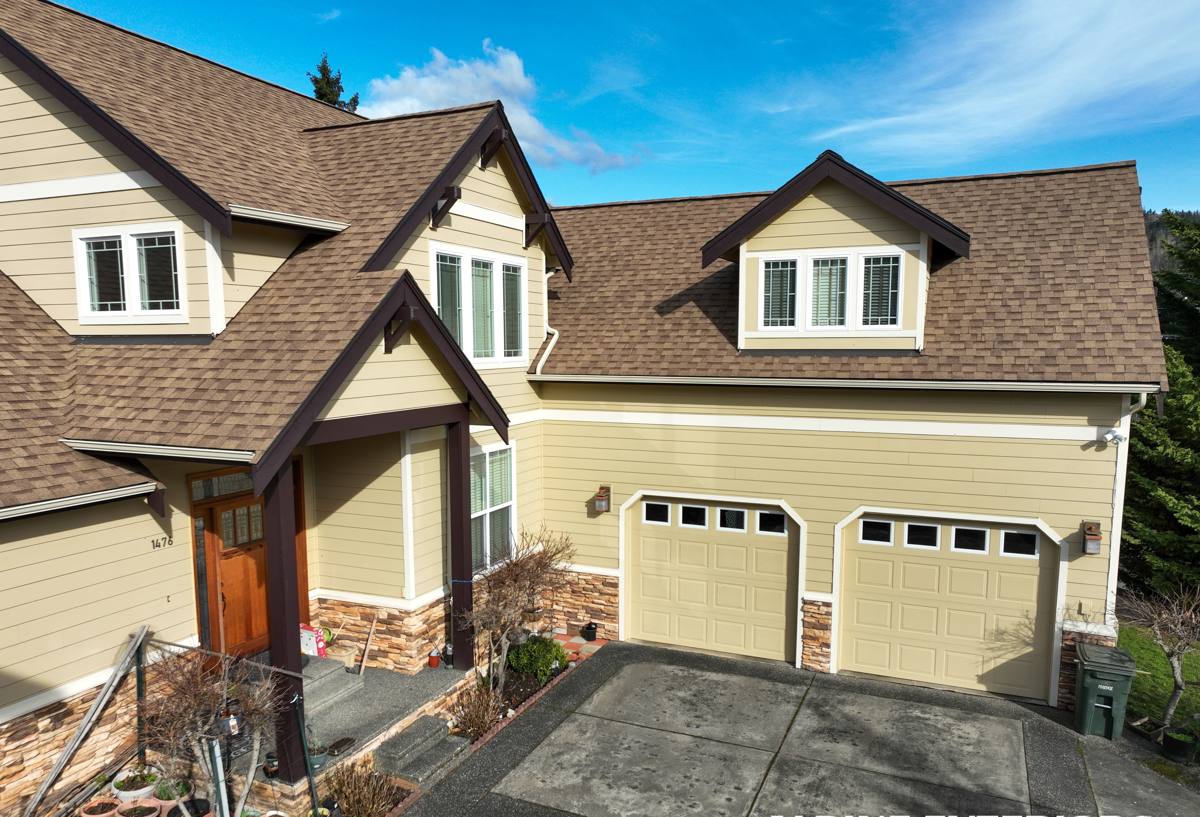
What Alger's Climate Actually Does to a Deck Over Time
Salt Air and Metal Fasteners
Proximity to salt water accelerates corrosion on anything metal — screws, joist hangers, ledger bolts, railing brackets. Standard zinc-coated fasteners can start breaking down faster near the coast than they would inland, which is why fastener and hardware selection is one of the first things we adjust for a job in this area, not an afterthought.
Driving Rain and Water Intrusion
Skagit County gets plenty of straight-down rain, but the coastal-influenced storms that reach Alger often come in at an angle, driven by wind off the water. That means water gets pushed into gaps and seams that a purely vertical rain would never reach — ledger connections, stair stringers, the point where a deck meets the house. If flashing and drainage aren't handled with that in mind, moisture works its way into places it shouldn't be.
Moss and Shade
Anywhere in Skagit County with tree cover or a north-facing exposure grows moss on decking, railings, and fascia. Moss isn't just cosmetic — it holds moisture against the surface long after the rain has stopped, and on wood decking that moisture retention is what drives rot. Composite decking doesn't rot, but moss will still grow on it if drainage and airflow underneath aren't right, and a slick, mossy composite surface is a genuine slip hazard on stairs and landings.
Why We Recommend Composite Decking for Homes in This Area
We're not going to tell you wood decking is a bad product — it isn't, and plenty of people love the look and are willing to keep up with it. But for Alger's specific combination of moisture and moss, composite decking solves problems that wood decking creates work for every year:
- No annual staining or sealing to keep water out of the fibers
- No soft, rotting boards from years of trapped moisture under moss
- Consistent color and texture that doesn't gray or splinter with UV and rain exposure
- Better slip resistance options on stair treads when the right board profile is chosen
- Long manufacturer warranties on the boards themselves, which matters when the climate is working against the material year-round
The trade-off is upfront cost — composite material runs more than pressure-treated lumber — and installation sensitivity. Composite boards expand and contract with temperature differently than wood, they need specific gapping and fastening patterns, and cutting corners on the substructure underneath composite decking causes problems that show up years later, not on day one. That's the honest trade-off: you're paying more for the material and for a crew that knows how to detail it correctly, in exchange for not doing this work again in eight years.
What a Correct Composite Deck Build Actually Involves
The Substructure Comes First
Composite boards are only as good as what's underneath them. We build or evaluate the joist framing for proper spacing (composite often requires tighter joist spacing than wood decking, depending on the board), and we make sure ledger connections to the house are flashed correctly so water is directed away from the wall assembly, not into it.
Joist Protection
Wrapping joists in a protective tape barrier before decking goes down keeps moisture from Skagit County's rain seasons from getting into the framing lumber, even though the visible decking itself is composite. This is a step that's easy to skip and impossible to see once the boards are on — which is exactly why we don't skip it.
Drainage and Airflow Underneath
Decks in shaded or ground-level locations need real airflow underneath to keep the space dry and unfriendly to moss. That means proper joist height off grade, gapping at the perimeter where needed, and keeping vegetation and debris from building up against the underside of the deck.
Fastening and Hardware
Given the salt-air exposure common near the coast, we use fasteners and structural hardware rated for corrosion resistance rather than standard-grade hardware. It costs a little more per piece; it's not worth saving that money on a deck that's supposed to last decades.
Board Gapping and Fastening Pattern
Composite boards need consistent gapping for drainage and thermal movement, and hidden fastening systems (versus face-screwing) give a cleaner look while still allowing the boards to expand and contract properly. We follow the manufacturer's specified pattern for the product being installed rather than eyeballing it.
Comparing Decking Materials for Skagit County Conditions
| Factor | Composite Decking | Pressure-Treated Wood | Cedar |
|---|---|---|---|
| Moisture/rot resistance | High — won't rot, but drainage under boards still matters | Moderate — resists rot when sealed and maintained | Moderate — naturally resistant but still needs sealing |
| Moss/algae resistance on surface | Good with proper airflow; some boards have textured grip | Poor in shaded, damp areas without regular cleaning | Poor in shaded, damp areas without regular cleaning |
| Maintenance | Occasional cleaning, no staining/sealing | Annual or biannual staining/sealing | Annual or biannual staining/sealing |
| Upfront material cost | Higher | Lowest | Mid-to-high |
| Installation sensitivity | High — gapping, fastening, and framing specs matter | Moderate | Moderate |
| Typical warranty | Long, often 20–25+ years on boards | Limited, on lumber treatment only | Limited or none |
Our Process for an Alger Decking Project
1. On-Site Evaluation
We look at the site conditions specific to the property — sun exposure, shade and moss patterns, proximity to the water, existing framing if it's a rebuild, and drainage around the footprint of the deck. This tells us what board type, fastener grade, and substructure spec make sense for that particular spot.
2. Honest Scope and Estimate
We walk through what the job actually requires — framing repair or replacement, ledger flashing, board selection, railing — and give a clear estimate before any work starts. No surprise change orders for things we should have caught on the walk-through.
3. Framing and Structural Work
Any framing that needs replacing or reinforcing gets handled before a single composite board goes down. This is the step that determines whether the deck is solid in ten years or needs boards replaced early because the substructure underneath failed.
4. Decking Installation
Boards go down per manufacturer spec — gapping, fastening pattern, expansion joints where needed for longer runs. We keep the cut ends properly capped or treated per the product's requirements so the core material isn't exposed to moisture at the ends.
5. Railings, Stairs, and Trim
Railings and stair components get the same corrosion-resistant hardware treatment as the deck itself, since these are often the first things to show wear in salt-air conditions.
6. Walkthrough and Cleanup
We walk the finished deck with the homeowner, cover basic care (what little there is with composite), and clean the site.
Composite Decking Pre-Project Checklist
- Confirm the existing framing (if any) is sound, or budget for replacement
- Check ledger board flashing and connection to the house — a common leak point
- Decide on board color and texture, keeping in mind darker boards show less moss staining but run hotter in direct sun
- Choose corrosion-resistant fasteners and hardware given the coastal-influenced air
- Plan for proper under-deck airflow, especially in shaded or ground-level sections
- Confirm stair tread board selection includes adequate slip resistance
- Ask about the manufacturer's warranty terms and what voids them
- Check whether local permitting applies to the scope of the project
Maintenance: What Composite Decking Still Needs
Composite decking is low-maintenance, not no-maintenance. In an area with Alger's moss and rain pattern, an occasional wash-down (a garden hose and stiff bristle brush, or a gentle deck cleaner) keeps organic buildup from getting a foothold in shaded corners and along the edges where debris collects. Homeowners should also keep gutters and downspouts near the deck clear so runoff isn't dumping extra water onto the deck surface or the ground underneath it. Beyond that, there's no staining, sealing, or sanding — which is the whole point of choosing composite in a climate that's hard on wood.
Why Hiring a Crew That Already Works This Area Matters
Composite decking installation isn't exotic, but installing it correctly for Skagit County's coastal-influenced conditions is a different job than installing it in a dry inland climate. A crew that already works in and around Alger knows which fastener grades hold up, how much airflow a shaded deck actually needs to stay moss-free, and where driving rain tends to find the gaps in a build that looks fine on paper. That local pattern recognition is the difference between a deck that needs attention again in a few years and one that doesn't.
If you're weighing composite decking for a home in Alger or elsewhere in Skagit County, we're happy to take a look at your site and talk through what it actually needs — no pressure, no obligation. Use the form below to request a free estimate.