 Skagit County
 Why Bow's Climate Is Hard on Siding
Bow sits close to the water in Skagit County, in the stretch of Western Washington where saltwater tidelands, farmland, and dense tree cover all sit within a few miles of each other. That combination is tougher on exterior siding than most homeowners realize. Salt-laden air carried in off the bay settles on exterior walls and, over years, works into seams, fastener heads, and any spot where a coating has started to fail. Add in the driving, wind-blown rain that comes through this part of Skagit County for much of the fall, winter, and spring, and siding here is dealing with near-constant moisture exposure rather than the occasional storm.
Then there's the moss. Skagit County's long, mild, wet stretch of the year is exactly what moss and algae need to take hold, and homes in Bow that sit under fir or cedar cover, or just get less direct sun on one elevation, will grow green or black staining faster than a similar home a few miles inland. Moss isn't just cosmetic — where it holds moisture against a wall for months at a time, it accelerates whatever is already going wrong underneath. Siding replacement in this area has to be planned around all three of these factors together, not just "what does it look like now."
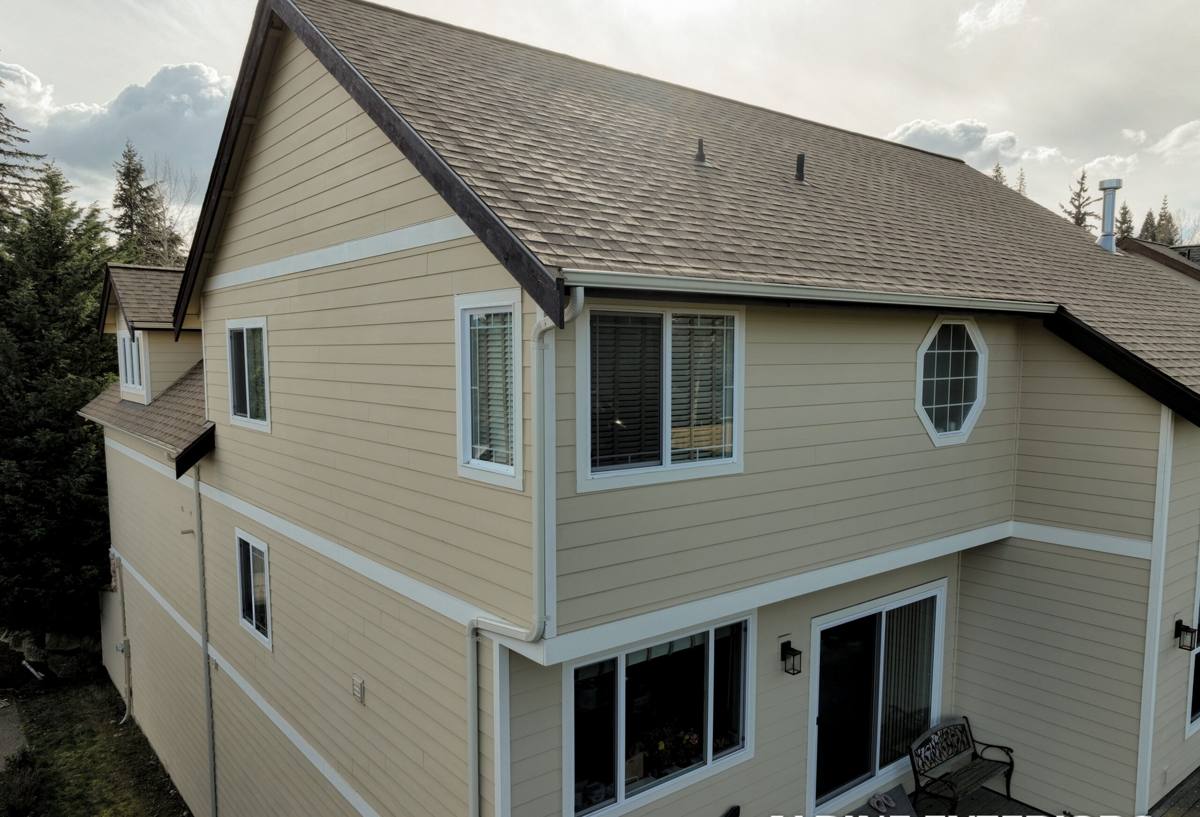
Signs a Bow Home Needs Siding Replacement, Not Just a Repair
Not every siding problem in this climate means a full replacement. But there are signs that point to a system that's failed rather than a spot that needs a patch:
- Soft or spongy spots when you press on the siding, especially near the bottom courses and around windows
- Paint that keeps failing within a couple of years no matter how often it's redone
- Visible gaps, warping, or buckling boards, particularly on the sides that face prevailing wind and rain
- Moss or algae that returns within months of being cleaned, or that's established on more than one elevation
- Rot or staining at butt joints, corners, and anywhere trim meets siding
- Interior signs — musty smell, peeling interior paint, or damp drywall on exterior-facing walls
If you're seeing two or more of these at once, it's usually a sign the water-management layer behind the siding — not just the visible surface — has been compromised. That's a replacement conversation, not a caulk-and-paint one.
What a Correct Siding Replacement Involves Here
A siding job done right in Bow isn't just pulling off old boards and nailing up new ones. Given the rain and salt exposure this area sees, the details behind the siding matter as much as the siding itself:
Moisture Barrier and Flashing
Every wall gets a weather-resistive barrier installed correctly — lapped shingle-style so water sheds down and out, never trapped behind a seam. Window and door flashing has to integrate with that barrier properly, since these are the most common failure points on older homes in this area. Kick-out flashing at roof-to-wall intersections is non-negotiable; it's a small detail that prevents a huge amount of hidden rot.
Fastening and Clearances
Fiber cement siding has specific fastener spacing, embedment depth, and clearance requirements from grade, roof lines, and decks. Getting these wrong doesn't show up as a problem in year one — it shows up in year five or six as trapped moisture and premature failure, which is exactly the kind of failure that's hardest to trace back to installation.
Factory Finish, Not Field Paint
In a climate with this much rain and salt exposure, the quality of the paint job is one of the biggest variables in how long siding actually lasts. Factory-applied, baked-on finishes hold up more consistently than field-applied paint, especially at cut edges and joints, which is one of the reasons material selection matters as much as workmanship.
Material Comparison: What Actually Holds Up in This Climate
Homeowners in Bow are usually choosing between a handful of common siding materials. Here's an honest look at how each one tends to perform against salt air, driving rain, and a long moss season specifically:
| Material | Salt Air / Moisture Behavior | Moss & Algae Resistance | Maintenance Burden |
|---|---|---|---|
| Vinyl | Doesn't rot, but seams and J-channels can trap moisture; can warp or fade in coastal exposure | Grows on surface readily; hard to clean without damaging finish | Low until it fails, then replacement is the only fix |
| Untreated/primed wood (cedar, spruce) | Absorbs moisture at end grain and joints; prone to rot in wet coastal climates | High susceptibility, especially in shaded areas | High — regular repainting and sealing required |
| Engineered wood (LP-type products) | Better than raw wood but still wood-based; edge swelling is a known risk if seals fail | Moderate; depends on coating integrity | Moderate — coating maintenance matters |
| Fiber cement (James Hardie) | Non-combustible, dimensionally stable, engineered for wet/coastal climates | Factory finish resists staining better; still needs occasional washing | Low — periodic cleaning, no repainting cycle needed for years |
No siding material is completely maintenance-free in this environment — even the best product still needs occasional washing to keep moss and salt film from building up. But the starting point matters. A product engineered for wet, coastal conditions gives a Bow home a real head start that a general-purpose product doesn't.
Why We Install James Hardie and Nothing Else
We standardized on James Hardie fiber cement siding, and we don't install vinyl, LP-style engineered wood, or unfinished wood siding. That's a deliberate call based on what holds up in Western Washington's wet, coastal conditions, not a sales pitch.
Hardie's HZ5 product line is engineered specifically for climates like Skagit County's — higher moisture exposure and freeze-thaw cycling — rather than a one-size-fits-all national product. The fiber cement itself is non-combustible and dimensionally stable, so it doesn't expand and contract with moisture the way wood-based products can. The ColorPlus factory finish is baked on under controlled conditions, which holds color and resists the kind of edge and seam failure that's common with field-painted materials in high-rain climates. It also carries a strong transferable warranty, which matters to homeowners who may sell the home before the siding's functional life is up.
We're not saying every other product is a bad product everywhere — vinyl and engineered wood siding both have legitimate uses. We're saying that for the specific combination of salt air, driving rain, and moss exposure that Bow homes deal with, Hardie is the material we're willing to put our name behind and warranty our work on.
Our Process for a Bow Siding Replacement
- On-site assessment — we look at existing siding, check for hidden moisture damage at trim, corners, and penetrations, and evaluate the home's exposure to wind, rain, and shade
- Tear-off and inspection — once old siding is removed, we inspect sheathing for rot before anything new goes up; any damaged sheathing gets addressed before re-siding, not covered over
- Water management install — weather-resistive barrier, flashing, and drainage plane go in first, correctly lapped and sealed
- Hardie installation to spec — proper fastening, clearances, and joint treatment following manufacturer installation requirements
- Final walkthrough — trim, caulking, and touch-up details reviewed with the homeowner before we call the job done
Every one of these steps matters more in Bow than it would somewhere dry and inland, because there's less margin for error when the wall is going to see this much sustained moisture year after year.
What Affects the Cost of Siding Replacement in Bow
| Factor | Why It Matters Here |
|---|---|
| Extent of hidden damage | Homes with long-term moisture exposure often need sheathing repair discovered only after tear-off |
| Home size and elevation complexity | Multiple gables, dormers, and trim details add labor time regardless of material |
| Siding profile and accessories | Lap width, trim boards, and soffit work all factor into material and labor cost |
| Access and site conditions | Rural lots, tree cover, and limited equipment access can affect scheduling and labor |
| Existing paint or coating removal | Older wood or fiber cement siding may need extra prep depending on condition |
We don't quote a number without seeing the home, but we can tell you honestly that the biggest cost swings on jobs in this area usually come from what's found once old siding comes off — not from the new material itself.
Why Hiring a Crew That Already Works Bow Matters
Skagit County covers a lot of different micro-climates — the drier stretches inland behave differently than the saltwater-adjacent communities like Bow. A crew that's worked in this specific area knows which elevations of a home typically take the worst weathering, how local permitting works, and what kind of hidden damage tends to show up on homes exposed to this much salt air and rain. That's not something you can fully substitute with general siding experience from a drier part of the state.
It also matters for accountability. A contractor working regularly in this community has a reputation to maintain here — with neighbors, with local suppliers, and with repeat homeowners over time. That's a different incentive than a crew passing through once for a single job.
Get a Straight Answer About Your Siding
If your Bow home is showing signs of wear from salt air, rain, or moss, the best next step is an honest, no-pressure look at what's actually going on behind the siding — not just a quote based on square footage. Use the form below to request a free estimate, and we'll walk the property with you and tell you plainly what we find.