 Skagit County
 Siding Repair in Bow: What the Climate Does to Your Walls
Bow sits close enough to Samish Bay and Padilla Bay that salt-laden air is part of daily weather, not an occasional event. Add Skagit County's long, wet fall-through-spring stretch and the shaded, slow-drying conditions common on wooded and farm-adjacent lots, and you get a specific pattern of siding damage that looks different from what we see on drier east-county jobs. Moss and algae get a running start here because siding stays damp for days at a time. Fasteners and trim hardware corrode faster where salt spray reaches them. And driving rain off the water finds every gap in flashing, caulk, and panel seams that a drier climate would forgive.
This page is about repair specifically — patching, replacing damaged sections, and fixing the causes of failure — for homes in and around Bow. If your siding is sound but aging, or you're weighing a full re-side, that's a different conversation; here we're focused on what it actually takes to fix damaged siding correctly in this particular stretch of Skagit County.
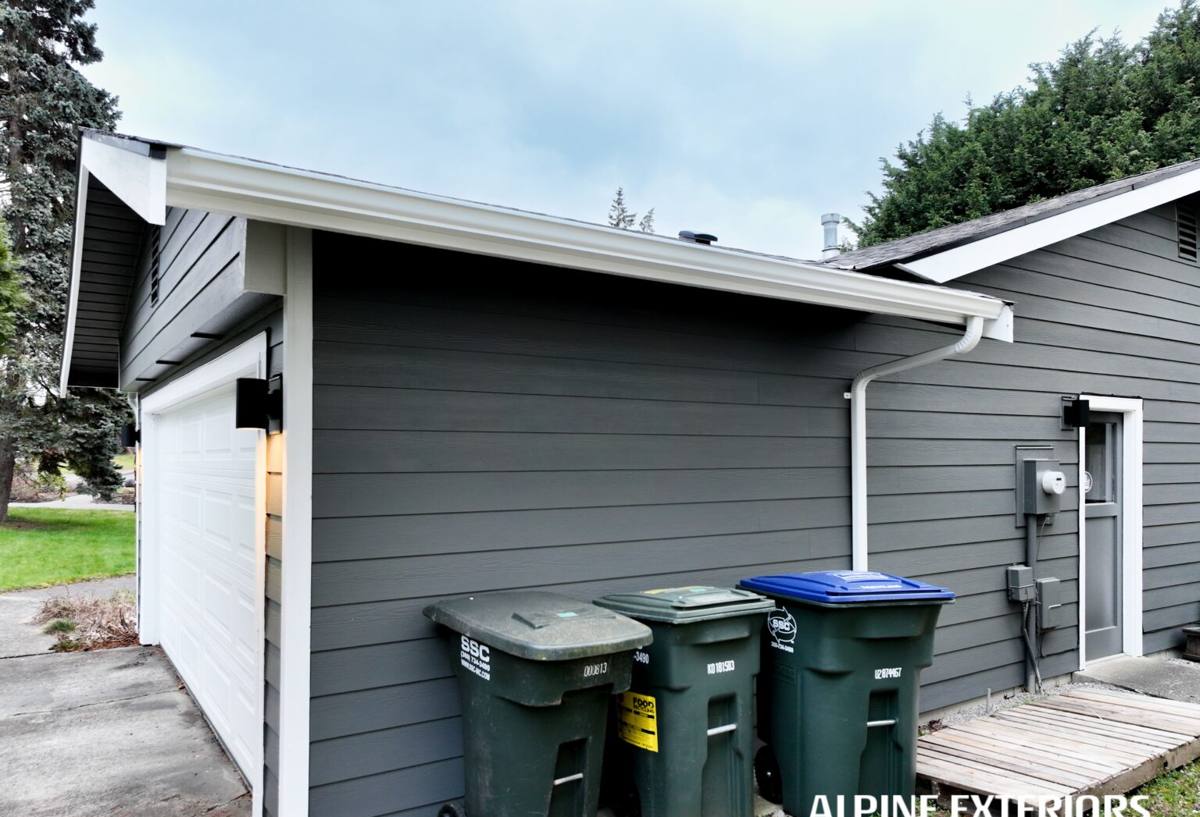
What We're Usually Called Out to Fix in Bow
Moss and algae holding moisture against the wall
Green or black growth on siding isn't just cosmetic. Once moss establishes on a shaded, north-facing or tree-covered wall, it holds water against the surface far longer than open weather would. On absorbent or poorly sealed siding, that constant dampness works into seams, fastener holes, and butt joints, and that's where rot and delamination start — not on the open face of the panel, but at the edges you can't fully see from the ground.
Salt-air corrosion at fasteners and trim
Bow's proximity to the bay means galvanized nails, exposed screws, and thin metal trim corrode faster than they would ten or fifteen miles inland. Rust streaking below a fastener head, or trim that's gone soft and pitted, is a reliable sign that the hardware — not necessarily the siding itself — needs attention before it stains or loosens the panel around it.
Caulk and seam failure from constant wet-dry cycling
Skagit County's rain pattern isn't just volume, it's frequency — long damp stretches followed by short dry spells. That cycling is hard on caulk joints at trim, window returns, and panel seams. Once a caulk joint cracks or pulls away, it's a direct path for water behind the siding, and it's often invisible until you're looking for it.
Storm-driven rain intrusion
Wind off the water can push rain sideways into laps and seams that would otherwise shed water fine. Repeated exposure gradually swells panel edges, especially on older or lower-grade siding that wasn't engineered for sustained wet exposure.
Why Fixing It Promptly Actually Matters
Siding damage in this climate rarely stays small. A soft spot at a butt joint that goes unaddressed for a season typically spreads — moisture wicks along the seam, the sheathing behind it starts to absorb water, and what would have been a one-panel patch becomes a multi-panel repair with sheathing work underneath. We'd rather tell a homeowner honestly that a repair is small and cheap now than have them wait a winter and come back to something structural.
There's also a simple economic argument: a $300–$800 localized repair, caught early, is a completely different project than the $2,000–$5,000+ range you're in once rot has spread into framing or multiple courses of siding need to come off to fix what's underneath.
What a Correct Repair Actually Involves
A lot of "siding repair" in this region is caulk-and-paint over a problem that's still active underneath. That buys a season, sometimes less, and it hides the damage instead of fixing it. A repair done right involves a few non-negotiable steps:
- Find the actual water path, not just the visible symptom — a stain three feet from the real entry point is common once water has traveled along framing or house wrap.
- Remove damaged material back to sound substrate, including sheathing or framing if it's been compromised, not just the siding face.
- Correct the flashing and weather barrier detail that let water in — a repair that reinstalls siding over the same flashing mistake just delays the next failure.
- Match the replacement material in profile, reveal, and finish so the patch doesn't stand out or create a seam that behaves differently in weather than the surrounding panels.
- Reseal and re-fasten correctly, with corrosion-resistant hardware given how hard salt air is on standard fasteners this close to the bay.
Our Repair Process for Bow Homes
1. On-site inspection
We look at the damaged area and the surrounding field — moisture readings where it matters, a check of flashing at windows, doors, and trim intersections nearby, and an honest read on whether this is isolated or a sign of a broader issue on that elevation.
2. Straight assessment
We tell you what we actually found, what's causing it, and what it'll take to fix — including if the honest answer is "this section is fine to leave for now" or "this is going to need more than a patch." We don't pad small jobs into bigger ones.
3. The repair
Damaged material comes out, the cause gets corrected (not just covered), and the section is rebuilt with matched material and proper flashing and sealant details — not a quick surface patch.
4. Follow-through
We tell you what to watch for afterward and, if the repair area is a sign that the rest of that elevation is aging out, we'll say so plainly rather than waiting for you to call us back next year.
Repair or Replace? How We Help You Decide
Not every damaged section justifies a full re-side, and not every re-side needs to happen all at once. Here's roughly how we think through it with homeowners:
| Factor | Repair Usually Makes Sense | Replacement Worth Discussing |
|---|---|---|
| Extent of damage | Isolated to one or two panels/sections | Recurring across multiple elevations |
| Cause | One-time event (impact, isolated flashing failure) | Systemic — original install or material issue |
| Siding age | Under 15–20 years, otherwise sound | Original material at or past its practical service life |
| Material | Matching stock available, still performing well elsewhere | Material is discontinued, badly faded, or a product we'd steer away from anyway |
| Moisture history | No sign of spread into sheathing/framing | Rot has already reached structural material |
When a repair is the right call, that's what we recommend and price — we're not trying to upsell a full re-side onto a homeowner who has a genuinely fixable problem.
When Repair Turns Into a Material Conversation
Occasionally a "repair" call turns into something bigger once we're into the wall — an entire elevation that's been absorbing water for years, or siding that's simply worn out its usefulness in this climate. When that happens, we'll say so honestly, and we'll tell you what we'd actually put back up: James Hardie fiber cement, which is the only siding product we install. It's non-combustible, engineered specifically for wet Pacific Northwest climates in its HZ5 product line, and finished with a factory-applied ColorPlus coating that holds color and resists the kind of moisture-driven failure we see so often on repair calls out here. We don't carry vinyl, LP SmartSide, or unfinished wood siding, because the repair patterns we see on those products — seam failure, moisture-driven swelling, coating breakdown — are exactly what we're trying to prevent when we recommend a replacement material.
For a straightforward patch or section repair, though, matching your existing material correctly is almost always the right move, and that's what we'll do when it's the honest fix.
Signs Your Bow Home Needs a Siding Repair Inspection
- Green, black, or gray growth that keeps returning after cleaning, especially on shaded or north-facing walls
- Soft or spongy panel edges near seams, corners, or butt joints
- Visible rust streaking below nails, screws, or metal trim
- Cracked, shrunken, or missing caulk at window and door trim
- Paint or finish that's peeling in a localized patch rather than uniformly across the wall
- Bulging, warped, or separated panels after a stretch of heavy wind-driven rain
- A musty smell or visible staining on interior walls that share an exterior wall with a suspect area
Why a Crew That Already Works Bow Matters Here
Siding repair in this stretch of Skagit County isn't the same trade as siding repair in a dry inland climate. A crew that hasn't dealt with salt air, moss cycles, and driving rain off the bay will diagnose the wrong cause, use the wrong hardware, or miss a flashing detail that matters here specifically. Working this area regularly means we already know which elevations tend to take the worst of it, what corrosion-resistant fasteners hold up, and how to sequence a repair so it doesn't get rained out or reopened before it's fully sealed. That local familiarity is the difference between a repair that lasts and one you're calling us back about in a year.
Get an Honest Look at Your Siding
If you're seeing moss buildup, soft spots, rust staining, or storm damage on your Bow home's siding, we're glad to come take a look. We'll give you a straight read on what's causing it and what it actually takes to fix — no pressure, no upsell, just an honest estimate you can use to decide what's next.