 Skagit County
 Why Conway Roofs Fail Differently Than Roofs Inland
Conway sits low in the Skagit River delta, close enough to salt water and open farmland that roofs here take a beating most inland Washington homes never see. Three things drive most of the roof replacements we do out this way: salt-laden air moving in off the Sound, wind-driven rain that gets pushed sideways under poorly lapped flashing, and a moss season that runs longer than almost anywhere else in the county because the flat, damp terrain around Conway rarely dries out fast between storms.
None of that is exotic information, but it matters for how a roof should actually be built here. A roofing crew that mostly works drier, higher ground can put on a technically fine roof that still underperforms in Conway because the details — underlayment coverage, flashing laps, ventilation balance — weren't sized for this specific combination of moisture and salt exposure. That's the gap we build every Conway roof to close.
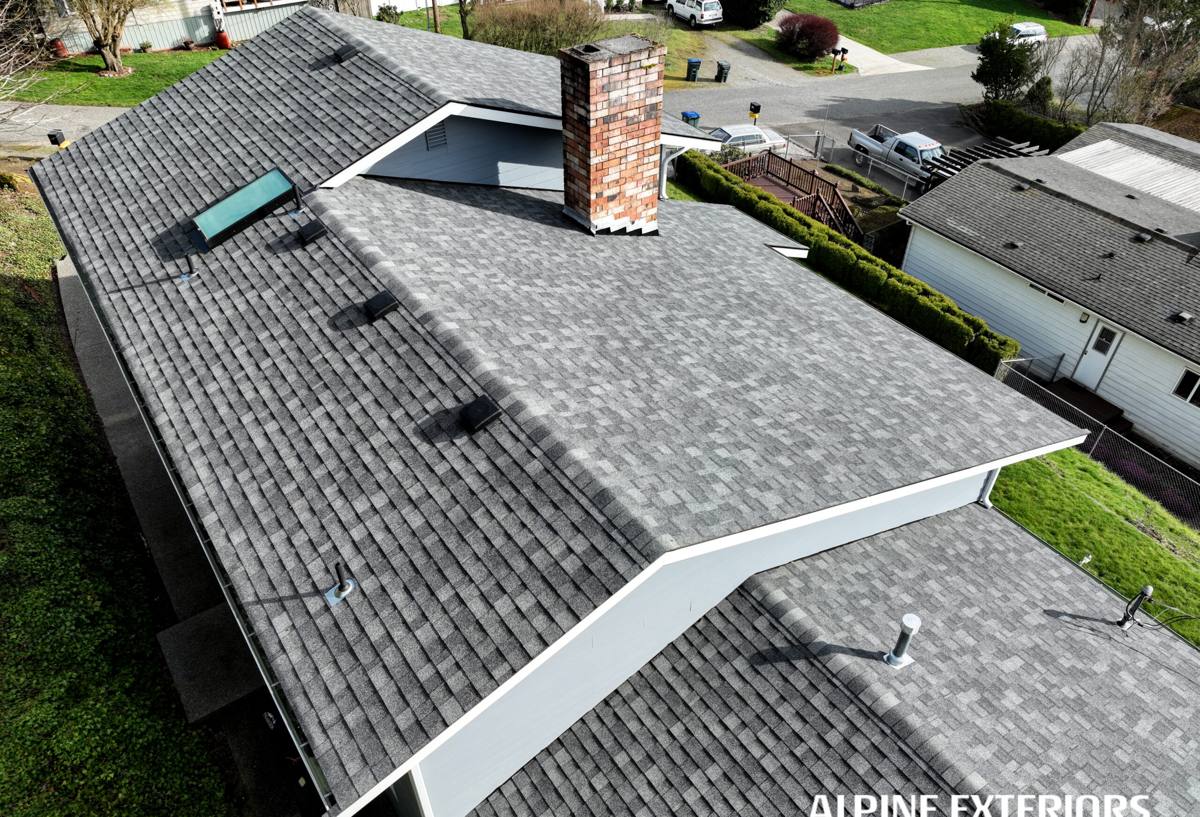
Signs Your Conway Roof Needs Replacement, Not Another Repair
Roof repair has a ceiling. Past a certain point, patching a roof in a wet, moss-prone area like Conway just moves the problem instead of solving it. Here's how we tell homeowners the difference during an inspection:
- Granule loss and bald patches on asphalt shingles, especially on south- and west-facing slopes that take the worst of the driving rain
- Moss established at the shingle tabs, not just on the ridge — once it's lifting tabs, water is already getting underneath
- Soft or spongy decking found during a walk-across, usually near valleys, chimneys, or old vent penetrations
- Daylight or staining in the attic around flashing points, which almost always means the underlayment beneath is compromised
- A roof past 20-25 years on standard asphalt shingle in this climate — coastal moisture shortens the practical service life compared to drier parts of the state
- Repeated repair calls to the same area of the roof, which usually signals a systemic flashing or ventilation issue rather than a one-off leak
If you're only seeing one or two of these and the roof is otherwise young, a repair is often the honest answer and that's what we'll tell you. Replacement makes sense when the underlying deck, underlayment, or flashing system is failing broadly rather than in one isolated spot.
What a Correct Roof Replacement Involves in Conway
Tear-Off and Deck Inspection
We don't roof over old material. A full tear-off is the only way to see the actual deck condition, and in a delta-adjacent town like Conway, trapped moisture under old shingles is common enough that skipping this step is a real risk. Any soft or delaminated sheathing gets replaced before anything new goes down — patching over bad decking just means the new roof is sitting on a weak foundation.
Underlayment and Flashing Sized for Driving Rain
Standard felt underlayment is a minimum, not a plan, for a home exposed to wind-driven rain off open ground. We run synthetic underlayment across the full deck and self-adhered ice-and-water barrier at the vulnerable spots — eaves, valleys, and any low-slope transitions — where wind can push water backward under the shingle line. Step flashing at walls and chimneys gets replaced rather than reused, and all penetrations get new boots and counterflashing, not caulk over old metal.
Ventilation That Fights Moss Instead of Feeding It
A poorly ventilated attic traps warm, moist air against the underside of the roof deck, which keeps the shingles damp longer after every rain and helps moss and algae take hold faster. Balanced intake at the eaves and exhaust at the ridge keeps the deck drier and extends the life of whatever roofing material goes on top of it. We check and correct ventilation as part of every replacement — it's cheap to fix while the roof is open and expensive to fix later.
Material Options for Skagit County's Climate
There's no single "right" roofing material for Conway — the right call depends on your budget, the roof's slope and complexity, and how much upkeep you want to take on. Here's how the common options compare for a coastal, moss-prone, high-rainfall setting like this one:
| Material | Typical Lifespan Here | Moss/Algae Resistance | Maintenance Load |
|---|---|---|---|
| Standard 3-tab asphalt | 15-20 years | Low without treatment | Higher — needs periodic cleaning |
| Architectural (laminate) asphalt | 20-25 years | Moderate; better with algae-resistant granules | Moderate |
| Metal (standing seam or panel) | 40-50+ years | High — moss struggles to anchor on smooth metal | Low |
| Synthetic/composite shake or slate | 30-50 years | Moderate to high depending on product | Low to moderate |
Most of the roofs we replace in Conway are architectural asphalt with algae-resistant (copper-infused) granules — it's the best balance of upfront cost and moss resistance for the money. Metal comes up often for homes with simpler roof lines where the higher material cost is offset by decades of lower maintenance, especially for owners who don't want to deal with moss treatment on a ladder every couple of years.
Cost Factors Homeowners Should Understand
We're not going to quote a price without seeing the roof, but the factors that move the number are consistent from job to job:
| Factor | Why It Matters |
|---|---|
| Roof pitch and access | Steep or hard-to-access roofs cost more in labor and safety setup |
| Number of layers to remove | Tear-off cost rises with each existing layer of roofing |
| Decking condition | Rotten sheathing found during tear-off adds material and labor |
| Roof complexity | Valleys, dormers, and multiple penetrations add flashing labor |
| Material choice | Asphalt, metal, and composite carry very different material costs |
| Permit and disposal fees | Set by the county and by landfill/dump rates, not by us |
How Our Process Works
- On-site inspection — we walk the roof and the attic, not just look from the ground, and note deck condition, ventilation, and flashing problems
- Written scope and estimate — spelled out material by material, so you know exactly what's being replaced and why
- Scheduling around Skagit County weather — we watch the forecast and won't open a roof deck to a system rolling in off the Sound
- Tear-off, deck repair, and dry-in — the old roof comes off, damaged decking is replaced, and the deck is protected the same day whenever possible
- Underlayment, flashing, and new roofing installed to manufacturer specification, not shortcuts
- Daily jobsite cleanup, including a magnetic nail sweep of the yard and driveway
- Final walkthrough where we show you the completed work and go over warranty coverage before we consider the job done
Living With Salt Air and Moss After the Roof Goes On
A correctly installed roof still needs a little ongoing attention in a place like Conway. It's minor compared to the cost of premature replacement, but it's worth knowing:
- Zinc or copper strips near the ridge help suppress new moss growth between cleanings on shingle and composite roofs
- Keep gutters clear — clogged gutters hold water against the roof edge, which is exactly where wind-driven rain already causes the most stress
- Trim back overhanging branches where practical; shade and leaf litter both extend how long the roof stays damp after rain
- Have the roof looked at every few years, not just when a leak shows up — catching flashing wear or granule loss early is cheap; catching it late isn't
- Rinse metal roofing periodically in areas with heavier salt exposure to slow surface buildup, per manufacturer guidance
Why It Matters to Hire a Crew That Already Works Conway
Roofing code, permitting, and disposal requirements in Skagit County are things we deal with on every job, so there's no learning curve or delay figuring out who to call or what's required. More importantly, we've seen how roofs actually fail in this specific stretch of the county — which slopes take the worst of the wind-driven rain, how fast moss re-establishes on a north-facing roof shaded by trees, and where standard details need to be upgraded for salt exposure. That's the kind of judgment that only comes from working the area repeatedly, not from a general roofing checklist applied the same way everywhere in Washington.
Before you hire anyone for a roof replacement in Conway, it's worth asking a few direct questions:
- Are you licensed and insured to work in Washington, and can you provide proof?
- Will you provide a written scope that names the underlayment, flashing, and ventilation work, not just "new roof"?
- Do you tear off down to the deck, or do you ever install over existing layers?
- What's your plan for decking found to be soft or rotten once the tear-off starts?
- What warranty covers labor, separate from the manufacturer's material warranty?
If a contractor can't answer those plainly, that's worth weighing before you sign anything.
If your Conway roof is showing granule loss, moss at the tabs, or you're just past the point where another patch makes sense, we're happy to take a look. The estimate is free, there's no pressure to sign anything on the spot, and you'll get a straight answer about whether you need a full replacement or something less. The form below is the easiest way to get on our schedule.