 Skagit County
 Why Sedro-Woolley Homes Ask About Metal Roofing
Sedro-Woolley sits where the Skagit Valley starts climbing into the foothills, and that location gives it a weather pattern that's tougher on roofs than most homeowners realize. You get long stretches of steady, low-intensity rain off the Puget Sound air mass, moisture-laden air that carries a trace of salt even this far inland, heavy tree cover that keeps roofs shaded and damp, and winters that swing between soaking rain and the occasional wet snow load off the Cascade foothills. Put those together over a few decades and you get moss, algae streaking, and asphalt shingles that granulate and curl years before their rated life is up. That's the main reason we get calls about metal roofing here — not because it's trendy, but because it directly answers the problems this climate creates.
This page covers metal roofing specifically for Sedro-Woolley and the surrounding Skagit County area: what the climate demands, what a correct installation actually looks like, and how to tell a contractor who knows this area from one who's just passing through.
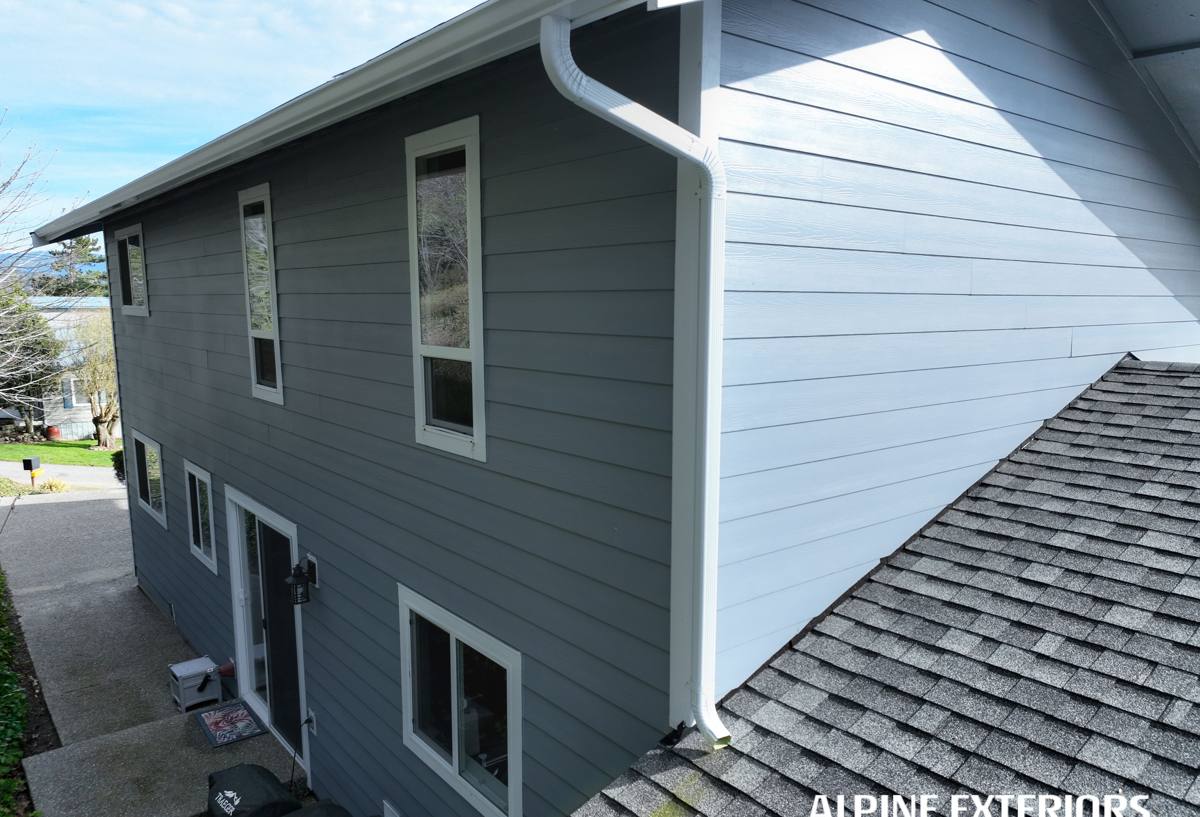
What Skagit County's Climate Does to a Roof Over Time
It helps to separate the specific stresses out, because each one points to a different part of a good roofing spec:
- Driving rain — wind-driven rain off the Sound doesn't just fall straight down; it gets pushed under lapped materials, which is why flashing detail and underlayment matter more here than in drier climates.
- Salt-tinged, moisture-heavy air — even away from the immediate waterfront, the marine air mass that sits over Skagit County carries enough salt and humidity to accelerate corrosion on unprotected metal fasteners and untreated flashing.
- Long moss season — shaded, north-facing slopes and roofs under fir and cedar cover stay damp for months at a stretch, which is exactly what moss and moss-related algae need to take hold.
- Freeze-thaw cycling — Sedro-Woolley's proximity to the foothills means occasional hard frosts and wet snow, which stresses any roofing material that can trap or absorb moisture.
None of these are exotic problems, but they compound. A roof that's marginal in a drier part of the state can fail years early here simply from being wet more often, for longer, with less drying time between storms.
Why Metal Holds Up Better in This Environment
Metal roofing isn't immune to Skagit County's weather, but it responds to it differently than asphalt shingles or wood shakes:
Moss and moisture
Metal's smooth, non-porous surface gives moss spores far less to grip than the granulated texture of asphalt shingles or the rough grain of cedar shakes. Moss can still grow in seams, valleys, and anywhere debris collects, but it doesn't root into the material itself the way it can work into shingle granules or shake fibers over time.
Rain shedding
A properly installed metal roof — whether standing seam or a well-lapped panel system — sheds water fast and doesn't rely on layers of overlapping tabs that can wick water sideways under wind pressure. That matters directly for the driving-rain pattern common to this part of the county.
Longevity under repeated wetting
Asphalt shingles lose their protective granules and dry out over decades of UV and moisture cycling. Metal doesn't degrade the same way — the failure points to watch are coating wear, fastener corrosion, and sealant life at penetrations, all of which are maintainable rather than material-wide replacements.
Metal Roofing Systems We Install
"Metal roofing" isn't one product — the system you choose changes cost, appearance, and long-term maintenance. Here's how the main options compare for a Sedro-Woolley home:
| System | How It's Fastened | Typical Look | Best Fit |
|---|---|---|---|
| Standing seam | Concealed clips, no exposed fasteners on the field | Clean vertical panel lines | Homes wanting the longest maintenance-free stretch; most resistant to wind-driven rain intrusion |
| Exposed-fastener panel (screw-down) | Screws through the panel face with rubber-washer seals | Ribbed, agricultural-style panel | Lower upfront cost; requires fastener inspection and washer replacement over time |
| Stone-coated steel | Interlocking panels, often shingle- or shake-profile | Mimics shingle or shake appearance | Homeowners who want a traditional look with metal's underlying durability |
We don't push one system on every roof. Roof pitch, existing structure, attic ventilation, and how much of the roof is shaded all factor into which system makes sense for a given house.
A note on why we're selective about panel gauge and coating
Not every "metal roof" quoted at a low price is built to the same standard. Thinner-gauge panels and bargain coatings can oil-can (show visible waviness), corrode faster at cut edges, and fail sooner at fastener points — especially in a climate with this much sustained moisture. Our standard is to spec panel gauge and coating based on what actually holds up here, not the cheapest option that technically qualifies as "metal roofing." That's a maintenance and warranty decision on our part, not a knock on every lower-cost product — it's just not what we're willing to put our name behind in this climate.
What a Correct Installation Actually Involves
Metal roofing fails early almost exclusively because of installation mistakes, not because the material itself gave out. The details that matter most in a wet, moss-prone climate like Sedro-Woolley's:
- Deck inspection and repair — any soft, rotted, or previously water-damaged decking gets addressed before a single panel goes down. Metal over a compromised deck just hides a problem.
- Underlayment — a high-temperature, self-adhering or synthetic underlayment rated for metal roofing, with extra protection at valleys and eaves where wind-driven rain concentrates.
- Ice-and-water protection at vulnerable points — valleys, eaves, and low-slope transitions get additional membrane protection, since these are where standing water and wind-driven rain do the most damage.
- Flashing at every penetration — chimneys, vents, skylights, and wall intersections need custom-formed flashing, not generic trim pieces caulked into place. Caulk is a backup, not a flashing strategy.
- Proper fastening pattern — correct fastener spacing and torque so panels can expand and contract with temperature swings without working loose or oil-canning.
- Attic ventilation — metal roofing performs best over a properly ventilated attic; trapped moisture underneath the deck causes problems no matter what's on top of it.
Skipping any one of these doesn't show up on day one. It shows up as a leak two winters later, once the underlayment has been sitting under standing water at a valley, or once a poorly flashed penetration has let moisture into the deck.
Our Process, Start to Finish
We keep the process straightforward because most homeowners are dealing with a roof for the first time in years, if not ever:
- On-site assessment — we walk the roof (not just the ground), check the deck condition where accessible, note ventilation, moss buildup, and any existing damage.
- Written estimate — a clear scope covering material system, underlayment, flashing detail, and cleanup, so there's no guessing what's included.
- Material order and scheduling — we work around Skagit County's weather windows rather than rushing an install between storm systems.
- Tear-off or overlay decision — we'll tell you honestly whether your existing roof can be built over or needs to come off first; this depends on deck condition and local code, not on what's easiest for us.
- Installation — deck repair, underlayment, flashing, panels, and trim, in that order, with attention to the details above.
- Final walkthrough and cleanup — magnetic sweep for stray fasteners, debris hauled off, and a walkthrough so you know what maintenance, if any, to expect going forward.
Maintenance: What Metal Roofing Still Needs
Metal roofing is lower-maintenance than shingles or shakes, not maintenance-free. In Sedro-Woolley's climate, the realistic upkeep looks like this:
- Clearing needles, leaves, and debris from valleys and gutters at least once a year, more often on heavily treed lots.
- Rinsing off moss growth in shaded areas before it builds up enough to hold moisture against the panel or trim.
- Checking exposed fasteners on screw-down panel systems every few years, since rubber washers do have a service life shorter than the steel itself.
- Watching for scratches or coating damage after storms or falling branches, and touching those up before bare metal is exposed to the weather.
None of this compares to the granule loss, moss rooting, and periodic full replacement cycle that asphalt shingles need in this climate, but "low maintenance" shouldn't be sold as "no maintenance."
Cost Factors on a Sedro-Woolley Metal Roof
We won't quote a number without seeing the roof, but the honest cost drivers are consistent from job to job:
| Factor | Why It Affects Cost |
|---|---|
| Roof pitch and complexity | Steep, cut-up rooflines with multiple valleys and dormers take longer to flash correctly and use more material. |
| System type | Standing seam runs higher than exposed-fastener panel due to labor and concealed-clip material; stone-coated steel falls in between. |
| Tear-off vs. overlay | Removing an old roof adds labor and disposal cost but is often the right call when the deck needs inspection or repair. |
| Deck condition | Rot or soft decking found during tear-off means repair cost that can't always be predicted before the old roofing comes off. |
| Access and site conditions | Steep lots, mature tree cover, and limited staging space — common around Sedro-Woolley — can add time to a job. |
Broadly, metal roofing costs more upfront than asphalt shingles, but the gap narrows when you factor in how many shingle roofs in this climate need earlier replacement or repeated moss and moisture-related repairs.
Signs Your Current Roof Needs a Closer Look
Whether you're leaning toward metal or just trying to figure out where you stand, these are worth checking or having a contractor check:
- Moss buildup thick enough to hold visible moisture, especially on north-facing slopes or under tree cover
- Granule loss showing up in gutters or downspouts
- Curling, cracked, or lifted shingle tabs, particularly after wind events
- Rust staining or streaking at flashing points, vents, or chimney penetrations
- Any interior ceiling staining, especially after a heavy rain event
- Visible sagging along the roofline or in valleys
Catching these early is almost always cheaper than waiting for an active leak, especially with how much standing moisture Skagit County winters can put on a roof.
Why Local Experience in Sedro-Woolley Matters
A lot of roofing problems in this area aren't material failures — they're specification failures, where a crew used a system or detail that works fine in a drier climate but wasn't built for this much sustained moisture and moss pressure. A contractor who works Skagit County regularly already knows which valleys collect debris fastest, which neighborhoods sit under enough tree cover to need extra moss-resistant detailing, and how local permitting and inspection works for tear-offs and re-roofs. That local pattern recognition is hard to replace with a generic spec sheet, and it's the difference between a roof that's still performing in twenty years and one that needed attention in five.
If you're weighing metal roofing for a home in Sedro-Woolley, we're glad to walk the roof, talk through what your specific structure and site actually need, and give you a straightforward estimate — no pressure, no upsell, just an honest look at what makes sense for your house.