 Skagit County
 Storm Damage Roof Repair Built for March Point's Weather
March Point sits out on the water, exposed on multiple sides to wind and weather coming off Similk Bay and the Salish Sea. That exposure means roofs here take a different kind of beating than roofs a few miles inland in Mount Vernon or Burlington. Wind-driven rain finds every weak seam. Salt-laden air accelerates corrosion on flashing, fasteners, and gutters. And the mild, wet Skagit County winters keep moss and moisture working on the roof deck almost year-round. Storm damage repair out here isn't just patching a hole — it's understanding why that spot failed in the first place and fixing the actual cause.
We work on homes throughout Skagit County, and March Point roofs consistently show a specific pattern of wear: fastener backout and flashing lift on the windward side, moss buildup and granule loss on north-facing slopes that stay shaded and damp longer, and gutter systems overwhelmed during heavy rain events. A generic repair that ignores that pattern tends to fail again within a season or two.
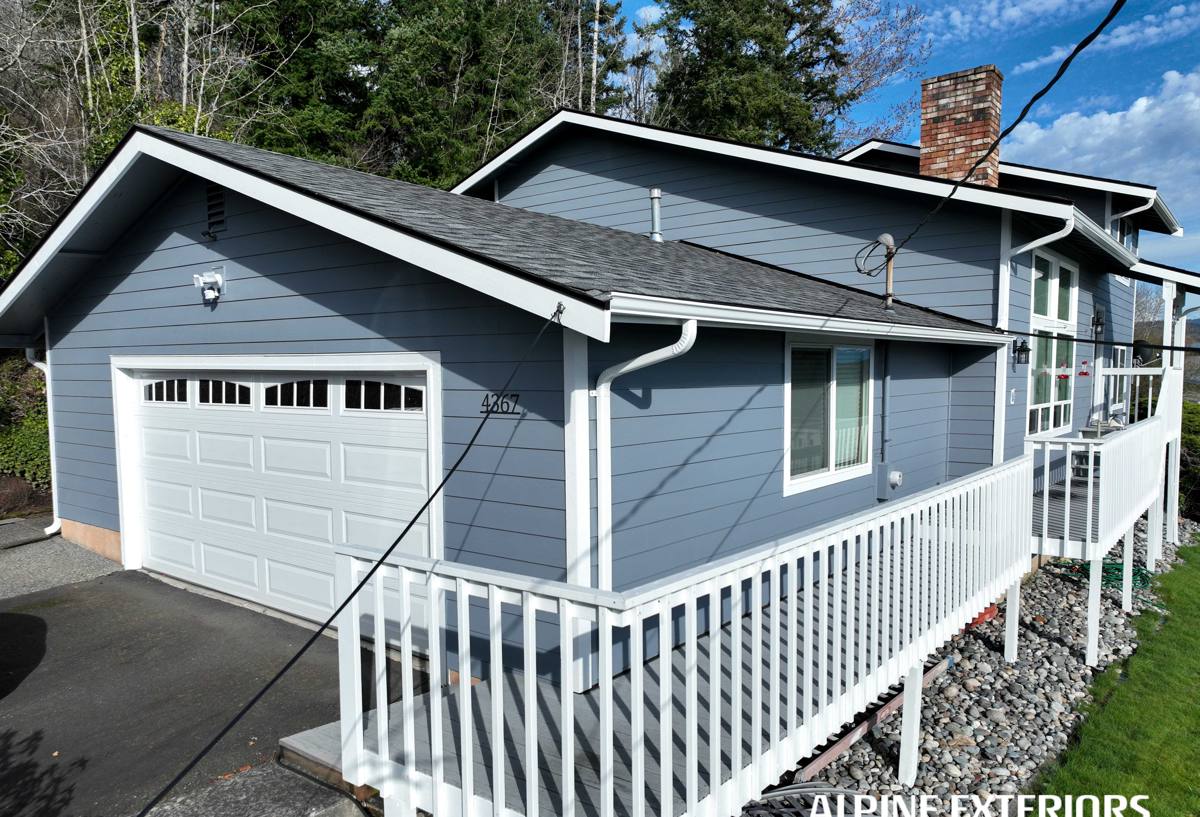
What a Storm Actually Does to a March Point Roof
Wind and Driving Rain
Wind off the water doesn't just push rain sideways — it gets up under shingle tabs, ridge caps, and flashing edges that were sealed for normal weather, not sustained gusts. Once a seal is broken, wind-driven rain pushes water uphill under the roofing material instead of running off it, which is how a small missing shingle turns into a soaked attic deck weeks later.
Salt Air and Metal Fatigue
Homes closer to the shoreline see faster corrosion on exposed metal — flashing, fasteners, gutter hangers, and vent boots. Corroded fasteners lose their grip on the decking, and corroded flashing develops pinholes that leak long before they look obviously "broken" from the ground.
Moss and Prolonged Moisture
Skagit County's long wet season gives moss plenty of time to establish, especially on shaded, north-facing, or tree-covered slopes common around March Point properties. Moss holds moisture against the shingle surface, lifts tabs as it grows under the edges, and traps organic debris that clogs valleys and gutters — all of which sets up future storm damage even on a calm day.
Signs You Have Storm Damage That Needs Attention
- Missing, cracked, or curled shingles after a wind event
- Granules collecting in gutters or at downspout outlets
- Water stains on interior ceilings, especially near exterior walls or chimneys
- Lifted or visibly loose flashing around vents, skylights, or the chimney
- Sagging or soft-feeling sections of roof deck
- Moss mats thicker than an inch, or moss growing under shingle tabs rather than just on top
- Gutters pulling away from the fascia or overflowing during heavy rain
- Daylight visible through the roof deck from inside the attic
Any one of these on its own might not be an emergency, but after a storm they're worth a professional look before the next system rolls through — which in this part of Skagit County can be days, not weeks.
Our Storm Damage Assessment Process
We don't start with a repair quote — we start with an honest look at what's actually happening on the roof.
1. Exterior and Attic Inspection
We walk the roof surface and check the attic from inside when access allows. Water stains, damp insulation, and daylight gaps often tell us more than what's visible from the ground or a ladder.
2. Documenting the Damage
We photograph and note the specific failure points — lifted flashing, missing shingles, corroded fasteners, moss intrusion — so you have a clear record if you're filing an insurance claim.
3. Distinguishing Storm Damage from Wear
Insurance covers sudden storm damage, not gradual deterioration. Part of our job is being straight with you about which is which — a roof near the end of its service life that also took storm damage usually needs a broader conversation than a single-point repair.
4. A Written Scope, Not a Guess
You get a written explanation of what's damaged, what's causing it, and what fixing it correctly involves — not just a number.
What a Correct Repair Actually Involves
A storm repair on a March Point roof needs to account for the same wind and salt exposure that caused the damage, or it's just a temporary patch.
| Repair Element | Why It Matters Here |
|---|---|
| Fastener replacement, not just resealing | Salt air corrodes standard fasteners faster; replacing with corrosion-resistant fasteners in the repair area extends the fix's life |
| Flashing re-set with fresh sealant | Wind lifts flashing edges; a proper repair re-seats and re-seals rather than just caulking over a gap |
| Matching shingle course, not a mismatched patch | A patch that doesn't tie into the existing shingle pattern creates a new water entry point |
| Underlayment check beneath the repair area | If wind-driven rain got past the shingles, the underlayment and deck underneath may already be wet or damaged |
| Moss and debris clearing before repair | Repairing over trapped moisture just seals the problem in |
| Gutter and drainage check | A roof repair holds up better when water is actually leaving the roof instead of backing up against it |
Repair, Partial Re-Roof, or Full Replacement?
Not every storm-damaged roof needs the same scope of work. Here's how we think through it:
- Spot repair — isolated damage (one lifted section of flashing, a small area of missing shingles) on an otherwise sound, reasonably young roof.
- Partial re-roof — damage concentrated on one slope, or a roof old enough that patching one area just means the next storm hits a different weak spot nearby.
- Full replacement — widespread granule loss, multiple leak points, or a roof deck showing soft spots in more than one area — signs the underlying material has reached the end of its useful life, storm or no storm.
We'll tell you honestly which category your roof falls into. Recommending a full replacement for a roof that only needs a repair doesn't serve you, and neither does patching a roof that's going to need real work again in a year.
Working With Your Insurance Claim
Most homeowners dealing with storm damage are also dealing with an insurance adjuster for the first time in a while. A few things that help the process go smoother:
- Document the damage as soon as it's safe to do so, before any cleanup
- Keep our written scope and photos alongside your own — adjusters respond well to specific, documented findings
- Understand the difference between a covered "sudden event" and excluded "wear and deterioration" before the adjuster's visit, so there are no surprises
- Ask questions if the adjuster's scope doesn't match what we found on the roof — it's not unusual for a first estimate to miss something
We're glad to walk a roof with an adjuster or provide additional documentation if it helps your claim move faster. We don't manage the claim for you, but we make sure the roof itself is represented accurately.
Preventing the Next Round of Storm Damage
Once the immediate repair is done, a few habits keep March Point roofs ahead of the next storm season instead of catching up to it:
- Clean gutters and valleys before the fall storm season starts, not after the first big rain
- Have moss treated and removed before it establishes under shingle tabs, not just scraped off the surface
- Check flashing and fasteners annually, since salt-air corrosion doesn't announce itself until it's already caused a leak
- Trim overhanging branches that hold moisture against the roof or drop debris into valleys and gutters
- Get a post-storm look after any significant wind event, even if nothing looks obviously wrong from the ground
Why a Crew That Already Works March Point Matters
March Point's exposure isn't the same as a sheltered inland lot, and a repair approach that works fine in a calmer part of Skagit County can fall short here. Knowing which slopes take the worst of the wind, how fast salt air corrodes exposed metal in this specific location, and how aggressively moss establishes on shaded roofs in this microclimate all come from having done the work here before — not from a generic storm-repair checklist. That local familiarity is what keeps a repair from becoming a repeat visit.
If a recent storm has left your March Point roof with missing shingles, lifted flashing, or a leak you can't quite trace, we're happy to take a look and give you a straight assessment — no pressure, no inflated scope. Fill out the form below to request a free estimate.