 Skagit County
 Why Skyline Roofs Wear Differently Than Roofs Inland
Skyline sits in a stretch of Skagit County where the roof over your head deals with three things at once: salt-laden air moving off the water, long stretches of driving rain, and a moss season that can run most of the year. None of these three problems is unusual on its own for Western Washington. What makes Skyline roofs age the way they do is all three hitting the same shingles, year after year, with very little dry-out time in between.
Salt air accelerates corrosion on exposed metal — nail heads, flashing edges, vent housings — long before most homeowners notice a leak. Driving rain, especially when it comes in at an angle during a windstorm, finds every weak lap, every under-driven nail, every place where flashing was cut short. And moss doesn't just sit there looking bad; it holds moisture against the shingle surface, works its way under tabs, and lifts granules that are supposed to protect the asphalt mat underneath. A roof that would last 25+ years in a drier climate can start showing real problems well before that out here if it wasn't built for these conditions from day one.
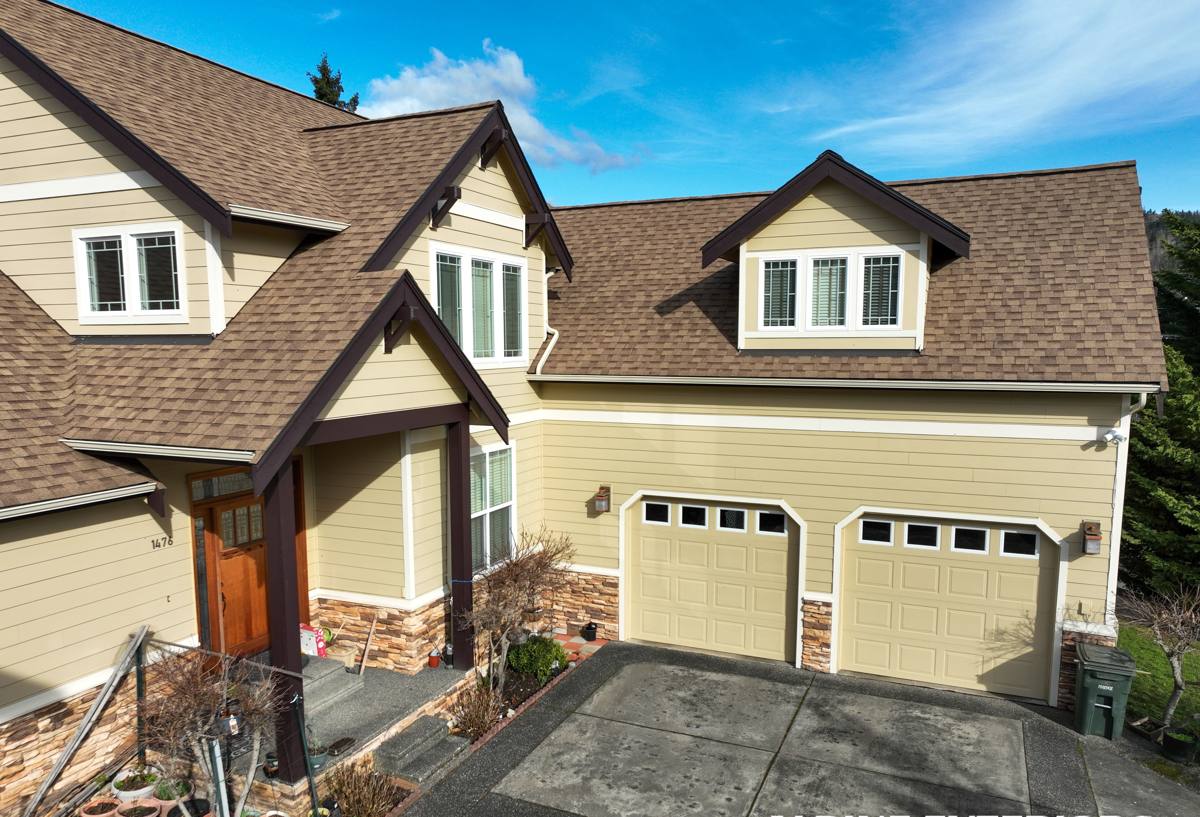
What a Correct Asphalt Shingle Job Actually Involves
A shingle roof is a system, not a single product. Skipping or shortcutting any layer is how a roof that looks fine on installation day starts leaking two winters later. For a Skyline home, we treat every one of these as non-negotiable:
Underlayment
Synthetic underlayment, installed with proper overlap and fastened correctly, is your backup layer if wind-driven rain ever gets past the shingles themselves. In a climate this wet, we don't treat underlayment as an afterthought — it's sized and lapped for the amount of sideways rain this area actually sees.
Ice and water barrier at vulnerable points
Even without heavy snow, eaves, valleys, and roof penetrations benefit from self-adhering membrane in this climate. Valleys collect the most water volume on any roof, and eaves are where ice and cold rain can back up under shingles during a cold snap.
Flashing
Chimneys, skylights, sidewalls, and any roof-to-wall transition need step flashing and counterflashing done correctly — not caulked over as a substitute for proper metal work. Caulk fails; correctly lapped flashing doesn't rely on a sealant staying intact for 20 years.
Nailing pattern and fastening
Manufacturer-specified nailing patterns exist for a reason, especially for wind resistance. Under-nailed or overdriven shingles are one of the most common causes of premature blow-off, and it's invisible from the ground until a windstorm proves it wrong.
Ventilation
Balanced intake and exhaust ventilation keeps moisture from building up in the attic space, which matters as much for the underside of your roof deck as the shingles do for the top side. We'll cover this in more detail below because it's one of the most overlooked parts of a roofing job.
Choosing the Right Shingle for This Climate
Not every asphalt shingle product is built the same way, and the differences matter more here than in a drier part of the state. The table below is a general guide — actual pricing depends on your roof's size, pitch, and complexity, and we'll give you real numbers after a look at your roof.
| Shingle Tier | Typical Lifespan | Wind Rating | Best Fit for Skyline |
|---|---|---|---|
| 3-Tab (economy) | 15–20 years | Lower | Budget-driven projects; less margin against wind and moss over time |
| Architectural / Dimensional | 25–30 years | Moderate to high | Most common choice locally — good balance of durability and cost |
| Premium / Algae-Resistant Lines | 30+ years | High | Best long-term value where moss and algae pressure is heavy, like Skyline |
For most Skyline homes, we steer people toward architectural shingles with algae-resistant (AR) granules at minimum. The AR coating uses copper-containing granules that discourage algae growth, which directly addresses the black streaking and moss-friendly buildup this climate produces. It doesn't make a roof moss-proof, but it meaningfully slows the problem compared to standard granules.
We also pay attention to a shingle's wind rating, not just its warranty length. A roof with a long warranty but a mediocre wind rating is a poor match for a place that gets real winter windstorms off the water.
Moss, Algae, and Salt Air: What Actually Works
Moss and black algae streaking are the two complaints we hear most from Skyline homeowners, and they call for different responses.
Moss grows where moisture sits — usually on the shaded, north-facing slopes and anywhere debris collects, like valleys and behind chimneys. The real fix is prevention: keep gutters and valleys clear, trim back overhanging branches that keep a section of roof shaded and damp, and consider zinc or copper strips near the ridge on moss-prone slopes. Rain washing over these metals releases trace amounts that discourage regrowth over time. What we don't recommend is aggressive pressure washing — it strips granules and shortens the life of the shingle faster than the moss itself would.
Algae streaking is a different organism entirely and shows up as dark staining rather than raised growth. AR shingles are the best long-term answer since the copper granules work continuously. On an existing roof, a gentle low-pressure wash with the correct cleaning solution can improve appearance, but it's cosmetic — it won't extend the roof's life the way starting with the right shingle does.
Salt air's damage is mostly to metal, not the shingle mat itself. This is why we pay close attention to flashing material and fastener choice on roofs this close to open water — cheaper coated fasteners corrode faster here than they would even ten miles inland.
Ventilation: The Part of the Roof You Don't See
A shingle roof with poor attic ventilation traps moisture underneath the roof deck, which can rot sheathing, void shingle warranties, and — ironically — make moss and algae problems worse from the inside out as trapped humidity works its way to the surface. Balanced ventilation means intake at the eaves (through soffit vents) and exhaust at or near the ridge, sized to move air through the attic space rather than just poking a few vents in without a real system.
When we replace a roof, we check the existing ventilation as part of the job, not as an upsell afterward. If your current attic is under-vented, we'll tell you plainly what that's costing you in shingle life and what it would take to fix it.
Signs Your Skyline Roof Needs Attention Now
Most roof failures don't happen suddenly — there's usually a warning period first. Here's what we tell homeowners to watch for between inspections:
- Granules collecting in gutters or at downspout outlets (a sign the shingle surface is wearing)
- Dark streaking on north-facing or shaded slopes
- Visible moss growth, especially thick moss at ridges or valleys
- Curling, cupping, or cracked shingle tabs
- Soft spots or sagging when viewed from the ground or attic
- Daylight visible through the roof deck from inside the attic
- Water stains on interior ceilings or in the attic near penetrations
- Missing or lifted shingles after a windstorm
Any one of these on its own might just mean a repair. Several at once, or a roof approaching 20+ years old, usually means it's time for a real conversation about replacement versus continuing to patch.
Our Process, Start to Finish
- On-site assessment. We look at the whole system — shingles, flashing, ventilation, deck condition — not just the parts that are obviously failing.
- Straight recommendation. Repair, partial replacement, or full replacement — we'll tell you which one actually makes sense for your roof's age and condition, not just sell the biggest job.
- Written estimate. Clear scope, materials, and pricing before any work starts. No surprise change orders for things we should have caught during the assessment.
- Tear-off and deck inspection. Once the old roof is off, we check the sheathing underneath for rot or soft spots before anything new goes down.
- Underlayment, flashing, and ventilation installed correctly. This is where most of a roof's real lifespan is decided.
- Shingle installation to manufacturer spec. Correct nailing pattern, correct exposure, correct starter and ridge detail.
- Cleanup and magnetic sweep. Job site and yard cleared of debris and stray fasteners.
- Final walkthrough. We go over the finished roof and the warranty coverage with you directly.
Why a Crew That Already Works Skyline Matters
Roofing knowledge that works fine in a dry climate doesn't automatically transfer here. A crew that regularly works Skyline and the surrounding parts of Skagit County already knows which slopes hold moss the longest, how much wind-driven rain to design flashing details for, and which fastener and flashing materials actually hold up against salt air over time instead of just on paper. That's not something you can fully judge from a brochure — it comes from doing the work in this specific climate, repeatedly, and seeing which choices held up years later and which ones didn't.
It also means straightforward answers about local permitting and code requirements when a project needs them, instead of guessing based on rules from somewhere else. When you're comparing contractors, ask directly how many roofs they've done in this area and what they'd do differently here versus a drier region — the answer tells you a lot.
Get a Straight Answer About Your Roof
If your Skyline home's roof is showing moss, granule loss, staining, or is simply getting old, we're happy to take a look and give you an honest read on where it stands — repair, partial fix, or full replacement — with no pressure either way. Reach out below for a free estimate.