 Skagit County
 Why March Point's Climate Is Hard on an Asphalt Shingle Roof
March Point sits close to the water, and that changes what a roof has to deal with compared to a house even a few miles inland. Salt-laden air moves across the peninsula regularly, and over years that airborne salt accelerates the breakdown of metal flashing, fasteners, and exposed granule surfaces on lower-grade shingles. Add in the long stretch of wet months that Skagit County sees every fall through spring, and you've got two separate problems working on the same roof at once: corrosion from the air and saturation from the rain.
Then there's moss. The combination of shade from mature trees, persistent moisture, and mild temperatures gives moss and algae a long growing season here — longer than most of the drier parts of Washington. Moss doesn't just look bad. It holds water against the shingle surface, works its way under tab edges, and lifts shingles enough that wind-driven rain can get underneath. On a roof that isn't installed or maintained with that in mind, moss is usually the first visible sign that something underneath is already staying wet longer than it should.
None of this means asphalt shingles are a poor choice for March Point — they're still one of the most practical, cost-effective roofing materials available, and a huge share of homes in this part of Skagit County are shingled for good reason. It means the installation details matter more here than they would in a milder climate, and cutting corners on underlayment, ventilation, or flashing shows up faster on a property exposed to salt air and driving rain.
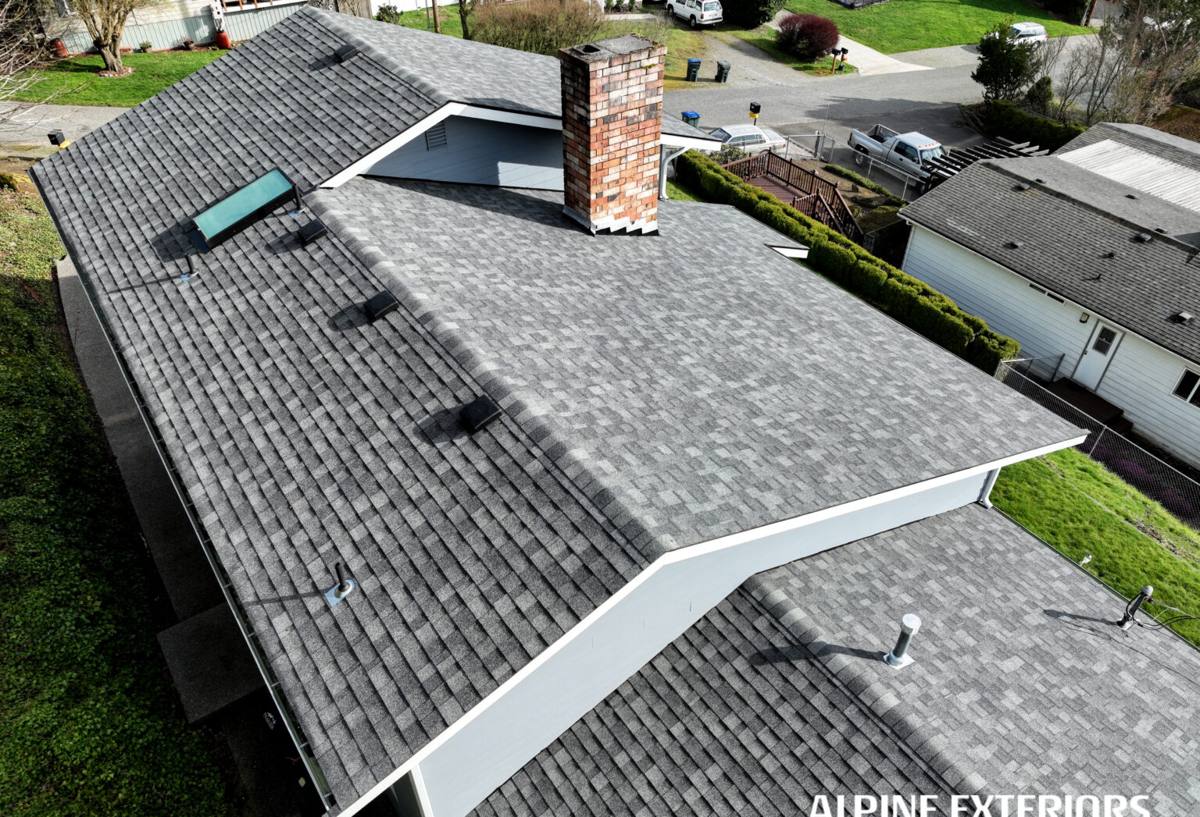
What a Correct Asphalt Shingle Roof Installation Actually Involves
Tear-Off and Deck Inspection
A roof is only as good as what's underneath it. We remove the old roofing down to the deck rather than layering over existing shingles, because that's the only way to actually see the condition of the sheathing. Any soft, delaminated, or water-stained decking gets replaced before anything new goes down — installing new shingles over a compromised deck just hides the problem for another few years.
Underlayment and Ice-and-Water Barrier
In a high-moisture area like this, underlayment choice isn't a place to save money. We use a synthetic underlayment across the full roof and install self-adhering ice-and-water membrane at the eaves, valleys, and any roof-to-wall transitions — the spots where wind-driven rain is most likely to find its way in during a hard Skagit County storm. This is standard practice for us on every shingle roof, not an upgrade.
Flashing
Flashing failure, not shingle failure, is the most common reason roofs leak. Around chimneys, skylights, dormers, and sidewalls, we install new metal flashing rather than reusing old pieces, and we favor corrosion-resistant materials given the salt exposure in this area. Step flashing at wall intersections and properly formed valley flashing matter more here than the shingle brand on top of them.
Shingle Installation
Nail placement, exposure, and pattern all affect wind resistance — asphalt shingles are only as wind-rated as the installation behind them. We follow manufacturer nailing specifications exactly, because it's what keeps the warranty valid and what actually keeps shingles attached during winter windstorms.
Choosing the Right Shingle for Salt Air and a Long Moss Season
Not every asphalt shingle product handles this climate the same way. The two decisions that matter most for a March Point roof are the shingle's algae resistance and its overall weight/thickness class.
| Shingle Feature | Why It Matters Here |
|---|---|
| Algae-resistant (copper/zinc-infused) granules | Slows the black streaking and moss/algae growth that this area's shade and moisture accelerate; standard granules have no defense against it |
| Architectural (laminated) vs. 3-tab | Architectural shingles are heavier and thicker, which generally means better wind performance and a longer service life in wet, breezy conditions |
| Manufacturer wind rating | Coastal-adjacent exposure means higher gusts more often; a higher wind rating, properly installed, reduces lifted or torn tabs |
| Warranty structure | Algae-resistance warranties and wind warranties are often separate from the base material warranty — worth reading closely before you decide |
We typically recommend algae-resistant architectural shingles for March Point homes, particularly on north-facing slopes or roofs shaded by trees, since those are the areas that hold moisture longest and green up first. It's a modest cost difference upfront that pays off in fewer moss treatments and a cleaner-looking roof for longer.
Ventilation and Moisture Control
A shingle roof doesn't just shed water from above — it also has to manage moisture from inside the attic. In a climate with this much ambient humidity, poor attic ventilation traps warm, moist air against the underside of the roof deck, which can cause condensation, premature sheathing rot, and ice-adjacent problems during cold snaps. It also shortens shingle life from underneath, which is easy to miss because the damage isn't visible from the ground.
We check and, where needed, correct intake ventilation (soffit vents) and exhaust ventilation (ridge vents) as part of a full roof replacement. Balanced ventilation is one of the most overlooked factors in how long a shingle roof actually lasts, and it costs far less to address during a re-roof than to retrofit later.
Our Process, Start to Finish
- On-site inspection and honest assessment of your current roof's condition, including deck, flashing, and ventilation
- Written estimate that spells out materials, scope, and any deck repair contingencies before work starts
- Protection of landscaping, siding, and gutters during tear-off
- Full tear-off to the deck, with sheathing repair as needed
- Ice-and-water barrier at vulnerable areas, synthetic underlayment across the field
- New flashing at all penetrations, valleys, and wall transitions
- Shingle installation to manufacturer nailing and exposure specifications
- Ventilation check and correction if intake/exhaust balance is off
- Full site cleanup, including a magnetic sweep for nails
- Final walkthrough so you can see the completed work before we call it done
Living With Your Roof: Moss and Maintenance After Installation
Even a well-installed, algae-resistant shingle roof benefits from some basic upkeep in a place with this much rain and shade. A few habits go a long way toward protecting the investment:
- Keep gutters clear so water isn't backing up under the eaves during heavy rain events
- Trim back overhanging branches to reduce shade and debris buildup, both of which feed moss growth
- Have moss gently removed (not pressure-washed, which strips granules) if it does establish, rather than letting it spread
- Schedule a periodic visual inspection after major windstorms to catch lifted or missing shingles early
- Address small leaks immediately — in this climate, a slow drip left over a winter can do real damage to decking and insulation
What a Shingle Roof Typically Costs, and What Changes the Number
Every roof is different, and a real number only comes from an on-site look at your specific roof — but the broad cost factors are the same for most March Point homes:
| Factor | How It Affects Cost |
|---|---|
| Roof size and number of facets | More square footage and more valleys/hips mean more labor and material |
| Deck condition | Rotted or soft sheathing found at tear-off adds repair cost not visible in an initial estimate |
| Shingle tier | Standard 3-tab, architectural, and premium algae-resistant lines each carry different material costs |
| Roof pitch and access | Steep or hard-to-access roofs require more safety equipment and time |
| Ventilation upgrades | Adding or correcting soffit and ridge venting is usually modest compared to the reroof itself, but it's a line item |
| Flashing scope | Chimneys, skylights, and multiple dormers each add flashing labor and material |
We'd rather walk your roof and give you real numbers than quote a range that doesn't mean much for your specific house. A written estimate should list out materials and scope clearly enough that you know exactly what you're paying for.
Why It Matters to Hire a Crew That Already Works in March Point
A roofing crew that works regularly in this part of Skagit County has already seen how salt air treats bare metal fasteners over five winters, which slopes in this area hold moss the longest, and how hard the wind actually gets during a real Pacific storm coming off the water. That's not something you can fully account for from a general roofing checklist — it comes from doing the work here repeatedly and paying attention to what holds up and what doesn't.
It also means being available if something comes up after the job is done. A local crew can get back out to your property quickly if a question comes up after a storm, rather than you waiting on a company with no regular presence in the area.
Get a Free, No-Pressure Estimate
If your March Point roof is showing moss, losing granules, or just getting old enough that you're wondering what shape it's really in underneath, we're happy to take a look. Fill out the form below for a free estimate — no pressure, just a straight assessment of what your roof needs and what it would take to do it right.