 Skagit County
 Why Alger's Climate Is Hard on Siding
Alger sits in a stretch of Skagit County where marine air off Samish Bay and Puget Sound meets thick evergreen tree cover and a lot of shade. That combination is rough on exterior building materials in three specific ways: salt-laden moisture that accelerates corrosion and finish breakdown, driving rain that gets pushed sideways into laps and seams during winter storms, and long stretches of low sun and dampness that let moss and algae take hold on north-facing walls and anything shaded by trees. Most siding failures we see out here aren't dramatic — they're slow. Paint chalks and peels earlier than it should. Seams stay damp for days at a time. Moss creeps up from the ground line or down from a shaded eave, and by the time it's visible, moisture has usually been working underneath it for a while.
None of that is unique to any one product, but it changes what "good siding" actually means for a home in this area. A material that performs fine in a drier climate can struggle here, and a decent product installed without the local climate in mind will still fail early.
What Alger's Conditions Mean for a Siding Choice
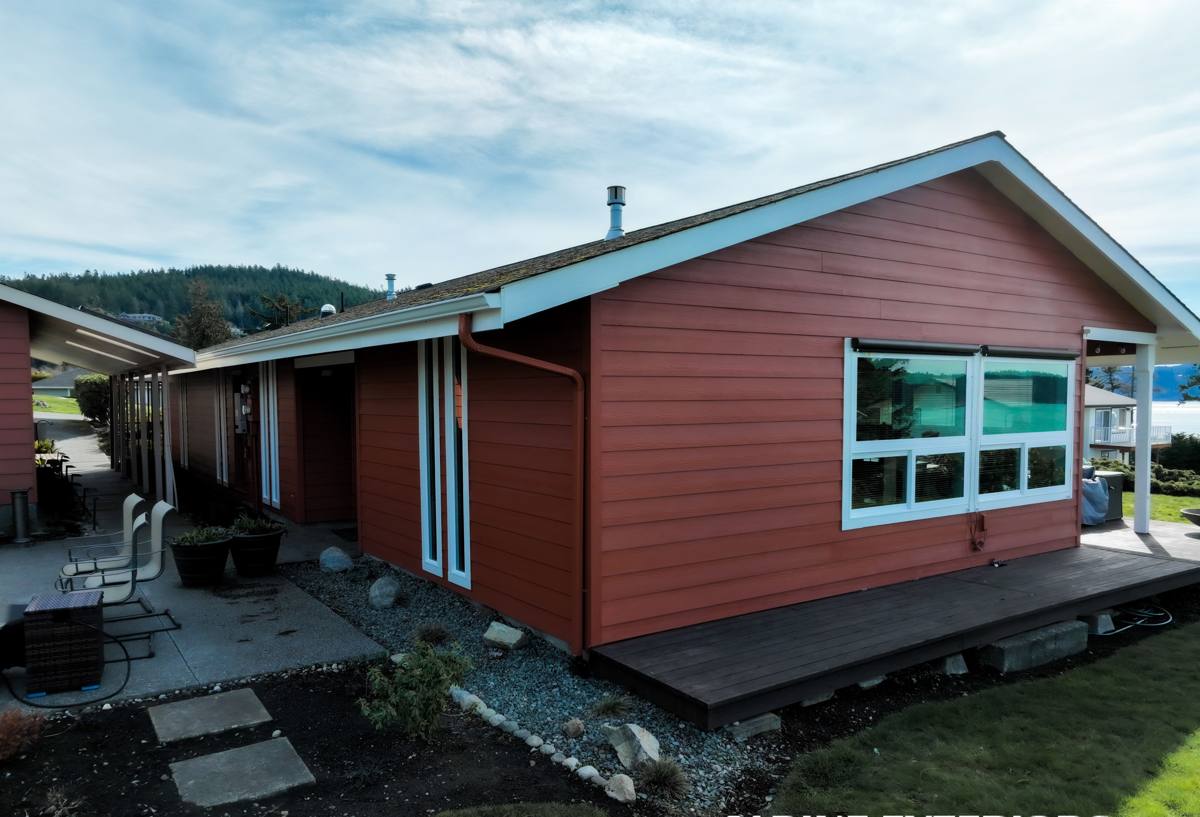
Three things matter more here than in a typical inland install: how the material handles repeated wetting and drying, how the finish holds up against salt air, and how resistant the surface is to moss and algae growth in shaded, damp spots. Wood-based products swell and shrink with moisture cycles, which stresses paint and joints over time. Vinyl doesn't rot, but it can't be painted to refresh a weathered finish, and it flexes and gaps in the wind-driven rain events that roll through this part of the county. Fiber cement, done right, handles moisture cycling without swelling and holds a factory finish far longer than field-applied paint.
| Factor | James Hardie Fiber Cement | Vinyl | Wood / Engineered Wood |
|---|---|---|---|
| Moisture swelling | Minimal — cement-based, dimensionally stable | None, but can warp/buckle from heat and wind | Swells and shrinks with wet/dry cycles |
| Finish life in salt air | Factory ColorPlus finish, warrantied against fade/peel | Color molded in, but chalks and fades over time | Field-applied paint, recoats needed every few years |
| Moss/algae resistance | Hard, dense surface resists growth, easy to clean | Can grow moss in shaded/damp panels | Porous surface holds moisture, moss-prone |
| Fire resistance | Non-combustible | Melts/deforms under heat | Combustible |
The James Hardie System We Install
We install James Hardie exclusively, and for Skagit County homes that generally means HardiePlank lap siding in a ColorPlus factory finish, sometimes paired with HardiePanel for accent areas or trim details. Hardie's HZ product line is engineered for regional moisture and temperature exposure rather than a one-size-fits-all formula, which matters in a county that sees both hard winter rain and drier summer stretches. The ColorPlus finish is baked on at the factory under controlled conditions, which is a meaningfully different process than brush- or spray-applied paint on site — it resists fading and chipping far longer, and it comes with its own finish warranty separate from the product warranty on the siding itself.
Why We Don't Install Alternatives
We get asked why we don't offer vinyl, LP SmartSide, or cedar as options. It comes down to what we're willing to warranty and stand behind. Vinyl can't be refinished when it fades and is vulnerable to wind damage in exposed, storm-facing walls. Engineered wood products carry moisture-sensitivity that requires strict field practices to avoid edge swelling, and any lapse in that process shows up years later as a callback we'd rather not have. Cedar and primed spruce look good on day one but need ongoing maintenance — recoating, caulking, moisture checks — that most homeowners don't sign up for and don't keep up with. Fiber cement, installed correctly, removes most of that maintenance burden and gives us a product we can confidently warranty for the long term.
What a Correct Install Looks Like on an Alger Home
James Hardie siding is only as good as the installation underneath it. In a wet climate zone like this one, a handful of details separate a job that lasts decades from one that causes problems in five years.
Moisture Management
- A weather-resistant barrier installed continuously behind the siding, with all seams properly lapped and taped
- Flashing at every window, door, and roof-to-wall transition — the most common point where driving rain finds its way behind siding
- Correct clearance between the bottom edge of siding and grade, decks, and roof lines, so water has somewhere to go instead of wicking upward
- Rainscreen or drainage gap furring where the wall assembly calls for it, giving trapped moisture a path to dry out
Fastening and Fit
Hardie siding needs to be fastened per the manufacturer's specification for the HZ zone it's rated for — nail placement, spacing, and depth all affect how the panel performs under wind load and moisture cycling. Butt joints need to be caulked or flashed correctly, not just pushed together. Corners and trim need consistent reveals, both for appearance and so water sheds the way the system is designed to shed it. This is where a lot of the difference between a mediocre installer and a careful one actually shows up — not in how the wall looks the day it's finished, but in how it performs after a few winters of Skagit County rain.
Our Process
- On-site assessment — we look at existing siding condition, sheathing, moisture barrier, and any trouble spots (shaded walls, low-clearance areas, past leak signs) specific to your home's exposure.
- Tear-off and inspection — once old siding is off, we check the sheathing underneath for rot or damage before anything new goes on. This step gets skipped by crews in a hurry, and it's the single biggest predictor of how the new siding will perform.
- Weather barrier and flashing — installed to spec before a single piece of Hardie siding goes up.
- Installation — HardiePlank, HardiePanel, and trim installed per manufacturer fastening and clearance requirements for our HZ zone.
- Final walkthrough — we go over the finished job with you, seam by seam, before calling it done.
Living With Hardie Siding in a Moss-Prone, Salt-Air Area
One advantage of fiber cement here is how little upkeep it actually needs compared to wood or repainted surfaces — but "little" isn't "none," especially on a shaded, damp lot.
- Rinse siding down once or twice a year, focusing on shaded north-facing walls and anywhere tree cover keeps the surface damp longer
- Keep gutters clear so overflow doesn't run down the face of the siding and feed moss growth at seams
- Trim back vegetation and tree branches that hold moisture against the wall or block airflow
- Watch caulked joints around windows and trim for cracking over time, and have them touched up before gaps let water behind the siding
- Address any moss or algae early with a gentle wash rather than letting it build up and hold moisture against the finish
Why Hiring a Crew That Already Works Alger Matters
Skagit County covers a lot of ground, from tighter coastal exposure near the water to more sheltered inland areas, and the right siding details shift depending on where a home sits. A crew that's already worked in and around Alger knows which walls typically take the worst of the driving rain, where moss tends to build up fastest, and how local permitting and inspection expectations run in the county. That familiarity shows up in fewer surprises during the job and a finished install that's set up for the specific conditions on your lot, not a generic spec sheet.
What Affects the Cost of a Hardie Siding Job
| Factor | Why It Matters |
|---|---|
| Home size and complexity | More corners, gables, and trim details mean more labor and material |
| Condition of existing sheathing | Rot or damage found during tear-off adds repair work before siding can go on |
| Siding profile and finish | Lap widths, panel styles, and ColorPlus color options vary in material cost |
| Accessibility | Tree cover, slope, and tight lot lines around Alger properties can affect staging and labor time |
| Trim and accent work | HardieTrim boards and accent panels add cost but improve durability at high-exposure edges |
We don't quote pricing without seeing the home — too many of these factors are specific to your walls, your exposure, and what's underneath the existing siding.
If you're weighing a siding replacement on an Alger property, we're happy to walk the exterior with you and give you a straight, no-pressure estimate — what your home needs, what it doesn't, and what a correct James Hardie install would involve. Use the form below to get started.