 Skagit County
 Windows in Edison Work Harder Than Windows Almost Anywhere Else in the County
Edison sits close enough to Samish Bay and the surrounding tidal flats that salt air is a constant, not an occasional visitor. Add in the driving rain that comes sideways off Puget Sound during fall and winter storms, and a moss season that can stretch from October well into spring, and you've got a set of conditions that will find every weakness in a window system. Old wood sashes swell and stick. Aluminum frames pit and corrode. Seals that were never rated for wind-driven rain let water in behind the trim instead of shedding it. None of this is dramatic — it's slow, and that's what makes it dangerous. By the time you can see rot or feel a draft, moisture has usually been working on the framing for a season or two already.
Custom windows done right in this part of Skagit County aren't about style upgrades first. They're about matching the window — frame material, glass package, flashing details, and installation method — to a climate that is wetter, saltier, and mossier than most manufacturers' standard specs assume.
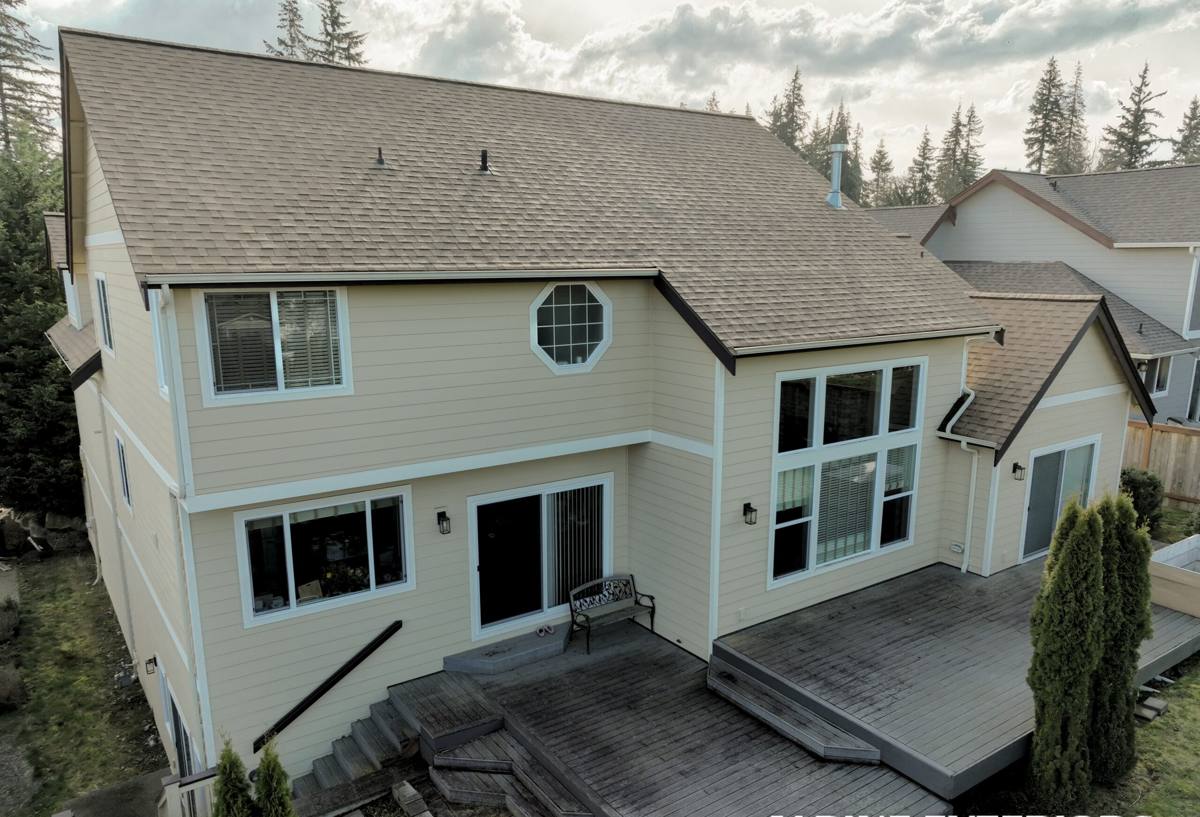
Signs Your Current Windows Are Losing That Fight
Homeowners in Edison usually call us for one of two reasons: they're renovating and want windows that fit an addition or a changed opening, or their existing windows are failing and they want to stop the bleeding before it turns into a bigger repair. Here's what tells us it's the second case.
- Condensation forming between the panes (a sign the seal has failed and the argon or air gap is gone)
- Soft or discolored wood at the sill or bottom corners of the frame
- Visible pitting, chalking, or white corrosion on aluminum frames
- Green or black growth on the exterior trim around the window, especially on north-facing walls
- Windows that are noticeably harder to open and close than they used to be
- Drafts you can feel with your hand along the frame edge on a windy day
- Paint that keeps failing in the same spot no matter how often it's touched up
Any one of these can be a minor fix. Two or three together, especially on a window that's original to the house, usually means the window itself — not just the caulk or the paint — is the problem.
What "Custom" Actually Means on a Job Like This
"Custom" doesn't mean expensive or fancy. It means the window is built to the actual opening and the actual wall assembly of your house, instead of forcing your house to fit a stock size. That matters more in Edison than in a lot of newer subdivisions because a good number of homes here are older farmhouses, converted outbuildings, or homes that have been added onto over the decades. Openings are rarely perfectly square, wall depths vary, and the original construction often predates modern flashing standards entirely.
Measuring for Reality, Not for the Catalog
We measure width and height in three places each (top, middle, bottom for height; left, middle, right for width) because older framing settles unevenly. We also check for square and for out-of-plumb walls, since a window that's dimensionally correct but installed into an out-of-square opening will bind, leak, or both.
Reading the Wall Behind the Trim
Before we order anything, we want to see what's actually happening at the rough opening — whether there's existing rot, whether the sheathing is sound, and what kind of weather-resistive barrier (if any) is already in place. On a coastal, high-moisture site like Edison, this step catches problems that would otherwise get sealed up behind a brand-new window and left to keep spreading.
Frame Material: What Actually Holds Up Here
There's no single "best" window frame material for every house — it depends on your budget, your home's style, and how much maintenance you're willing to keep up with. But in a salt-air, high-rain environment like Edison, some materials are a noticeably easier fit than others.
| Material | How It Handles Salt Air & Rain | Maintenance | Typical Fit |
|---|---|---|---|
| Vinyl | Won't corrode or rust; performs well with good seals | Low — occasional cleaning | Budget-conscious replacements, rentals, most home styles |
| Fiberglass | Excellent — dimensionally stable, resists moisture and salt corrosion | Low | Coastal-exposed walls, long-term durability priority |
| Wood-clad (wood interior, metal or vinyl exterior) | Good if cladding and flashing are done correctly; vulnerable where cladding is compromised | Moderate — watch cladding seams and interior wood | Historic or traditional-style homes wanting a wood look inside |
| Solid wood | Poor without diligent upkeep; salt air accelerates finish breakdown | High — regular refinishing | Restoration projects where authenticity matters more than low maintenance |
| Aluminum | Poor — prone to pitting and corrosion near salt air unless marine-grade and well-finished | Moderate to high | Generally not our first recommendation this close to the water |
Our default recommendation for most Edison homes is vinyl or fiberglass, simply because they take salt air and driving rain out of the maintenance equation almost entirely. If you're restoring a period home and want real wood on the interior, wood-clad is a reasonable middle ground — but we'll be upfront that it asks more of you over the years than vinyl or fiberglass will.
Glass Packages and Weatherproofing Details That Actually Matter
The frame gets most of the attention, but the glass package and the installation details around the window are where a lot of long-term performance is decided.
Glass
Double-pane, low-E glass with an argon fill is the standard baseline we recommend for this area — it cuts down on heat loss during our long wet winters and reduces UV fading. For rooms that take direct afternoon sun or face open exposure toward the water, we'll talk through upgraded coatings that manage solar heat gain without darkening the glass noticeably.
Flashing and Sealing
This is the part that decides whether a window leaks in five years or twenty. A correct install includes a sloped sill pan to direct any water that gets past the sash back outside instead of into the wall, self-adhered flashing tape integrated with the house wrap or building paper (not just caulk over the top), and a drainage path so incidental moisture has somewhere to go. In driving rain, water finds gaps that would never be a problem in calmer weather — the flashing detail is what stops it from becoming a wall problem.
Sealant Choice
We use exterior-grade sealants rated for the temperature swings and UV exposure of coastal Western Washington, not general-purpose caulk that chalks and cracks within a couple of seasons.
Our Process, Start to Finish
- On-site assessment — we look at existing windows, the wall assembly where accessible, and any signs of past moisture problems.
- Precise measurement — multiple points per opening, noting any out-of-square or out-of-plumb conditions.
- Material and glass selection — matched to the wall's exposure (a window facing open water or prevailing wind gets treated differently than a sheltered wall).
- Ordering and lead time — custom sizes take longer than stock; we'll give you a realistic timeline up front.
- Removal and opening prep — old window out, opening inspected and repaired if we find rot or compromised sheathing before anything new goes in.
- Flashing and sill pan installation — the moisture-management step that most callback problems trace back to when it's skipped.
- Window set, shimmed, and fastened — checked for square and level, not just tight to the opening.
- Insulation, interior and exterior trim, and final sealing.
- Walkthrough — we operate every window with you before we call the job done.
Local Realities: Edison's Older Housing Stock and Permitting
Edison's mix of farmhouses, older cottages, and converted structures means we regularly run into non-standard openings, balloon framing, or additions built in different decades with different methods. That's normal for this area, and it's exactly why we measure and inspect before ordering rather than assuming a stock size will work. Skagit County requires permits for window replacement in most cases where the opening size changes or structural work is involved; straightforward like-for-like replacements are often more straightforward, but we handle the permit question with you up front rather than after the fact, so there are no surprises mid-project.
Living With New Windows in a Moss-and-Salt Climate
Even the right materials benefit from a little upkeep. None of this is heavy work — it's the difference between windows that look and perform well at year fifteen versus year five.
- Rinse frames and sills a couple of times a year to clear salt residue, especially on walls facing open water or prevailing wind
- Keep gutters and downspouts clear so overflow isn't running down past window heads
- Check exterior caulk lines each fall before the wet season sets in
- Trim back vegetation or moss buildup on nearby siding and trim so it doesn't hold moisture against the window casing
- Operate every window at least a few times through the year so hardware and weatherstripping don't seize or compress permanently
What Custom Windows Typically Cost, and Why
Pricing depends on size, material, glass package, and how much prep or repair the opening needs — we won't quote a number without seeing the job. But here's what actually moves the price up or down.
| Cost Factor | Why It Matters |
|---|---|
| Frame material | Vinyl is typically the most budget-friendly; fiberglass and wood-clad cost more upfront but change the maintenance picture |
| Opening condition | Rot repair or reframing at the opening adds labor and material before the window ever goes in |
| Glass package | Upgraded low-E coatings or solar control glass add cost but reduce long-term energy loss |
| Non-standard sizing | Custom dimensions and shapes (arched, oversized, oddly proportioned) run higher than stock rectangular sizes |
| Number of openings | Doing a whole elevation or the whole house at once typically has better per-window economics than one-off replacements |
| Access and site conditions | Second-story work, tight setbacks, or limited equipment access add labor time |
As a rough range, straightforward vinyl replacements in an existing, sound opening tend to sit at the lower end of the market; fiberglass, wood-clad, larger custom shapes, or jobs that uncover rot repair push toward the higher end. We'll break down exactly where your project falls once we've seen the openings in person.
Why It Matters That We Already Work in Edison
A crew that mostly works inland or in drier parts of the county can still do competent work, but they're not necessarily thinking about salt exposure, wind-driven rain angles, or moss-holding surfaces as a matter of habit — they're solving for it as a special case. Working Edison and the surrounding Skagit County coastline regularly means those factors are just part of how we scope every job: which wall gets the harder glass package, where the flashing detail needs extra attention, which frame material we steer people away from. That's not a sales pitch — it's just what happens when a crew sees the same climate problems on repeat instead of once in a while.
If your windows are original to the house, showing early signs of wear, or you're planning a renovation that needs openings built to fit, we're happy to come take a look. There's no cost and no pressure to move forward — just a straightforward assessment and an honest read on what your home actually needs. Fill out the form below to schedule a free estimate.