 Skagit County
 Why Cedardale Decks Take a Different Kind of Beating
Cedardale sits close enough to the water that a deck here deals with a mix of stresses most inland Skagit County homes never see. There's the salt-laden air drifting in off the bay, the steady soaking rain that defines a Pacific Northwest fall and winter, and a moss and algae season that can run eight months or more depending on how much shade and moisture a given yard holds onto. Any one of those factors is manageable on its own. Together, they're what separates a deck that looks good for fifteen years from one that's warping, staining, or rotting out its frame in five.
Salt air accelerates corrosion on anything metal — fasteners, brackets, railing hardware — long before it does visible damage to the decking surface itself. Driving rain, especially the sideways kind that comes with winter storms off the water, gets pushed into gaps and seams that would stay dry in a calmer climate. And moss doesn't just look bad; it holds moisture against the board surface and turns a deck into a slip hazard by late fall. A composite deck built without accounting for all three of these will still show problems — they just show up as hardware failure, subsurface rot, or a slick green surface instead of splintering and graying like a poorly maintained wood deck would.
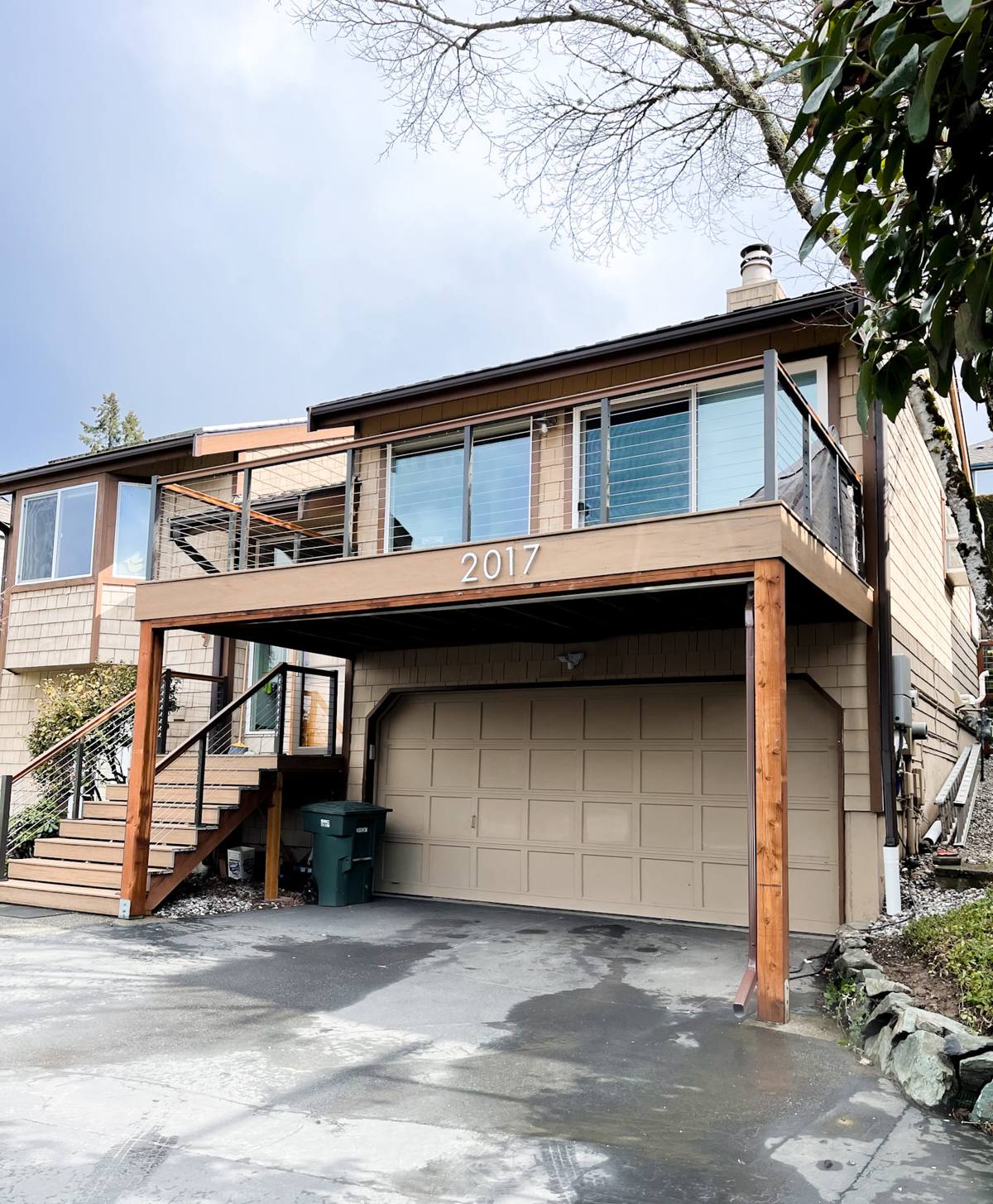
What "Correct" Composite Decking Actually Involves Here
Composite decking is often sold as a low-maintenance upgrade, and it is — but "low-maintenance" only holds true if the installation underneath it is right. The board itself is the least of the problems we see on decks that fail early in this area. It's almost always something in the substructure, the drainage path, or the hardware choice.
Drainage and Airflow Underneath the Deck
Composite boards don't rot, but the framing underneath them absolutely can if water has nowhere to go. In a climate that gets as much sustained rain as Skagit County, the space under a deck needs a clear path for water to run off and enough airflow to let everything dry between storms. That means correct joist spacing, gapping between boards that accounts for board expansion, and grading or drainage systems underneath low decks so water doesn't pool against ledger boards or posts.
Flashing at the House Connection
Where a deck ties into the house is the single most common failure point we find on any deck, composite or wood. Ledger board flashing has to shed water away from the siding and framing, not just sit there decoratively. On a home exposed to driving rain off the water, a poorly flashed ledger connection can be feeding moisture into the wall framing for years before anyone notices a soft spot or a stain inside.
Choosing the Right Composite Board for This Climate
Not all composite decking is built the same way, and the differences matter more here than they would in a drier inland climate. The two broad categories are capped composite, which has a protective polymer shell wrapped around a wood-plastic core, and uncapped composite, which is the core material exposed on all sides.
| Factor | Capped Composite | Uncapped Composite |
|---|---|---|
| Moisture resistance | Strong — shell blocks water absorption into the core | Weaker — core can absorb moisture over time |
| Staining/mildew resistance | Better surface resistance to algae and mildew staining | More prone to surface staining and moss growth |
| Fade resistance in coastal sun/salt exposure | Generally holds color longer | More likely to fade or chalk over time |
| Upfront cost | Higher material cost | Lower material cost |
| Long-term maintenance | Occasional washing | More frequent cleaning and sealing needed |
Given what Cedardale decks are up against — salt air, rain, and a long moss season — we generally steer homeowners toward capped composite for anything exposed to weather year-round. It costs more up front, but it holds up to the specific combination of moisture and organic growth this area produces better than uncapped product does. That's our professional judgment based on how these materials perform in the field here, not a knock on uncapped composite as a product category — it has its place in drier, more sheltered applications.
Color Choice Matters More Than People Expect
Darker composite boards absorb more heat, which can be a comfort issue on sunny days, but they also tend to show mineral and hard-water staining differently than lighter boards. Lighter and mid-tone colors tend to hide the kind of pollen, dust, and light algae film that builds up on a shaded, moisture-prone deck between cleanings. It's worth thinking about the specific spot on the property — full sun, shaded by trees, close to the ground — before locking in a color.
Substructure and Hardware: Where Salt Air Does Its Damage
The framing and fasteners under a composite deck do more work than most homeowners realize, and they're also where salt air causes the most trouble. Standard galvanized fasteners can corrode faster near the water than they would further inland, which is why we specify stainless steel or coated fasteners rated for coastal or high-moisture exposure on every composite deck we build in this area. The same goes for joist hangers, post bases, and any exposed structural hardware.
Hidden fastener systems, which clip composite boards to the joists from underneath rather than screwing through the face, give a cleaner look and eliminate a lot of the small gaps where face-screwed boards can trap moisture and grime. They're not required for a correct installation, but they're worth the added cost for homeowners who want the cleanest possible surface and the fewest places for algae to take hold.
Our Installation Process
Every composite deck project follows the same core sequence, adjusted for the specific site conditions at the property:
- On-site assessment of the existing structure (if replacing a deck) or the ground/foundation conditions for new construction
- Ledger flashing inspection or replacement where the deck ties into the house
- Framing built or verified to current code, sized for the specific composite product's span ratings
- Drainage and grading check underneath the deck to confirm water has somewhere to go
- Corrosion-resistant hardware installed throughout — fasteners, hangers, post bases
- Composite board installation with correct gapping for thermal expansion
- Railing, stair, and trim installation matching the composite system's engineered components
- Final walk-through covering maintenance expectations specific to this climate
We don't skip the framing and flashing steps to get to the visible decking faster. Those hidden steps are exactly what determines whether the deck is still solid in fifteen years or needs structural repair in five, and they're the parts a homeowner can't easily inspect themselves once the boards are down.
Permitting and Code Considerations
Deck construction in Skagit County is subject to permitting requirements tied to size, height, and structural attachment to the home, and those requirements get enforced. Knowing which projects need a permit, what inspectors in this area are specifically looking for on ledger attachment and footing depth, and how to design around setback or height restrictions on a given lot saves real time and rework. This is one of the clearest advantages of working with a crew that already pulls permits regularly in this county rather than one seeing local requirements for the first time on your project.
Living With Moss and Coastal Grime: Realistic Maintenance
Composite decking is genuinely lower maintenance than wood, but "low maintenance" in Cedardale still means dealing with moss season. Moss spores settle into any spot that stays damp and shaded, and a composite deck near trees or on the shaded side of a house will develop moss and algae film faster than one in open sun. The good news is that a correctly installed capped composite deck cleans up easily — it doesn't need staining, sealing, or sanding the way wood does.
A simple seasonal routine keeps a composite deck looking right through the wet months:
- Sweep debris and fallen leaves off regularly in fall so they don't trap moisture against the board surface
- Wash the deck surface with a soft-bristle brush and a manufacturer-approved composite deck cleaner once or twice a year, more often in shaded, moss-prone spots
- Avoid pressure washers on the highest settings — they can etch or damage the cap layer on composite boards
- Check that gaps between boards stay clear of packed debris so water keeps draining through rather than pooling on the surface
- Inspect railing posts and stair connections annually for any sign of loosening hardware, especially after a hard winter storm season
Cost Factors for a Cedardale Composite Deck
Every deck project is different, but the same handful of factors drive most of the cost variation we see on composite decks in this area:
| Factor | How It Affects Cost |
|---|---|
| Deck size and shape | Larger and multi-level decks require more material, framing, and labor hours |
| Board type (capped vs. uncapped) | Capped composite carries a higher material cost but lower long-term maintenance cost |
| Height and structural complexity | Taller decks or those requiring stairs, extra footings, or engineering add cost |
| Existing structure condition | Replacing decking over sound framing costs less than a full tear-down and rebuild |
| Railing system | Composite or metal railing systems cost more than basic wood rail but match the low-maintenance goal |
| Site access | Difficult access for equipment or material delivery can add labor time |
We don't quote a project without seeing the site, but as a general range, composite deck installation in this region typically runs from the low thousands for a small, simple replacement deck up to well into five figures for a large, multi-level deck with a full railing system and structural work. The only way to get a number that means anything for your specific property is a walk-through.
Why Hiring a Crew That Already Works Cedardale Matters
A deck built to a generic national spec sheet isn't necessarily built for this specific coastal stretch of Skagit County. A crew that already works in Cedardale and the surrounding area knows which fastener grades hold up against the salt air here, how the local permitting office wants ledger attachments documented, and which parts of a property tend to hold moisture longest based on tree cover and sun exposure. That local pattern recognition is the difference between a deck that gets built to code and one that's actually built to last in this exact environment.
It also matters for warranty support. Composite manufacturers have specific installation requirements — fastener type, gapping, ventilation — that have to be followed for the material warranty to hold. A crew that installs composite decking regularly in this climate knows those requirements cold and builds to them by habit, not by looking them up mid-project.
If you're weighing a composite deck for a Cedardale property, we're glad to walk the site, talk through board options for your specific exposure, and give you an honest, no-pressure estimate — just fill out the form below.