 Skagit County
 Why Anacortes Roofs Wear Differently Than Roofs Inland
Anacortes sits on Fidalgo Island, surrounded by saltwater on most sides, which puts every roof in town under a different kind of stress than a roof twenty miles inland in the Skagit Valley. Salt-laden air carries fine chloride particles that settle on any exposed metal — fasteners, flashing, gutters, panel edges — and accelerate corrosion in ways that don't show up for years but eventually show up everywhere. Add the region's driving rain, which comes in sideways off the water during winter storms, and you have a climate that punishes any roofing detail that relies on gravity alone to shed water. Then there's moss. Skagit County's long wet season and mild temperatures are close to ideal moss-growing conditions, and moss doesn't just look bad — it holds moisture against roofing surfaces and works into any seam or fastener that isn't sealed correctly.
None of this means metal roofing is a bad fit for Anacortes — it's actually one of the better long-term answers to these exact problems, if it's specified and installed correctly. The catch is that "correctly" means something different here than it does in a drier, inland climate, and a lot of roofing mistakes that would be minor elsewhere become expensive here.
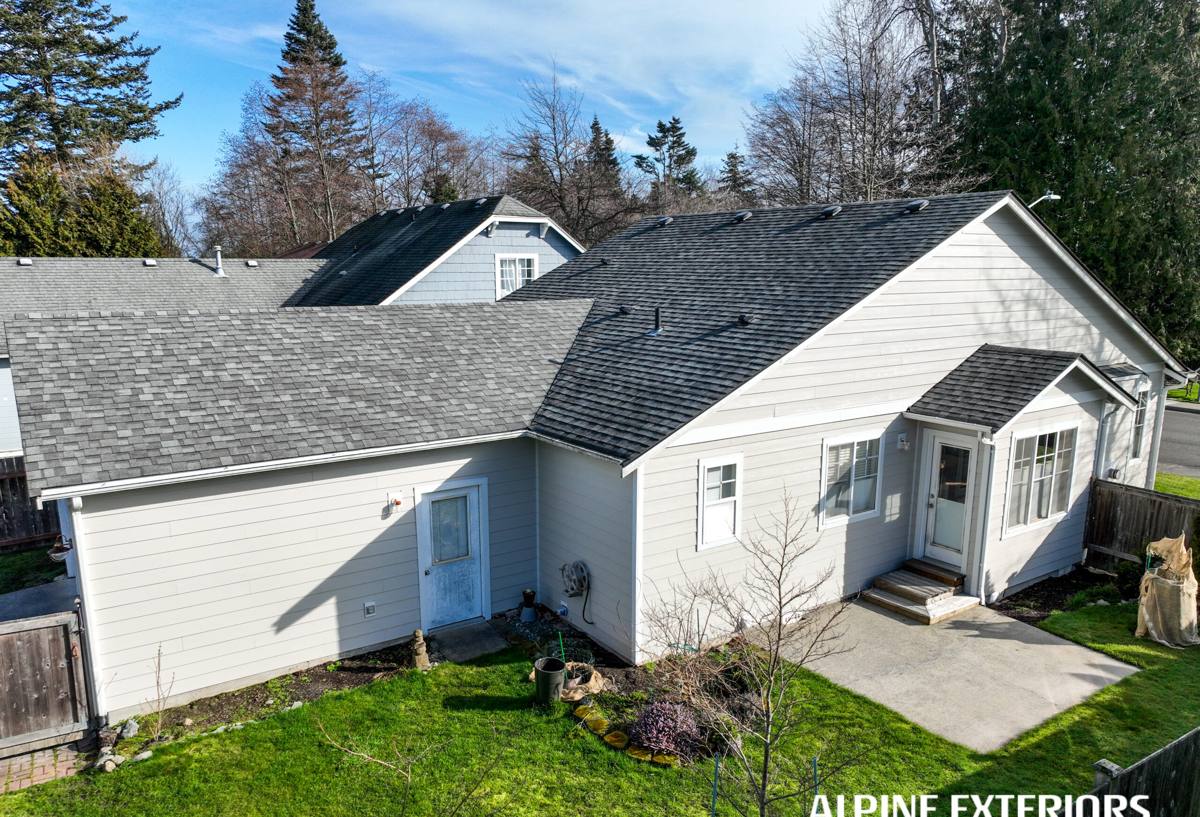
What a Correct Metal Roof Installation Involves in This Climate
Underlayment and Water Management First
Metal panels are the visible layer, but the underlayment and flashing details underneath do most of the actual water-management work. In a driving-rain environment, we treat synthetic underlayment and self-adhered membrane at eaves, valleys, and penetrations as non-negotiable, not an upgrade option. Wind-driven rain can travel uphill under panels during a real coastal storm, so laps, seams, and fastener patterns all get built with that in mind rather than assuming water only ever flows downhill.
Fasteners and Flashing Matched to the Coast
Every exposed fastener, clip, and flashing piece is a potential corrosion point near saltwater. We match fastener and flashing metal to the panel material to avoid galvanic corrosion — mixing incompatible metals (say, plain steel fasteners on an aluminum panel) sets up a reaction that eats away at the less noble metal, often right where you can't see it until it fails. Oversized washers, correct torque, and coated fasteners rated for coastal exposure all matter more here than in a typical inland install.
Ventilation That Fights Moss and Moisture Together
Proper attic and roof-deck ventilation does double duty in Skagit County: it keeps roof-deck temperatures more even (which slows moss growth on some surfaces) and keeps moisture from condensing under the roofing where it can't dry out during our long stretches of overcast weather. A metal roof installed over a poorly ventilated deck can trap moisture just as easily as any other roofing material — the metal itself doesn't fix a bad ventilation plan.
Choosing Panel Material for Salt Air Exposure
Not every metal roofing product handles a saltwater-adjacent environment the same way. This is one of the few decisions we push harder on for Anacortes homes than we would inland.
| Material | Coastal Performance | Trade-Offs |
|---|---|---|
| Aluminum | Naturally corrosion-resistant; doesn't rust even with regular salt exposure | Softer than steel, slightly more prone to denting; typically a higher material cost |
| Galvalume steel | Good corrosion resistance from its aluminum-zinc coating; solid mid-range choice | Cut edges and scratches expose bare steel and need proper edge treatment or paint touch-up |
| Bare or lightly coated galvanized steel | Weakest coastal performance of the common options | We don't recommend it for immediate waterfront or heavy salt-air exposure without a strong finish system |
We're not knocking any manufacturer here — these are basic material-science trade-offs, and they apply no matter whose name is stamped on the coil. Our standard for Anacortes jobs is to steer homeowners toward aluminum or a well-coated Galvalume product with a finish rated for coastal use, and to be upfront when a cheaper option would save money now but add maintenance burden later.
Paint and Coating Systems: What the Difference Actually Means
The paint finish on a metal roof does the everyday work of blocking UV, holding color, and adding a second layer of corrosion protection over the base metal. Two coating families come up most often:
- PVDF (Kynar-type) finishes — generally hold color and chalk resistance longer under UV and salt exposure, with warranty terms to match; typically the higher-cost option.
- SMP (polyester-type) finishes — reasonable performance for the price, but tend to fade and chalk sooner in high-UV, high-salt exposure than PVDF systems.
For a roof that's going to sit in coastal air for decades, we generally steer clear of the thinnest, cheapest coating packages — not because any one brand fails, but because the maintenance and repainting burden that comes with a weak finish system isn't worth the up-front savings on a roof that's expensive to access again once it's installed.
Metal Roofing Profiles Compared
The profile — how the panels are shaped and fastened — matters as much as the material for a driving-rain, salt-air climate.
| Profile | Fastening | Best Fit | Relative Cost |
|---|---|---|---|
| Standing seam | Concealed clips, no exposed fasteners on the field of the panel | Best water-shedding performance for wind-driven rain; our default recommendation near the water | Higher |
| Exposed-fastener panel | Screws through the panel face into the deck or purlins | Workable on lower-slope, less exposed sections if fasteners and gaskets are maintained | Lower to mid |
| Metal shingle/shake panel | Interlocking panels, largely concealed fastening | Good where a homeowner wants a traditional look with metal's durability | Mid to higher |
Exposed-fastener panels aren't wrong for every situation, but every exposed screw is a future maintenance point — the neoprene washer under each one eventually hardens and needs replacing, and that job gets harder to keep up with the more exposed a roof is to salt air and rain. For most full Anacortes reroofs, we recommend standing seam specifically because it takes that long-term maintenance item off the table.
How Our Process Works
- On-site assessment: we look at the existing roof deck, ventilation, flashing details, and how exposed the home is to prevailing wind and salt spray before recommending a system.
- Material and profile selection: we walk through the trade-offs above in plain terms — there's rarely one "right" answer, just the right fit for the budget and the exposure.
- Deck prep and underlayment: any soft or damaged decking gets addressed before a single panel goes down; underlayment and ice/water membrane go in at all the vulnerable points first.
- Panel installation: panels, clips, and fasteners matched to avoid galvanic corrosion, with flashing detailed for wind-driven rain rather than just straight-down rainfall.
- Final walk-through: we go over the completed roof, the maintenance items that matter for this climate, and what to expect over the next several years.
A Maintenance Checklist for Anacortes Metal Roofs
Metal roofing is low-maintenance compared to most other roofing materials, but "low-maintenance" isn't "no-maintenance," especially with moss season and salt air in the mix.
- Clear needles, leaves, and debris from valleys and gutters at least once a year — trapped debris holds moisture against the panel and gives moss somewhere to take hold.
- Rinse off visible moss or algae growth rather than letting it build up season after season; avoid pressure washing directly at seams or fastener heads.
- Check exposed fasteners (on exposed-fastener panels) every couple of years for washer wear or backing-out screws.
- Look at flashing around any roof penetrations — vents, chimneys, skylights — after major windstorms, since that's where wind-driven rain finds a way in first.
- Watch for surface scratches near the coast; touching up bare metal early prevents a small corrosion spot from spreading under the finish.
Why a Crew That Already Works Skagit County Matters
A metal roof installed to a generic spec sheet, without accounting for Anacortes's specific mix of salt air, wind-driven rain, and moss, will usually still look fine on installation day — the problems show up three, five, ten years later, and by then they're a lot more expensive to fix than they would have been to prevent. A crew that works this area regularly has already seen which flashing details hold up to a real winter storm off the water, which fastener choices age badly near saltwater, and how the local permitting and inspection process for Skagit County actually runs in practice, rather than learning it project by project.
There's also a practical side to being local: warranty callbacks, storm-damage inspections, and simple questions two years down the road get answered by a crew that's a short drive away and still doing roofs in the same neighborhoods, not one that has to be tracked down from somewhere else in the state.
Getting Started
If you're weighing a metal roof for a home in Anacortes or anywhere else in Skagit County, we're happy to walk the roof with you, talk through material and profile options honestly, and give you a straightforward estimate — no pressure, no hard sell. Use the form below to request a free estimate and we'll get in touch to schedule a time that works.