 Skagit County
 Alger sits in the rural stretch of Skagit County between Mount Vernon and Bellingham, where wooded lots, longer driveways, and a wetter, mossier climate than the coast towns to the south are just part of daily life. Decks out here take a beating that decks in drier parts of the state never see. If yours is soft underfoot, green with algae no matter how often you scrub it, or starting to separate at the ledger board, patching it usually just delays the real fix. This page covers what a proper deck replacement looks like for an Alger property, and what our crew actually does differently because we already work this area.
What Skagit County's Climate Does to a Deck
Alger gets the same marine air that moves through the rest of Skagit County — heavy fall and winter rain, long stretches of overcast humidity, and a salt-tinged breeze off the nearby Puget Sound lowlands that carries moisture further inland than people expect. None of that is dramatic on its own, but it's relentless, and a deck is one of the few structures on a house that's exposed to it from the top, the bottom, and the sides all at once.
Three things drive most of the deck failures we see out here:
- Driving rain that gets pushed sideways into ledger connections, stair stringers, and the gaps between deck boards instead of just falling straight down.
- A long moss and algae season — often eight or nine months a year — that keeps board surfaces damp and lets organic growth build up in board gaps, fastener heads, and anywhere water sits instead of draining.
- Salt-laden air that accelerates corrosion on fasteners, joist hangers, and any hardware that isn't rated for coastal exposure, even well inland.
A deck built to a generic spec sheet, without accounting for these three things, will look fine for a few years and then fail all at once — usually at the ledger, the framing, or the fasteners, not the decking surface itself.
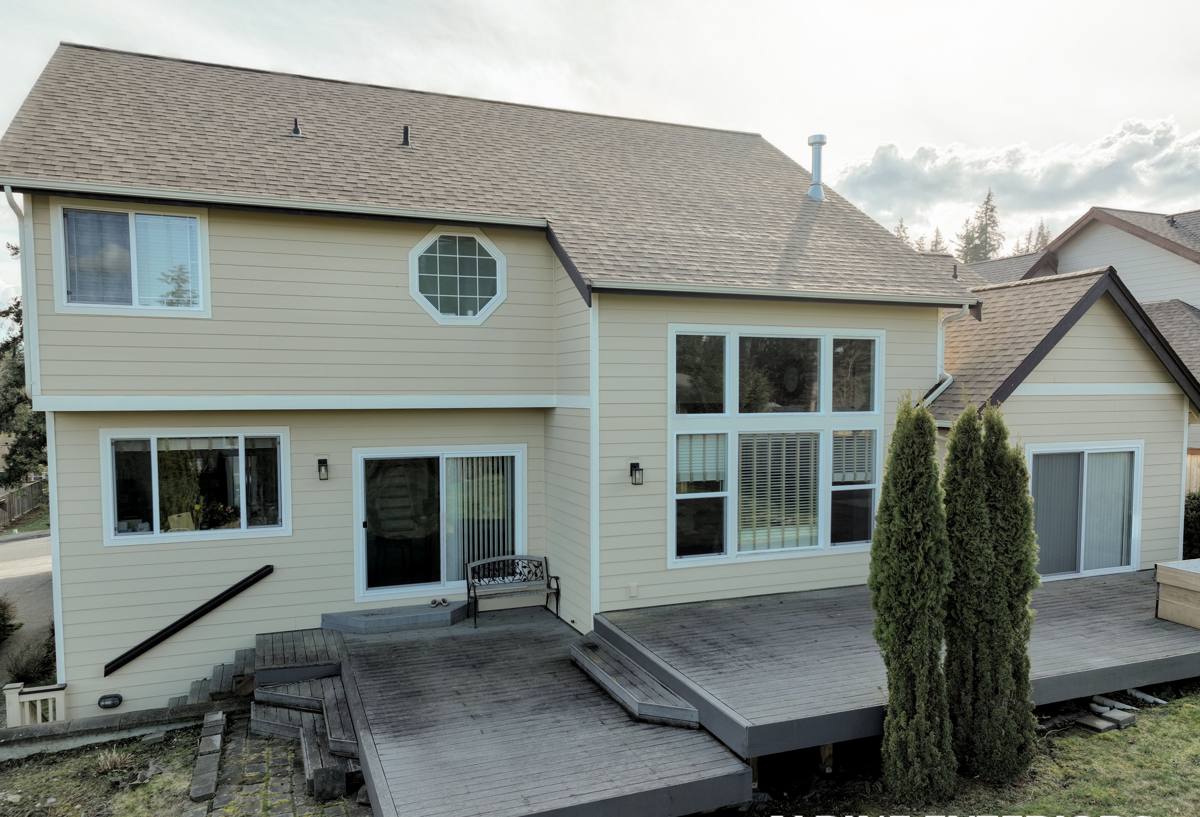
Signs Your Deck Has Crossed From "Needs Repair" to "Needs Replacing"
Not every tired-looking deck needs a full teardown. But there's a point where individual board swaps and re-staining stop being worth the money, because the problem has moved into the structure itself. Signs we look for:
- Soft, spongy, or springy sections when you walk across the deck, especially near the house
- Visible gaps, staining, or soft wood at the ledger board where the deck attaches to the house
- Rust streaks running from joist hangers, bolts, or screws
- Persistent moss or black algae that comes back within weeks of cleaning
- Railing posts that wiggle at the base, which usually means the post-to-frame connection has rotted
- Stair stringers that feel uneven or have visible splitting
- A deck more than 20-25 years old that has never had the ledger flashing checked or replaced
If it's just a few boards showing wear on an otherwise sound frame, we'll tell you that honestly and price a repair instead. Full replacement makes sense when the framing, ledger connection, or footings are compromised — at that point, replacing boards on top of bad structure just wastes money on something that still isn't safe.
Quick Self-Check Before You Call
- Push a screwdriver gently into the deck boards near the house and at the outer edge — if it sinks in easily, there's rot
- Look under the deck (if accessible) for daylight gaps at the ledger, standing water, or dark staining on framing
- Check railing posts for movement by pushing side to side at the top
- Note whether moss regrows within a month of cleaning — fast regrowth usually means poor drainage, not just dirty wood
What a Correct Deck Replacement Actually Involves
A deck is only as good as what you can't see once it's finished. Most of the failures we get called out to inspect trace back to shortcuts in three areas: the ledger, the framing, and the fasteners.
Ledger Flashing
The ledger board — where the deck bolts into the house rim joist — is the single most common failure point in this climate. Water that gets behind an unflashed or poorly flashed ledger has nowhere to go, and it will rot both the ledger and the house framing behind it before it's ever visible from outside. A correct install uses proper metal flashing integrated with the house's water-resistive barrier, not just caulk over a bolted board. Caulk is not flashing, and in a climate with this much sustained rain, it fails long before the wood does.
Framing and Footings
Joists, beams, and posts need to be sized for the actual span and load, set on footings that go below frost depth and bear on solid ground, not just resting on the surface. We also run protective tape over the top of joists before decking goes down — it's a small material cost that keeps water from sitting in fastener holes and starting rot from the inside of the joist out.
Fasteners and Hardware
Given the salt air this area gets, we use stainless or coated fasteners and joist hangers rated for exterior/coastal exposure, not standard interior-grade hardware. Mixing metals (for example, the wrong screw in the wrong hanger) sets up galvanic corrosion that can eat through hardware in a few years even if the wood itself is fine.
Choosing Decking Material for an Alger Property
There's no universally "right" decking material — it's a trade-off between upfront cost, maintenance, and how the material handles constant moisture and moss pressure. Here's how the common options actually perform in this climate:
| Material | Moisture/Moss Behavior | Maintenance | Typical Lifespan Here |
|---|---|---|---|
| Pressure-treated wood | Absorbs water, needs gaps and airflow to dry between rain events; prone to moss buildup if not cleaned regularly | Annual cleaning, re-staining/sealing every 2-3 years | 15-20 years with upkeep |
| Cedar | Naturally rot-resistant but still needs to dry out between wet spells; can gray or stain without maintenance | Sealing every 2-3 years, occasional cleaning | 15-25 years with upkeep |
| Composite (capped) | Doesn't absorb water into the board itself, but grooved/gapped profiles can trap moisture and organic debris if not installed with proper drainage | Periodic washing, no staining or sealing | 25-30+ years, manufacturer-warrantied |
| PVC decking | Fully moisture-resistant board material; performance depends heavily on substructure ventilation underneath | Low — occasional washing | 25-30+ years, manufacturer-warrantied |
Our standard is to steer clients toward capped composite or PVC for anything low to the ground or shaded, simply because those spots hold moisture longest and see the most moss. Wood is still a fine choice on open, sun-exposed decks with good airflow underneath, especially if you're comfortable with the maintenance schedule. We're upfront that composite and PVC cost more up front — that's the honest trade-off for less maintenance and longer life in a wet climate.
Permits and Code in Skagit County
Most full deck replacements in unincorporated Skagit County — which covers Alger — require a building permit, especially when the deck is attached to the house, elevated, or involves guardrails and stairs. Permit requirements typically cover footing depth and bearing, ledger attachment method, guardrail height and baluster spacing, and stair geometry. We handle the permit application and inspection scheduling as part of the job so you're not the one tracking down the county office — it's one less thing to manage on a project that already involves enough decisions.
Our Deck Replacement Process
- On-site assessment — we inspect the existing deck's framing, ledger, footings, and decking to determine what's actually failing versus what's cosmetic
- Written estimate — a clear scope covering demolition, framing, decking material, hardware, and any permit work, with material options at different price points
- Permit filing — submitted to Skagit County before demolition starts, so there's no gap between teardown and rebuild
- Demolition and disposal — full removal of the old deck, including checking the house rim joist for hidden rot once the ledger is off
- Framing and flashing — new footings, framing, ledger flashing, and joist tape installed to current code and to our own moisture-management standard
- Decking and railings — installed per manufacturer spacing specs to allow drainage and airflow, with corrosion-rated fasteners throughout
- Final inspection and walkthrough — county inspection where required, plus our own walkthrough with you before we call the job done
Why a Crew That Already Works Alger Matters
Deck problems in this part of Skagit County are consistent enough that experience here actually changes how a job gets done. A crew that's replaced ledgers on homes in this same rain and moss pattern knows to check the rim joist behind every ledger before assuming it's sound, knows which decking profiles shed water well under this area's tree cover, and doesn't need to guess at footing depth or drainage slope for the local soil and rainfall. That's less about salesmanship and more about not relearning the same lessons on your project that we've already learned on others nearby.
Keeping a New Deck Performing Long-Term
A correctly built deck still needs basic upkeep in this climate — the goal is to make that upkeep minimal, not eliminate it entirely:
- Sweep debris out of board gaps a few times a year, especially in fall when leaves and needles build up
- Rinse off moss and algae growth before it gets established rather than after
- Keep gutters and downspouts near the deck clear so overflow isn't dumping extra water onto or under it
- Check railing posts and stair connections annually for movement
- Re-seal wood decking on schedule if you chose wood — skipping a cycle in this climate lets moisture in fast
If you're in Alger and dealing with a deck that's past its prime, we're happy to take a look and give you a straight answer on repair versus replacement — no pressure, no inflated scope. Use the form below to request a free estimate.