 Skagit County
 Siding Replacement in Burlington: Built for This Corner of Skagit County
Burlington sits in one of the more demanding stretches of Skagit County for exterior building materials. You're close enough to Padilla Bay and the Salish Sea to pick up salt-laden air, low enough in the valley to collect fog and standing humidity, and far enough into the Pacific Northwest rain belt that siding here spends a large share of the year wet, not just rained on. Add in the shaded, slow-drying north and east walls that are common on Burlington lots, and you get a climate that is genuinely hard on siding — harder than a lot of manufacturer warranties assume.
When homeowners call us about siding replacement in Burlington, the conversation is rarely just "my siding looks old." It's usually one of three things: visible damage after years of moss and moisture exposure, paint that won't hold anymore no matter how often it's redone, or a pre-sale inspection that flagged soft spots. This page walks through what actually causes siding failure in Burlington's climate, what a correct replacement involves, and why we install one product system — James Hardie fiber cement — on every home we work on here.
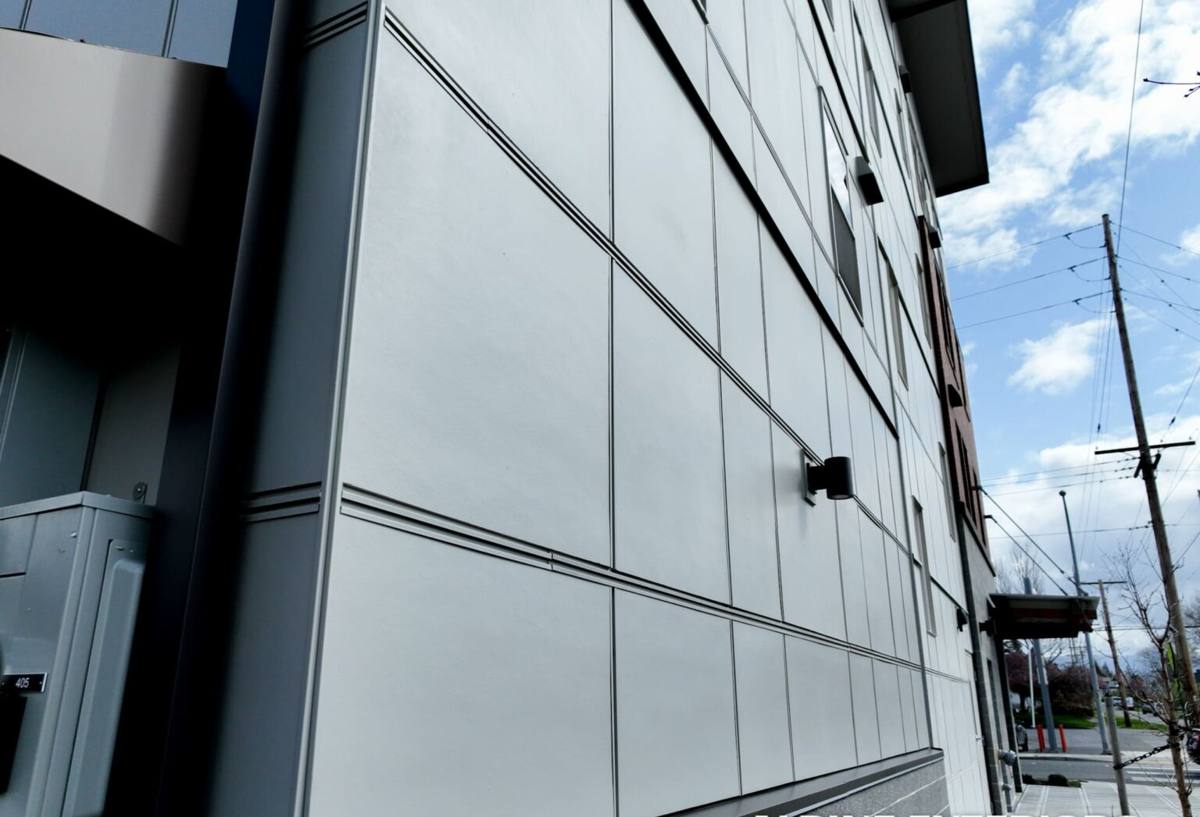
What Burlington's Climate Actually Does to Siding
Salt Air
Burlington isn't oceanfront, but it's close enough to tidal water that airborne salt reaches homes here, especially on west- and southwest-facing walls that catch prevailing weather. Salt is corrosive to fasteners and hard on paint films over time, accelerating the breakdown of coatings that would otherwise last much longer inland.
Driving Rain
Wind-driven rain doesn't just wet a wall's surface — it pushes moisture up under laps, into seams, and behind trim if the water-resistive barrier and flashing details aren't done right. This is less about the siding material itself and more about installation: a huge share of "siding failure" we see in Skagit County is actually a water-management failure behind the siding.
A Long Moss Season
Shaded walls, mature trees, and the region's damp, mild winters give moss and algae a long growing season in Burlington — often close to year-round on north-facing elevations. Moss holds moisture against the surface far longer than open air would, which is exactly the condition that causes paint failure, substrate softening, and rot in siding materials that aren't engineered to handle it.
How These Conditions Show Up on Burlington Homes
- Paint that blisters, peels, or chalks years before it should, especially on shaded or salt-exposed elevations
- Dark streaking or green-black moss growth that keeps returning no matter how often it's pressure washed off
- Soft, spongy, or delaminating siding near ground level, under windows, or at butt joints
- Visible board warping or cupping on walls that stay damp longer after rain
- Caulk joints that have cracked or pulled away, letting water track behind the siding
- Fastener corrosion or rust staining bleeding through the paint on older installations
Any one of these on its own might be a minor repair. Several together, or damage that's spread across more than a wall or two, usually means it's time to talk about full replacement rather than patching.
What a Correct Siding Replacement Involves
Replacing siding isn't just swapping old boards for new ones. In a climate like Burlington's, the work that happens before the new siding goes up matters as much as the siding itself.
Tear-Off and Inspection
We remove the old siding and inspect the sheathing underneath for rot, soft spots, or prior water damage — common around window and door openings and at the base of walls. Any damaged sheathing gets repaired or replaced before we move forward. Skipping this step is one of the most common corners cut in cheap siding jobs, and it's the step that determines whether the new siding lasts.
Water-Resistive Barrier and Flashing
A new weather-resistive barrier goes on correctly lapped, with proper flashing at every window, door, and penetration. Given how much of Burlington's siding damage traces back to water getting behind the wall rather than through the siding face itself, this stage is where a lot of long-term performance is decided.
Installation to Manufacturer Spec
James Hardie siding has specific requirements for fastener spacing, clearances above grade and roof lines, and gaps at butt joints and trim — all engineered around moisture management. Installing it "close enough" undermines both the performance and the warranty. We install to spec, not to whatever's fastest.
Trim, Caulking, and Finish Details
Corner boards, trim, and caulked joints are finished carefully, since these are the spots most prone to water intrusion over time. On Burlington's north- and east-facing walls in particular, we pay extra attention to detailing that keeps moisture from sitting against the material.
Why We Install James Hardie — and Nothing Else
We standardized on James Hardie fiber cement siding company-wide, and Burlington's climate is a good illustration of why. We don't install vinyl, LP SmartSide, primed spruce, cedar, or other fiber cement brands, and we're upfront about the reasoning rather than just picking a side.
| Factor | Why It Matters in Burlington's Climate |
|---|---|
| Moisture resistance | Hardie's fiber cement doesn't absorb and swell with moisture the way wood-based products can, which matters on shaded, slow-drying walls |
| Non-combustible material | Fiber cement doesn't feed a fire the way wood-based siding can — a meaningful long-term durability factor regardless of local wildfire risk |
| Factory finish (ColorPlus) | A baked-on factory finish holds up better against sun, salt air, and moss staining than field-applied paint, and reduces repainting cycles |
| Climate-engineered HZ lines | Hardie's HZ10 product line is formulated for wetter, cooler climates like the Pacific Northwest, not a one-size-fits-all national product |
| Warranty structure | A strong, transferable manufacturer warranty backed by installation to spec — valuable if you sell the home down the road |
None of this means other products are junk — vinyl and engineered wood sidings have real markets and real strengths elsewhere. But for the specific combination of salt air, driving rain, and heavy moss exposure that Burlington homes deal with, we've made a professional judgment call: Hardie's moisture behavior, finish durability, and warranty backing are the better long-term bet, and it's the only system we're willing to put our installation behind.
Our Process for a Burlington Siding Replacement
- On-site assessment. We walk the home, look at every elevation (moss and salt exposure often varies wall to wall), and check for signs of moisture damage.
- Sheathing and structure check. Where accessible, we evaluate what's likely underneath the current siding so there are no surprises once tear-off starts.
- Written estimate. A clear scope covering tear-off, any sheathing repair contingencies, the Hardie product line and color, and a realistic timeline.
- Tear-off and prep. Old siding comes off, sheathing issues get addressed, and a new water-resistive barrier goes on correctly.
- Installation. Hardie siding installed to manufacturer spec, with careful attention to flashing, fastening, and trim detail.
- Final walkthrough. We review the finished work with you before calling the job done.
What to Expect for Cost Factors
| Factor | How It Affects the Job |
|---|---|
| Home size and wall complexity | More corners, gables, and trim detail mean more labor and material |
| Sheathing condition | Rot or water damage found during tear-off adds repair scope |
| Siding profile and accessories | Lap width, trim style, and accent details affect material cost |
| Access and site conditions | Tight lots, landscaping, or multi-story walls affect labor time |
| Existing moisture damage | Extensive rot behind old siding can extend scope beyond a straight swap |
Why Hiring a Crew That Already Works in Burlington Matters
Siding installation isn't uniform across regions. A crew used to working in a drier climate may not naturally build in the same margin for water management that Burlington's rainfall and shaded-wall moss conditions call for. A local Skagit County crew has seen how these homes actually fail over time — which walls hold moisture the longest, which details tend to get missed, where moss keeps coming back — and builds the installation around that, not around generic best practices from somewhere else.
There's also a practical side: a company based in the area is easier to reach if a question comes up after the job is done, and has a reputation in the community worth protecting on every project, not just the ones that happen to get noticed.
Signs It's Time to Replace, Not Just Repair
- Damage or moss regrowth is spread across multiple walls, not isolated to one spot
- Soft or spongy siding is present anywhere near the base of the home
- You've repainted more than once in the last several years and it's still failing
- The home is more than 20-25 years old and has never had the siding replaced
- You're preparing to sell and want to avoid inspection issues around siding condition
If you're seeing one or two of these, a repair conversation may still make sense. If several apply, full replacement is usually the more cost-effective path over the long run, since patching around widespread moisture damage tends to be a short-term fix.
If your Burlington home is showing signs of moss, paint failure, or moisture damage, we're happy to take a look and give you an honest read on whether repair or full replacement makes sense — no pressure, no obligation. Fill out the form below to schedule a free estimate.