 Skagit County
 Siding Repair in Sedro-Woolley Isn't a One-Size Job
Sedro-Woolley sits at the edge of the Skagit Valley, where the flat farmland gives way to the foothills of the Cascades. That location matters more than most homeowners realize when it comes to siding. Homes here get a mix of open valley wind, river-bottom humidity, and heavy tree cover depending on which side of town you're on. A siding repair that works on a sun-exposed wall in a dry climate can fail within a couple of years on a shaded, damp wall in Sedro-Woolley. We don't treat siding repair as a generic patch-and-paint job — we treat it as a problem specific to this part of Skagit County.
Most of the calls we get aren't about a single obvious hole or crack. They're about siding that "looks fine from the street" but is soft, discolored, or growing something green in spots that never quite dry out. That's a climate problem showing up as a siding problem, and it needs to be diagnosed that way.
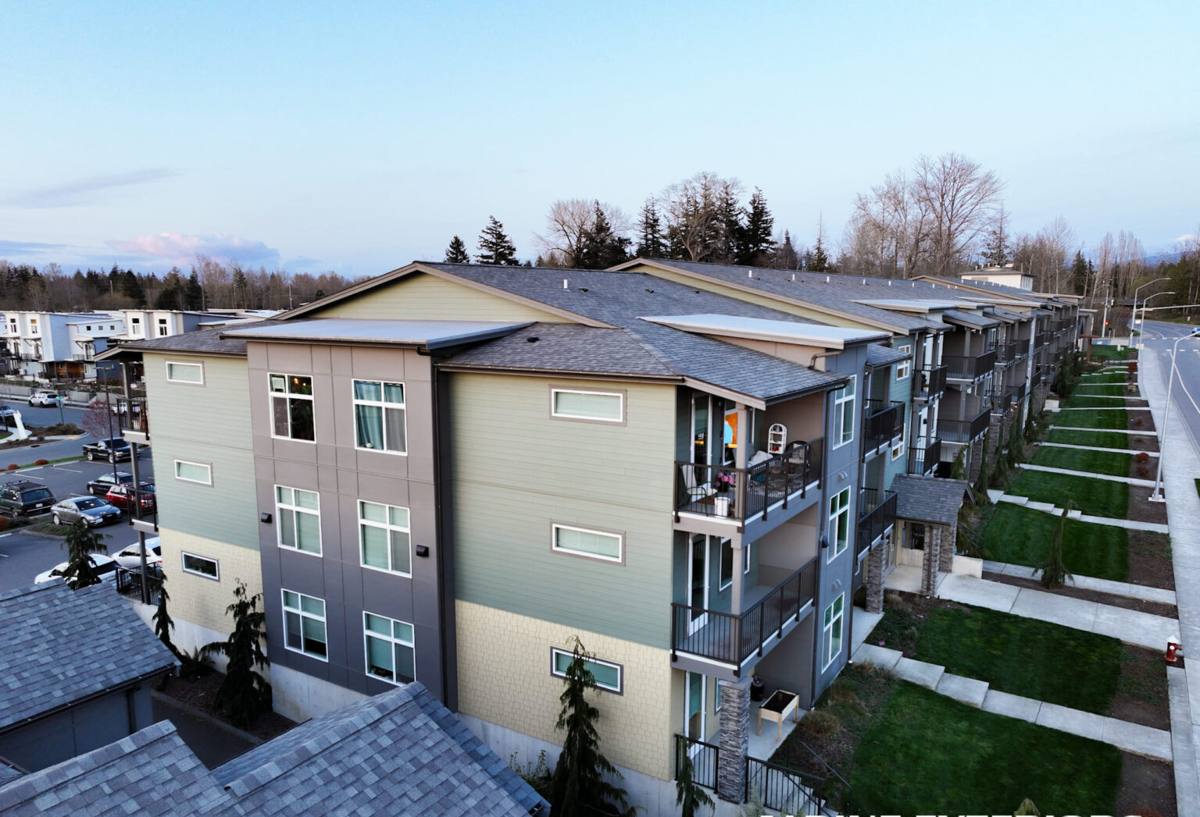
What Skagit County's Climate Actually Does to Siding
Salt Air and Driving Rain
Skagit County isn't right on the open ocean, but the marine influence off the Salish Sea still reaches inland, carrying moisture-laden, salt-tinged air across the valley. Combine that with the driving rain this region sees for months at a stretch — often blown sideways by wind funneling through the valley — and siding takes on water from angles that dry climates never test for. Water doesn't just hit a wall here; it gets pushed into seams, laps, and fastener holes.
The Long Moss Season
Sedro-Woolley's tree cover and river-valley humidity add up to a moss and algae season that runs far longer than most homeowners expect — often most of the year on north-facing or shaded walls. Moss holds moisture against the siding surface long after a storm has passed, and that constant dampness is what actually causes rot, not the rain itself. A siding material or repair that can't shed moisture and dry out quickly is fighting a losing battle in this climate.
Why This Combination Matters for Repairs
A repair that only addresses the visible damage — a cracked board, a stain, a soft spot — without addressing how water is getting in and staying in will fail again, usually in the same spot. That's the pattern we see most often on older repairs done by whoever was available at the time, not necessarily by someone who works this specific climate regularly.
Common Siding Repair Issues We See on Sedro-Woolley Homes
Housing stock in and around Sedro-Woolley spans everything from older farmhouses with original wood siding to newer construction with vinyl or hardboard products. Each material fails differently, but the underlying cause is almost always the same regional moisture load.
- Cedar and wood siding: rot at butt joints, delaminating paint, soft boards near the ground where splash-back and moss buildup keep wood wet longest.
- Vinyl siding: warping and buckling from heat/cold cycling, cracked panels from impact, and moisture trapped behind panels that never shows until the wall sheathing underneath is already damaged.
- Hardboard/OSB-based lap siding: swelling, crumbling edges, and paint failure — this material is especially unforgiving once water gets past the surface coating.
- Older fiber cement: cracking at fastener points or corners, usually from movement or a caulk joint that failed years earlier and was never re-sealed.
Moss and algae staining shows up across every material type, but it's a symptom, not the root problem — the root problem is a wall assembly that isn't drying out between storms.
What a Correct Siding Repair Actually Involves
Diagnosing the Real Problem First
A repair that starts and ends with "replace the damaged board" is incomplete. Before we touch a wall, we're checking what's behind the siding: is the water-resistive barrier intact, is flashing directing water out instead of behind the cladding, is there a moisture source (a gutter overflow, a grade issue, a failed caulk joint) that caused the damage in the first place. Fixing the visible board without fixing the cause just buys a homeowner a year or two before the same repair is needed again.
Matching Materials the Right Way
Patching siding isn't like patching drywall — color, profile, and material all have to match, or the repair sticks out and can actually create a new water entry point at the seam. This is where a lot of DIY and low-bid repairs go wrong: a mismatched board or the wrong caulk at a transition point becomes the next failure point within a season or two.
Repair or Replace? What Actually Decides It
Not every damaged section needs a full re-siding job, but not every repair is worth doing either. Here's how we walk homeowners through that decision honestly:
| Factor | Repair usually makes sense | Replacement usually makes sense |
|---|---|---|
| Extent of damage | Isolated to one or two wall sections | Spread across multiple elevations |
| Underlying wall condition | Sheathing and barrier still sound | Sheathing shows rot or water damage |
| Age of existing siding | Siding is under 10-15 years old | Siding is near or past its expected life |
| Material | Fiber cement with a clean crack or impact spot | Hardboard or OSB siding with widespread swelling |
| Moss/algae pattern | Limited to one shaded wall | Present house-wide, sign of a systemic moisture issue |
We'll tell a homeowner straight up when a repair is the smart, honest answer — not every visit is a sales pitch for full replacement. But we'll also tell you when a repair is just delaying a bigger cost.
Why We Repair and Rebuild With James Hardie, Not Vinyl or LP SmartSide
When a repair does require replacing a section, or when the damage is extensive enough that patching isn't the honest answer, the material we use is James Hardie fiber cement — and only James Hardie. We don't install LP SmartSide, vinyl, or cedar, even for a partial repair, and that's a deliberate standard, not a limitation.
Vinyl and hardboard products can look fine at installation, but in a climate with Skagit County's rain load and moss season, their moisture behavior is the real long-term cost. Vinyl can trap moisture behind it without showing damage until the sheathing is already compromised. Hardboard-based products are especially vulnerable once water gets past the surface — the failures we listed above are common with these materials in this exact climate. Cedar can perform well but demands ongoing maintenance (staining, sealing, moss treatment) that most homeowners don't keep up with consistently enough to prevent the rot patterns we see.
James Hardie fiber cement is non-combustible, holds its shape and paint line in wet-dry cycling far better than wood-based products, and its ColorPlus factory finish is engineered to resist the fading and moisture intrusion that plague field-painted materials in this climate. When we patch into existing Hardie siding, we're matching a system that was built for exactly the conditions Sedro-Woolley throws at it.
Our Siding Repair Process for Sedro-Woolley Homeowners
- Inspection: We look at the damaged area and the wall assembly behind it, not just the surface.
- Diagnosis: We identify the actual moisture source or failure cause, not just the symptom.
- Honest recommendation: Repair, partial replacement, or full replacement — whichever is actually justified.
- Correct execution: Matched materials, proper flashing and sealant details, and attention to how the repair will perform through another wet season, not just how it looks the day we finish.
- Cleanup and walkthrough: We show you what we found and what we did about it.
Signs Your Sedro-Woolley Home Needs Siding Repair Now
- Soft or spongy spots when you press on siding, especially near the bottom rows
- Paint or finish that's bubbling, peeling, or flaking in patches
- Persistent moss or dark staining that comes back after cleaning
- Visible gaps, cracks, or warping at seams and corners
- Rising interior heating bills with no other explanation — often a sign of a compromised wall
- Siding that feels damp or discolored around window and door trim
None of these on their own mean you need full replacement, but any of them left alone through another Skagit County winter will get worse, not better.
Why Hiring a Crew That Already Works in Skagit County Matters
A siding contractor who splits time across a dozen different climates has to relearn the same lessons about moss, rain angle, and moisture patterns every time they cross into a new region. A crew that works Skagit County regularly already knows which walls in a Sedro-Woolley home tend to hold moisture longest, which failure patterns show up on which materials, and how to sequence a repair so it actually holds through the next wet season instead of just looking fixed for a photo. That local pattern recognition is the difference between a repair that lasts and one that's back on our schedule next year.
If you're seeing any of the warning signs above, or you just want an honest look at what's going on with your siding, we're happy to come take a look. The estimate is free, there's no pressure, and if a simple repair is the right call, that's exactly what we'll tell you.