 Skagit County
 Why Sedro-Woolley Siding Has to Work Harder Than the Brochure Suggests
Sedro-Woolley sits in a stretch of Skagit County where the weather doesn't pick one thing to do to a house and stick with it. You get salt-tinged air working in from the Sound and the Skagit delta, driving rain off the Cascades foothills that hits siding sideways instead of straight down, and a moss season that can run eight or nine months out of the year on the shaded, north-facing walls that never fully dry out. Any one of those is manageable. Together, over years, they expose every shortcut in a siding job — the caulk joint that wasn't backed right, the butt seam that wasn't flashed, the paint film that couldn't handle constant damp-dry cycling.
This page is about one product, in one place: James Hardie fiber cement siding, installed on homes in and around Sedro-Woolley. We're not going to give you a generic rundown of fiber cement in general. We're going to talk about what this specific climate demands, what a correctly done installation actually involves, and why hiring a crew that already works this area — not one passing through — changes the outcome.
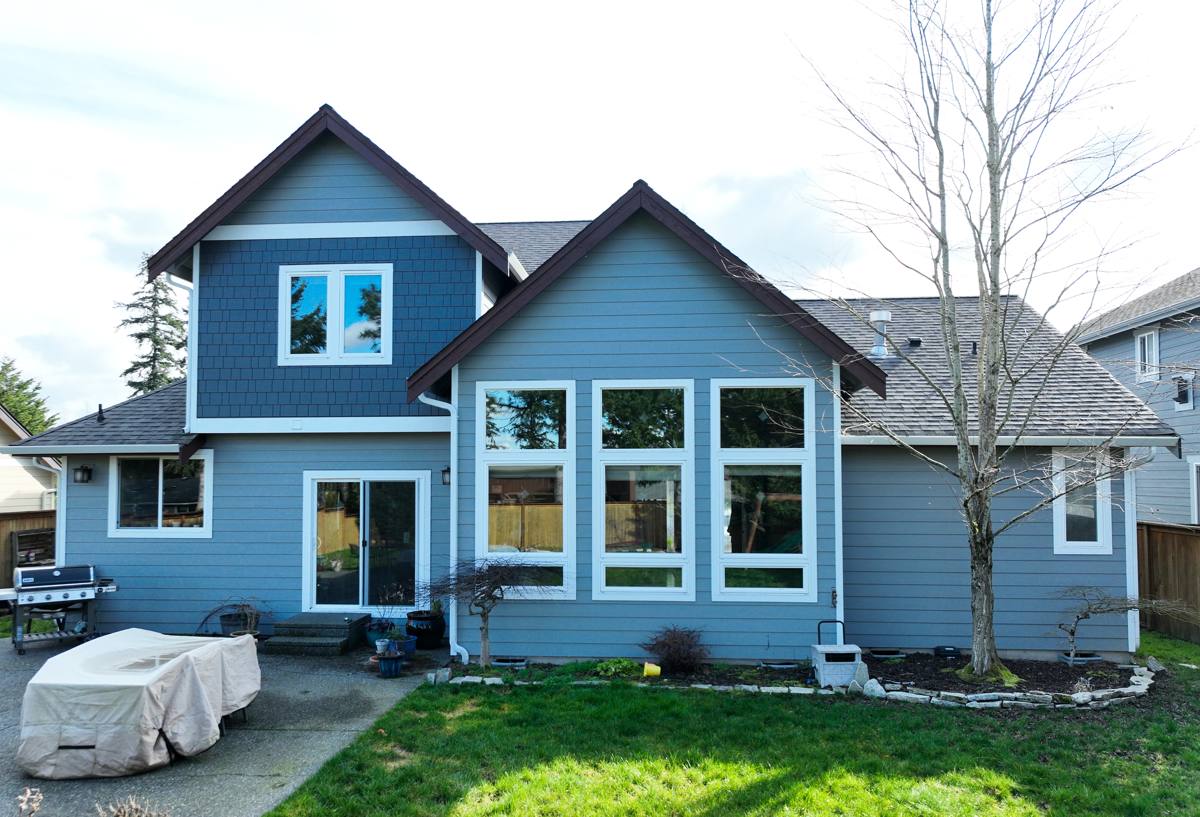
What the Local Climate Actually Does to Siding
Salt Air and Slow Corrosion
You don't have to live on the waterfront to feel the effect of salt air moving inland off Puget Sound and the Skagit River delta. It settles on exterior surfaces, works into fastener heads, and accelerates corrosion on anything that isn't rated for it. Fiber cement itself doesn't corrode — it's cement, sand, and cellulose fiber — but the fasteners, flashing, and trim that go with it absolutely can if the wrong materials get used. This is one of the most common places we see older installations fail early: galvanized nails instead of stainless or coated fasteners rated for coastal exposure, or aluminum flashing that reacts with dissimilar metals over time.
Driving Rain and Wind-Driven Moisture
Sedro-Woolley gets rain that doesn't fall straight down. Storms coming off the water push moisture sideways into wall assemblies, which means every horizontal joint, every window and door transition, and every inside and outside corner is a place water is actively trying to get behind the siding, not just run down the face of it. A siding product that resists moisture on its face but relies on perfect, permanent caulk joints to keep water out at the seams is only as good as the caulk — and caulk doesn't last as long as the siding does.
Moss, Mildew, and the Never-Quite-Dry Wall
Shaded elevations, tree cover, and the region's long wet season mean some walls in this area rarely get a full dry-out period. That's ideal growing conditions for moss and mildew, which hold moisture against the siding surface and, on products that aren't dimensionally stable, contribute to swelling, cupping, and paint failure at the edges. It's also why factory-applied, baked-on finishes hold up so much better here than field-applied paint — a factory finish cures under controlled heat and pressure; paint applied on-site during a dry window in Skagit County has to fight the next rain to fully cure.
Why We Only Install James Hardie — Not the Alternatives
We install James Hardie fiber cement exclusively. We don't install vinyl, LP SmartSide, primed spruce or cedar, or other fiber cement brands like Allura or Cemplank. That's not a marketing position — it's a standard we hold because of what we've seen happen to siding in exactly this climate over enough years to trust the pattern.
- Vinyl moves with temperature and can crack in cold snaps or warp under sun exposure on south and west walls; it also isn't fire-rated and offers little defense against the wind-driven rain typical here.
- LP SmartSide (engineered wood) is a legitimate product with real strengths, but it's wood-based, and wood-based siding depends heavily on unbroken paint film and sealed cut edges to keep moisture out — a tall order in a region with this much sustained dampness and moss pressure.
- Primed spruce or cedar looks great new but is the most maintenance-intensive option in a wet marine climate — repainting cycles come faster, and any gap in that maintenance lets moisture in fast.
- Other fiber cement brands are chemically similar to Hardie, but we standardized on one manufacturer so our crews install one system to one spec, every time, with one warranty structure we can stand behind and explain clearly to homeowners.
James Hardie's ColorPlus finish is baked on at the factory under conditions no field application can match, its HZ5 product line is engineered for exactly the freeze-thaw and moisture cycling the Pacific Northwest produces, and the material itself is non-combustible — a real consideration given how many Skagit County homes sit close to tree lines and brush. It's also backed by a strong transferable warranty on both the substrate and the finish, which matters more here than in a milder climate because this siding earns its keep every single season.
What a Correct Fiber Cement Installation Involves
Fiber cement is only as good as the install behind it. The board itself is durable; the failures we get called out to fix are almost always installation issues, not material defects. A correct job in this climate includes:
Water Management Before the First Board Goes Up
A weather-resistant barrier installed and lapped correctly, with flashing at every window, door, and horizontal transition, integrated so water is directed out and away from the wall assembly rather than trapped behind it. This step happens before any siding is visible, and it's the single biggest factor in how the wall performs ten years out.
Proper Clearances and Gaps
Fiber cement needs clearance from grade, roof lines, decks, and other hard surfaces — typically a minimum gap so water can drain and the bottom edge of the siding can dry out instead of wicking moisture. In a climate with Sedro-Woolley's rainfall, skipping this clearance is one of the fastest ways to see swelling and paint failure at the base of a wall.
Fastening Rated for Coastal-Influenced Air
Corrosion-resistant fasteners, installed at the manufacturer's specified pattern and depth — not overdriven, which cracks the board's edge and creates a moisture entry point, and not underdriven, which lets the board move and eventually work the fastener loose.
Joint Treatment That Doesn't Rely on Caulk Alone
Butt joints backed with flashing or treated per manufacturer spec rather than just caulked face-to-face. Caulk is a second line of defense here, not the only one — because in this climate, caulk joints degrade faster than the siding around them.
Factory-Finished Boards Wherever Possible
Pre-finished ColorPlus boards reduce the number of field-cut, field-painted edges, which are the most vulnerable points on any siding job. Where field cutting is unavoidable, cut edges get sealed per Hardie's specification before installation, not after the fact.
Our Process for Sedro-Woolley Homes
- On-site assessment — We look at your home's exposure: which walls take the most wind-driven rain, which stay shaded and slow to dry, where the existing siding or trim is already showing wear, and what the current water management (flashing, house wrap, clearances) looks like once we're up close.
- Product and line selection — We walk through which Hardie line and profile fits the home and the specific exposure, including where HZ5 product makes the most sense given wind and moisture load on that elevation.
- Written scope and estimate — A clear breakdown of what's being replaced, what water management work is included, and what it costs — no vague allowances.
- Installation to manufacturer spec — Proper barrier, flashing, clearances, fastening, and joint treatment as described above, not shortcuts to save a day of labor.
- Final walkthrough — We go over the finished work with you before we call it done, including care and maintenance specific to your home's exposure.
Cost Factors for a Sedro-Woolley Fiber Cement Project
Every home is different, but the variables that actually move the price on a fiber cement job here are consistent. This isn't a quote — it's what to expect to discuss when we assess your home.
| Factor | Why It Matters Here |
|---|---|
| Home size and wall complexity | More corners, dormers, and transitions mean more flashing detail and labor time, not just more square footage of board. |
| Existing siding removal and wall condition | If moisture has already gotten behind old siding, sheathing repair may be needed before new siding goes on — common on shaded, moss-prone walls. |
| Product line (HZ5 vs. standard) and profile | Higher-exposure walls facing prevailing weather may call for the more climate-engineered line even if the rest of the home doesn't strictly need it. |
| Trim and accessory scope | Fascia, soffit, and trim work done alongside siding protects the same vulnerable transitions the siding itself depends on. |
| Access and site conditions | Sloped lots, mature landscaping, and tight setbacks common in this area can affect staging and labor time. |
Signs Your Current Siding Is Already Losing the Fight
- Persistent moss or dark staining that comes back within weeks of cleaning, especially on north- or shaded-facing walls
- Soft spots, bubbling, or visible swelling near the bottom edge of siding boards or at ground-level trim
- Caulk joints that are cracked, gapped, or pulling away at seams and corners
- Peeling or chalking paint that returns quickly after repainting
- Visible fastener corrosion — rust streaks running down from nail or screw heads
- Warping, cupping, or boards that no longer sit flat against the wall
Any one of these, caught early, is a repair. Left through another wet season or two, it tends to become a full replacement — which is the pattern we see most often on homes that were sided with materials or methods not suited to this climate in the first place.
Why a Crew That Already Works Sedro-Woolley Matters
Installation detailing that works in a dry inland climate doesn't automatically work here, and a crew that hasn't installed siding through a full Skagit County wet season doesn't always know that. Local experience means knowing which elevations in this area take the worst of the wind-driven rain, understanding how long moss pressure actually lasts here versus what a generic install guide assumes, and having already seen — and fixed — what happens when flashing or clearances get shortcut in this exact climate. It also means being reachable after the job is done, not a crew that installed once and moved to the next region.
We install James Hardie fiber cement, and only James Hardie fiber cement, because we've put in the work to install it correctly and stand behind it. If you're weighing a siding replacement or repair in Sedro-Woolley, we're happy to take a look at your home, walk you through what we see, and give you a straightforward, no-pressure estimate using the form below.