 Skagit County
 Roof Repair Built for March Point's Conditions
March Point sits out on the water, surrounded by Fidalgo Bay and the Swinomish Channel, which means homes here take on a different kind of weather stress than a roof twenty miles inland in Mount Vernon or Sedro-Woolley. Salt-laden air off the bay accelerates corrosion on fasteners, flashing, and metal roof panels. Driving rain, pushed sideways by wind coming off the water, finds every gap a typical roof can hide for years elsewhere. And Skagit County's long, gray moss season gives organic growth months at a time to work into shingles, seams, and valleys. A roof repair here has to account for all three, not just patch what's visible on a dry day.
We've worked on roofs throughout Skagit County, and March Point roofs consistently show a specific pattern: wear concentrated on the windward (usually west and southwest) slopes, rusted or failing fasteners well before the shingles themselves are worn out, and moss colonies that started in a shaded valley or north-facing slope and spread. Understanding that pattern is most of what separates a repair that lasts from one that fails again in a year or two.
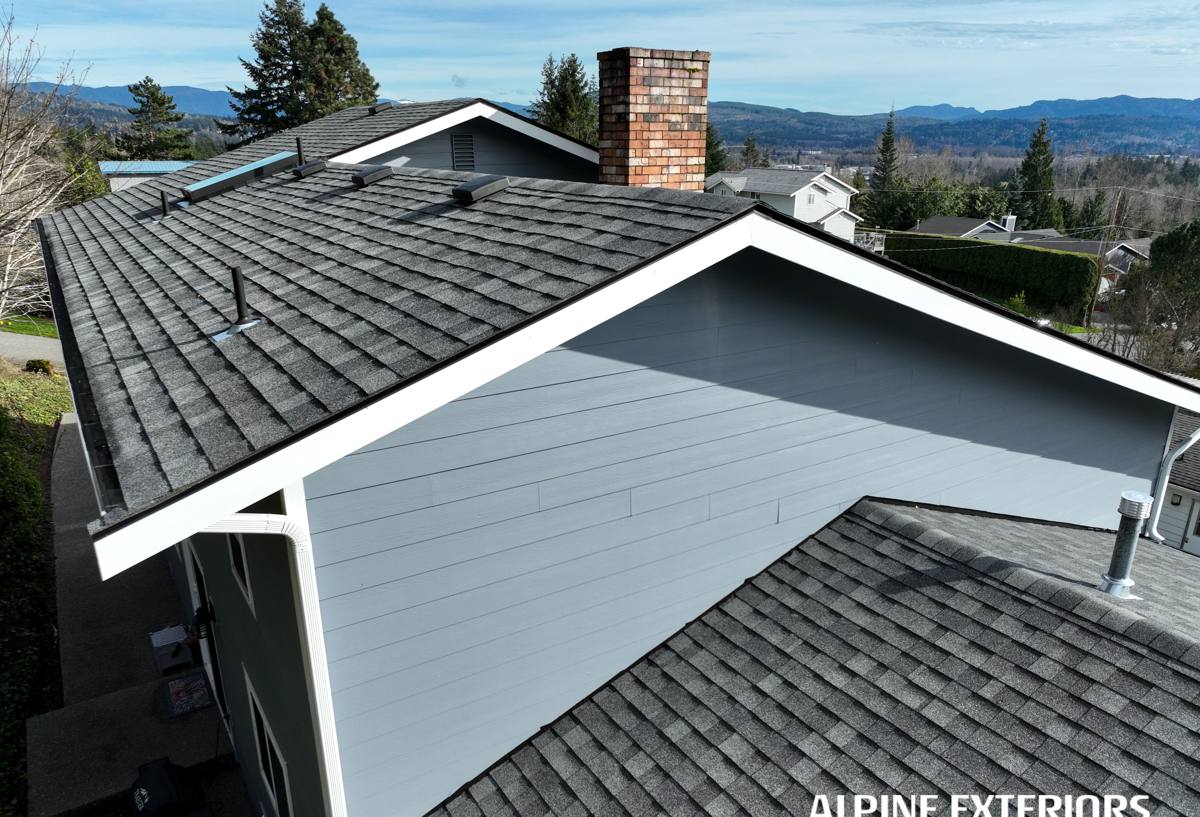
Signs a March Point Roof Needs Repair, Not Just a Look
Most roof problems don't announce themselves with a leak on day one. By the time water is visibly coming through a ceiling, the damage underneath has usually been building for a while. Here's what we tell homeowners to watch for between inspections:
- Granules collecting in gutters or at the base of downspouts — a sign asphalt shingles are wearing thin, often faster on salt-exposed slopes
- Moss or dark algae streaking on north-facing or shaded sections of roof, especially where tree cover keeps things damp longer
- Rust staining below metal flashing, vent boots, or exposed fasteners
- Curling, cupping, or lifted shingle edges, particularly on the side of the house that faces prevailing wind and rain
- Soft spots or slight sagging when walking the roof (we check this during inspections — homeowners generally shouldn't be up there)
- Daylight visible through the roof deck from inside the attic, or damp insulation near the eaves
- Cracked or brittle sealant around chimneys, skylights, and pipe penetrations
Any one of these on its own might be a minor fix. Several together usually mean it's worth having someone look at the whole roof system, not just the spot that's bothering you.
Where Damage Tends to Start
On most March Point homes, we find the earliest failures in three places: valleys (where two roof planes meet and water concentrates), flashing around penetrations like chimneys and vent stacks, and the first few feet of roof edge closest to gutters. These are the spots where wind-driven rain has the most opportunity to work its way under a shingle edge or through a compromised seal, and where salt air corrodes fasteners fastest since they're more exposed to airflow off the water.
What a Correct Roof Repair Actually Involves
A roof repair done right starts with diagnosis, not a patch. We've followed up on plenty of repairs from other crews where a visible leak was sealed over, but the actual entry point — often a failed flashing seam or a nail popped up under a shingle — was never found. The leak comes back, usually somewhere new, because water travels along the roof deck before it drips through the ceiling.
Our approach on a repair call:
- Full roof inspection, not just the reported problem area — we check the whole roof plane, valleys, flashing, vents, and attic if accessible, since one weak point often means others are close behind
- Trace the actual water path from the interior stain or attic damage back to its source on the roof deck, which can be several feet from where the leak shows up inside
- Assess the roofing material's remaining life — a 6-year-old roof and a 22-year-old roof call for different repair strategies even if the symptom looks identical
- Repair with matching materials where possible, and compatible ones where an exact match isn't available, so the patch doesn't create a new weak seam
- Re-seal and re-flash any penetration involved, since old sealant is almost always part of why the original leak started
- Document what we found and give you an honest read on whether it's a standalone repair or the first sign of a bigger issue coming
Repair Approaches by Roofing Material
Skagit County homes carry a mix of roofing types, and the right repair method depends on what's up there. Here's how the common materials in and around March Point typically hold up and what repair usually involves for each:
| Material | Typical Weak Point Locally | Repair Approach |
|---|---|---|
| Asphalt composition shingle | Granule loss and curling on wind-exposed slopes; moss lifting shingle edges | Replace damaged shingles in-kind, treat and remove moss, re-seal flashing |
| Wood shake or shingle | Moss and moisture retention in shaded areas; splitting from wet/dry cycling | Selective shake replacement, moss treatment, improved ventilation where possible |
| Metal roofing/panels | Fastener corrosion and seam fatigue from salt air | Fastener replacement with corrosion-resistant hardware, seam and sealant renewal |
| Torch-down or membrane (low-slope) | Seam separation and ponding near flashing details | Seam repair or patching, flashing rework, ponding correction where feasible |
Whatever the material, the goal of a repair is the same: fix the actual failure, match it to what's already there as closely as possible, and leave the roof in a condition where it's not likely to fail again in the same spot next winter.
Moss, Algae, and Salt Air: The Maintenance Side of Repair
A repair that ignores the cause tends to be a repeat visit. Moss doesn't just sit on top of a roof — its root structure lifts shingle edges and holds moisture against the roof deck, which is exactly the environment that leads to rot and leaks. On March Point, with tree cover in some yards and near-constant humidity off the water, moss can re-establish within a season if it's only scraped off and not treated at the root.
Salt air adds a second layer most inland Skagit County homes don't deal with as much: it accelerates corrosion on exposed metal — nail heads, flashing edges, gutter hardware — even when the metal itself is otherwise in decent shape. Part of an honest repair on a March Point home is checking fastener condition, not just shingle condition, since a rusted-through nail can let a shingle work loose well before the shingle material has actually worn out.
Where it makes sense, we'll recommend simple maintenance steps alongside a repair — moss treatment, gutter clearing, or minor trimming to improve airflow and sun exposure on a chronically damp section of roof — because those steps often do more to prevent the next leak than the repair itself.
Repair vs. Replacement: How We Help You Decide
Not every roof problem is a repair, and not every roof problem is a replacement. Homeowners are often unsure which side of that line they're on, and it's a fair question — the visible damage doesn't always tell the whole story. Here's roughly how we think through it:
| Factor | Leans Toward Repair | Leans Toward Replacement |
|---|---|---|
| Roof age | Under roughly 15 years, or well-maintained mid-life roof | Near or past the material's expected service life |
| Extent of damage | Isolated to one slope, valley, or penetration | Widespread granule loss, multiple failing valleys, structural sag |
| Underlying deck condition | Solid, no rot found during inspection | Soft spots or rot found in more than one area |
| Repair history | First or second repair in this area of roof | Same spot has needed repair multiple times |
We'll give you our honest read on which category your roof falls into, including telling you plainly when a repair is the right call even if a full roof would be the bigger job for us. A roof that only needs a repair doesn't need to be sold a replacement.
Our Process, Start to Finish
We keep the process straightforward because most homeowners just want the problem fixed correctly and want to understand what they're paying for:
- Free on-site inspection and honest assessment — we walk the roof, check the attic if accessible, and explain what we found in plain terms
- A written estimate that separates the repair scope from any maintenance recommendations, so you know what's necessary versus optional
- Scheduling that accounts for Skagit County's weather windows — we don't do temporary patch work when a proper repair is achievable, but we also won't leave an active leak waiting on a "perfect" dry stretch
- The repair itself, using materials matched to what's already on your roof wherever possible
- A final walkthrough so you can see what was done and ask questions before we call it complete
Why Local Experience on March Point Matters
A roofing crew that's worked on homes in this specific area already knows the patterns — which slopes take the worst of the wind-driven rain, where moss tends to establish first, and how salt air affects fasteners and flashing differently than it would on a roof further inland. That's not something you get from a general roofing checklist; it comes from having actually been on roofs in this exact stretch of Skagit County.
It also means we're not guessing at what "normal wear" looks like here versus what's an early warning sign specific to this environment. A repair informed by that experience is more likely to hold up through the next few wet seasons instead of becoming a callback.
Get an Honest Look at Your Roof
If you're seeing granules in the gutter, moss creeping across a slope, or a stain spreading on a ceiling, it's worth having it looked at before the next round of storms off the water makes it worse. We offer free, no-pressure estimates for roof repair in March Point and throughout Skagit County — just an honest inspection and a straight answer about what your roof actually needs. Fill out the form below to get started.