 Skagit County
 Siding Repair Built for Mount Vernon's Climate
Mount Vernon sits in the Skagit Valley, where marine air off Puget Sound, frequent rain, and long stretches of overcast, humid weather put constant pressure on exterior siding. It's not one dramatic storm that damages a home here — it's the slow, repeated cycle of moisture getting in, wood or fiberboard staying wet longer than it should, and moss and algae taking hold in shaded, north-facing areas. A siding repair in this climate has to address the actual cause of the damage, not just patch the visible symptom, or the same problem shows up again in a year or two.
We repair siding on homes throughout Mount Vernon and the surrounding Skagit County area, and the patterns we see are consistent: damage concentrated on the weather-exposed sides of the house, moisture trapped behind poorly flashed trim, and moss buildup in areas that don't get much sun or airflow. Understanding those patterns is what separates a repair that lasts from one that just looks fixed for a season.
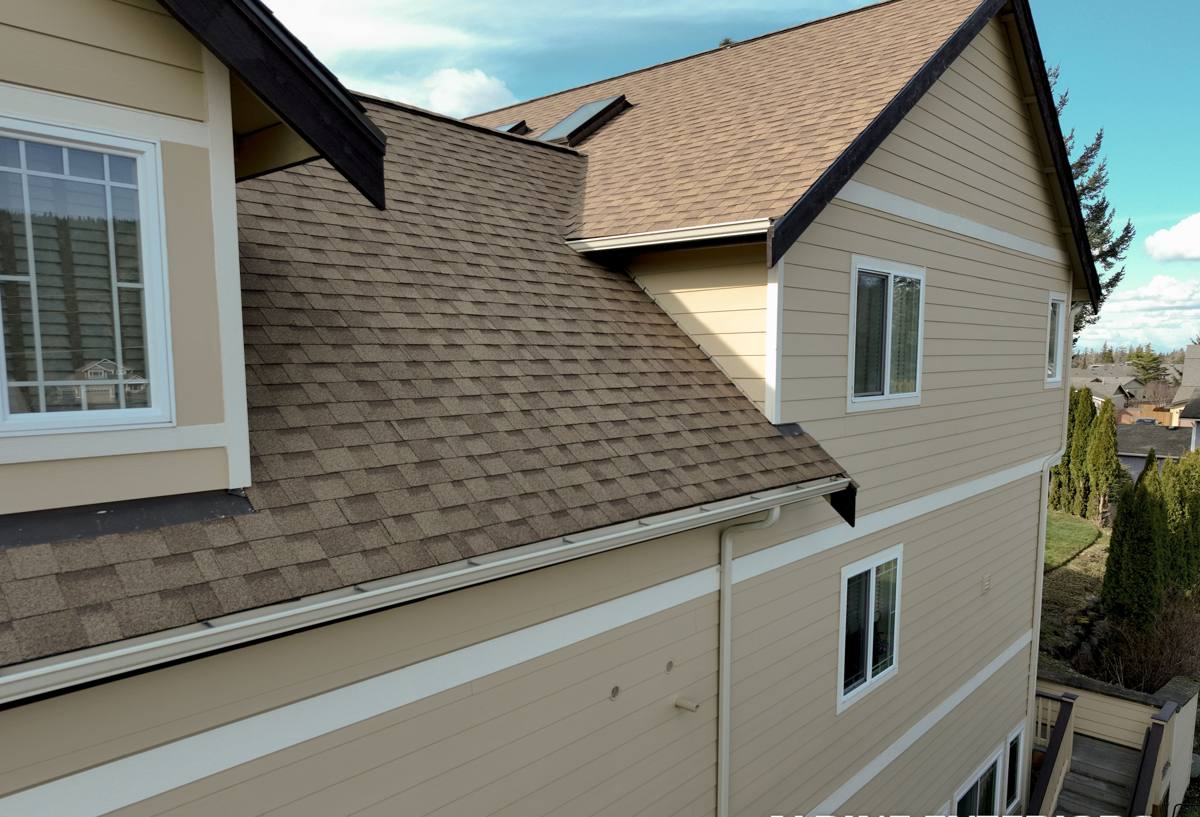
Why Local Homes Take a Beating
Skagit County's climate is defined by driving rain that comes in sideways during winter storms, salt-tinged marine air, and a moss season that can stretch from fall through spring. Each of these creates a different failure mode in siding:
- Driving rain pushes water into seams, laps, and butt joints that were fine in calm weather but fail under wind-driven pressure.
- Persistent moisture keeps wood-based siding and trim damp for days at a time, which is exactly the condition that leads to rot, swelling, and paint failure.
- Salt-influenced air accelerates corrosion of fasteners and metal flashing, which then lets water past points that used to be sealed.
- Moss and algae hold moisture directly against the siding surface, especially on north- and west-facing walls and anywhere tree cover blocks sun and airflow.
Combine all four and you get a climate that's genuinely hard on siding — not because Mount Vernon gets extreme weather, but because it gets damp weather for a very long portion of the year.
Signs Your Siding Needs Repair, Not Just Cleaning
A lot of homeowners assume moss or discoloration is a cosmetic problem that a pressure wash will solve. Sometimes that's true. Other times it's a sign the siding underneath is already compromised. Here's how to tell the difference:
Likely cosmetic
- Light green or black staining on the surface with no softness underneath
- Chalky fading on sun-exposed walls
- Dirt streaking below rooflines or gutters
Likely structural
- Soft, spongy, or crumbling spots when you press on the siding
- Visible gaps, cracks, or separation at seams and corners
- Bubbling, peeling paint that keeps coming back in the same spot
- Warped or bowed panels or boards
- Persistent moisture or a musty smell in the wall cavity from the inside
If you're seeing anything in the second list, that's a repair issue, not a cleaning issue — and waiting usually means more of the wall assembly gets involved, not less.
What Causes Most of the Damage We See
In our experience working on homes across this region, siding failure almost never starts with the siding material itself. It starts with a detail that let water past the surface:
- Failed caulking or sealant at trim, windows, and butt joints that dried out, cracked, and let water track behind the siding
- Missing or damaged flashing above windows, doors, and horizontal trim boards
- Poor original installation — panels nailed too tight, laps with insufficient overlap, or siding installed too close to grade or a deck surface
- Sprinkler or gutter overspray that keeps one section of wall wet far more often than the rest of the house
- Trapped moisture from inadequate ventilation behind the siding, which is common on older homes that predate current house-wrap standards
A repair that only replaces the damaged board without correcting the underlying cause is a repair that fails again. That's the standard we hold every job to.
Repair or Replace: How We Make the Call
Not every damaged section needs a full re-side, and we're not going to tell you it does. But there's a point where patch repairs stop being the economical choice. Here's how we evaluate it:
| Factor | Favors Repair | Favors Replacement |
|---|---|---|
| Extent of damage | Isolated to one or two wall sections | Spread across multiple elevations |
| Underlying cause | Identifiable and fixable (flashing, sealant, drainage) | Systemic — original installation or house-wrap failure |
| Siding age and condition | Siding is otherwise sound and not near end of life | Siding is original, brittle, or already failing elsewhere |
| Material availability | Matching material or color still obtainable | Discontinued color/profile, visible mismatch unavoidable |
| Moisture in the wall | No sign of trapped moisture behind adjacent panels | Rot or moisture found extending beyond the visible damage |
We'll always give you the honest answer, even when the honest answer is "this section can be repaired and doesn't need a full replacement." A repair that solves the problem correctly is a better outcome for you than an unnecessary upsell.
What a Correct Repair Involves
A siding repair done right is more than swapping a board. Our process addresses the whole assembly, not just the surface:
- Diagnose the cause — we trace the damage back to its source (flashing, sealant, drainage, installation error) before touching anything
- Remove damaged material — including any rotted sheathing or house-wrap underneath, not just the visible siding
- Inspect and repair the water-resistive barrier — house-wrap or building paper gets patched or replaced as needed so the wall drains correctly again
- Correct the original defect — re-flash, re-caulk with proper materials, or adjust clearances so the same failure doesn't recur
- Install matching or compatible material — matched as closely as possible in profile, reveal, and finish
- Final seal and paint/finish match — so the repair blends rather than standing out as an obvious patch
Skipping any of these steps is how you end up paying for the same repair twice.
Why Local Experience Matters for This Job
Siding repair is a detail-sensitive trade, and the details that matter change by region. A crew that mostly works drier climates may not think twice about a small gap at a butt joint — in a climate with Skagit County's rain volume and duration, that same gap is a guaranteed leak point within a season or two. Working Mount Vernon regularly means we already know which orientations take the worst weather, which older neighborhoods tend to have specific original-installation issues, and what moss and moisture patterns to expect based on tree cover and lot drainage. That local pattern recognition shortens the diagnosis and reduces the chance of missing a secondary problem hiding behind the obvious one.
It also means we're not guessing at product availability or making a one-time trip out for a callback. We're already working in the area, which keeps both the estimate and any follow-up practical.
When Repair Isn't the Right Long-Term Answer
Some sidings are harder to repair well than others, and it's worth being straight about that. Vinyl siding can crack in cold snaps and is difficult to color-match once it's faded. LP SmartSide and other engineered wood products are vulnerable to swelling and edge deterioration once moisture gets into a damaged seam, which is common in a climate this wet. Cedar and primed spruce need ongoing maintenance to keep moisture out at all, and once rot sets in, it tends to be more extensive than it looks from the outside.
When we find that kind of damage — not an isolated flashing issue, but a material that's structurally working against the climate — we'll tell you honestly that repair is a short-term fix, not a long-term one. In those cases, we install James Hardie fiber cement siding, which is what we exclusively use for full re-sides. It's non-combustible, engineered for Pacific Northwest moisture conditions in its HZ5 product line, and holds its ColorPlus factory finish far longer than field-painted materials — which matters a great deal in a climate where sun exposure and driving rain both take a toll on paint. We won't push a replacement you don't need, but we also won't repair a wall section with material we know is fighting a losing battle against this climate.
A Simple Homeowner Checklist
Between professional inspections, these checks take fifteen minutes and catch most problems early:
- Walk the full perimeter twice a year — after the wettest winter months and again in late summer
- Press-test any soft-looking or discolored siding sections with your palm, not a hard tool
- Check caulking at window and door trim for cracking or gaps
- Look for moss or algae buildup, especially on north- and west-facing walls
- Confirm sprinklers and downspouts aren't spraying or draining directly onto siding
- Note any musty smell or visible staining on interior walls near exterior corners
- Photograph anything questionable so you have a before-and-after reference if it changes
Get an Honest Assessment
If you're seeing damage, staining, or soft spots on your Mount Vernon home's siding, we'll come take a real look — not a sales pitch — and tell you plainly whether it's a repair, how extensive it is, and what caused it. Reach out for a free, no-pressure estimate using the form below.