 Skagit County
 Why La Conner's Waterfront Location Is Tough on Siding
La Conner sits right on the Swinomish Channel, and that waterfront position changes what a home's exterior has to deal with compared to homes even a few miles inland. Salt-laden air moves off the water and settles on siding, trim, and fasteners day after day. Add Skagit County's long wet season — months of low clouds, drizzle, and driving rain off Puget Sound weather systems — and you have a climate that is constantly testing whatever material is on the wall. Homes here don't get long dry stretches to shed moisture between storms the way homes east of the Cascades do.
The result is a slow, cumulative kind of wear: fasteners corrode faster near the water, paint and caulk break down sooner, and anything with exposed wood grain or seams that can wick moisture ends up fighting a losing battle. It's not one dramatic failure — it's years of small compromises that add up to premature repainting, rot at the bottom courses, and siding that looks tired well before it should.
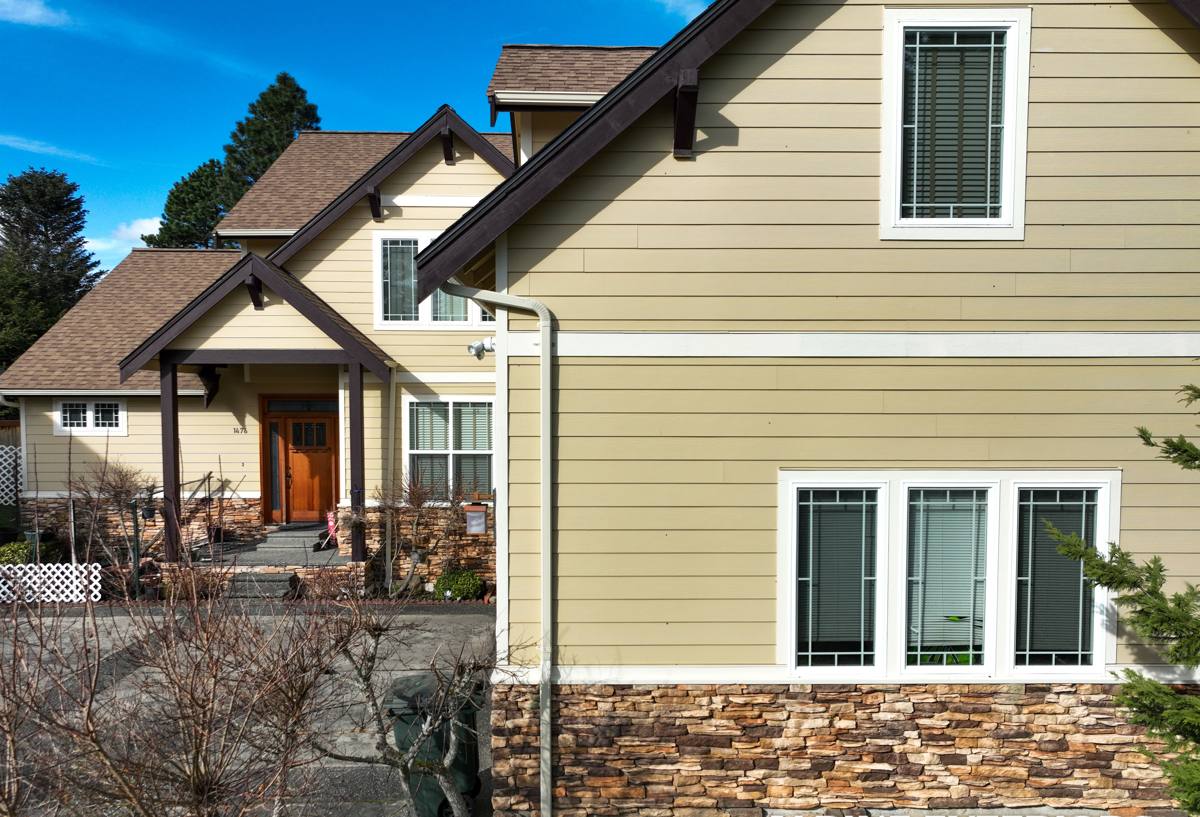
What Salt Air and Moisture Do to Different Siding Materials
Not every siding material handles this environment the same way. Some hold up fine for a decade or more and then start failing quickly once moisture finds a weak point. Others are engineered specifically for this kind of exposure. Here's a general comparison of how common siding materials behave in a marine, high-rainfall climate like La Conner's:
| Material | Behavior in Salt Air / High Rain | Common Long-Term Issue |
|---|---|---|
| Cedar / primed wood | Attractive but absorbs moisture readily; needs frequent refinishing | Cupping, checking, rot at joints and bottom courses |
| Vinyl | Sheds water on the face but relies on loose panels and weep holes; can warp in temperature swings | Water gets behind panels, fading, brittleness over time |
| LP SmartSide (engineered wood) | Better than raw wood but still wood-based; edges are moisture-sensitive | Swelling at cut edges and seams if sealing isn't maintained |
| James Hardie fiber cement | Non-combustible, dimensionally stable, doesn't absorb water the way wood-based products do | Still requires correct flashing and joint treatment, but the material itself isn't the weak point |
Every material has trade-offs, and none of them are maintenance-free. The difference is what happens when maintenance slips for a season or two — which, realistically, happens in every household. Fiber cement gives you more margin for that.
Why We Install James Hardie and Nothing Else
We made a decision a long time ago to install James Hardie fiber cement siding exclusively — no vinyl, no LP SmartSide, no Cemplank, no Allura, no cedar. That's not a marketing position; it's a standard we hold because of what we've seen play out on homes in this exact climate. Wood-based products, no matter how well engineered, are still vulnerable at cut edges and seams where moisture can get in. Vinyl depends on a drainage system behind it that's only as good as the installer, and it moves with temperature the way rigid materials don't. James Hardie's fiber cement formulation is engineered to resist moisture absorption and stay dimensionally stable, which matters enormously in a place where the siding is wet more months than it's dry.
James Hardie also makes a version of its product line — the HZ5 engineered-for-climate system — built specifically for regions with heavy moisture exposure like the Pacific Northwest. That's the line we spec for La Conner and the rest of Skagit County. It's paired with a factory-applied ColorPlus finish, which is baked on under controlled conditions rather than painted on-site, so the color layer itself resists the fading and cracking that field-applied paint struggles with in a marine environment.
None of this means Hardie siding is maintenance-free or immune to the climate — it isn't. It means the material itself isn't the weak link, so long as the installation is done correctly.
Where Correct Installation Matters Most
Fiber cement siding is only as good as the details around it. On a waterfront home, we pay particular attention to:
- Flashing at every window, door, and roofline intersection — this is where the vast majority of siding failures actually start, not in the field of the wall
- A drainage plane (rainscreen or weather-resistive barrier with proper lap) behind the siding so any moisture that gets past the face can still escape
- Fastener selection — corrosion-resistant fasteners rated for the exposure, not whatever is cheapest, since salt air accelerates corrosion on standard fasteners
- Correct nailing patterns and clearances per James Hardie's published installation instructions, which affect both the warranty and how the boards perform over time
- Proper caulking and joint treatment at butt joints and trim, using products rated for the movement and moisture this climate produces
- Adequate clearance between the bottom of the siding and grade, decks, or roof lines, so splash-back and standing moisture don't sit against the board
Moss, Algae, and the Long Wet Season
Skagit County's moss season is long, and La Conner's tree cover and channel humidity make north- and shade-facing walls especially prone to it. Moss and algae growth on siding isn't just cosmetic — trapped organic growth holds moisture against the surface longer than bare siding would, which is exactly the condition that causes problems over time regardless of material. A few things reduce how much of this you'll deal with:
- Adequate roof overhangs and gutter maintenance so runoff isn't sheeting directly down the wall
- Keeping vegetation and landscaping pulled back from the siding to allow airflow and sun exposure
- Periodic gentle washing (low-pressure, not a pressure washer aimed directly at seams) to keep organic buildup from establishing
- A factory finish that resists staining better than field-applied paint, which is one of the practical reasons ColorPlus finishes hold up well here
No siding material stops moss from growing on a shaded, damp wall entirely — that's a function of sun exposure and airflow as much as material. But a correctly installed, factory-finished fiber cement system gives you a surface that's easier to clean and less likely to be damaged by the growth or the cleaning process itself.
Our Process for La Conner Projects
A siding replacement in a waterfront community deserves a process that accounts for the site conditions, not a generic install. Here's how we approach it:
- On-site assessment — we look at existing siding condition, water intrusion points, current flashing, and how the home's exposure to wind and water off the channel affects which walls need the most attention.
- Product and color selection — we walk through James Hardie's HZ5 lines and ColorPlus color options, factoring in sun exposure and how colors read against the water and surrounding landscape.
- Tear-off and substrate check — removing old siding gives us a chance to inspect sheathing for hidden rot or moisture damage before anything new goes up, which matters more here than in drier parts of the county.
- Weather barrier and flashing installation — this is the step that determines whether the new siding actually performs, done to manufacturer spec, not shortcuts.
- Hardie board installation — following James Hardie's fastening, clearance, and joint-treatment guidelines to keep the manufacturer's warranty intact.
- Final inspection and site cleanup — checking every joint, corner, and penetration before we call the job done.
Why a Crew That Already Works Skagit County Matters
Hiring a contractor who already works in La Conner and the surrounding Skagit County area isn't just about convenience. It means the crew has already dealt with the permitting process for this jurisdiction, understands how homes here are typically built and what's usually hiding behind the existing siding, and knows what wind and moisture exposure actually looks like on a channel-front lot versus a home set back among trees. A crew that mostly works in a completely different climate can install Hardie siding correctly on paper and still miss the details that matter most for long-term performance in a marine environment — because those details aren't universal, they're regional.
It also means fewer surprises during the project itself. Local crews know which suppliers stock what, how weather windows typically run through the wet season, and how to sequence a job so exposed sheathing isn't sitting open during a stretch of rain.
What This Typically Costs
Every home is different, and an accurate number requires seeing the house, but these are the general factors that move the price on a La Conner siding project:
| Factor | Why It Matters |
|---|---|
| Home size and wall complexity | More corners, dormers, and trim details mean more labor and material cuts |
| Existing siding removal | Tear-off and disposal of old material adds time versus installing over a prepped surface |
| Substrate repair | Rot or moisture damage found during tear-off needs to be addressed before new siding goes on |
| Product line and profile | Lap width, shingle-style panels, and trim details vary in material cost |
| Access and site conditions | Waterfront lots, tight setbacks, or limited equipment access can affect labor time |
We give straightforward, written estimates after seeing the home in person — we don't quote sight unseen, because guessing on a job like this does homeowners a disservice.
Signs Your La Conner Home May Need New Siding
- Paint that's peeling, bubbling, or needs repainting more often than it used to
- Soft spots, visible cupping, or cracking, especially near the bottom courses or around windows
- Persistent moss or dark staining that comes back quickly after cleaning
- Visible gaps at seams, corners, or trim where caulking has failed
- Rising energy bills that suggest the wall assembly isn't performing the way it should
- Interior signs like musty smells or discoloration on walls that share an exterior wall
If your La Conner home is showing any of these signs, or you're planning ahead for a replacement, we're happy to come take a look and give you a straightforward, no-pressure estimate — no upsell to a product we don't stand behind, just an honest read on what your home needs.