 Skagit County
 Deck Damage in Hamilton Follows a Pattern
Decks in and around Hamilton don't fail randomly. After enough years watching how these structures age out here, the damage almost always traces back to the same source: moisture that has nowhere to go and no chance to dry out between storms. Skagit County's marine climate brings long stretches of driving rain and a moss season that can run most of the year, and a river-valley setting like Hamilton's adds its own wrinkle on top of that — shaded lots, low-lying ground, and cooler, damper air that sits longer than it does out toward the coast.
Why the River Valley Setting Matters
Homes closer to the saltwater side of the county deal with salt-laden wind and driving coastal rain hammering their exteriors. Hamilton's challenge is a little different. Tucked against the hills and the river, lots here tend to be shadier and slower to dry after a storm passes. Fog settles into the valley overnight, morning dew lingers longer under tree cover, and ground moisture stays elevated for more of the year. That combination is exactly what wood rot, moss, and hidden fastener corrosion need to get going — and it's why a deck that looks fine on the surface can be hiding real structural problems underneath.
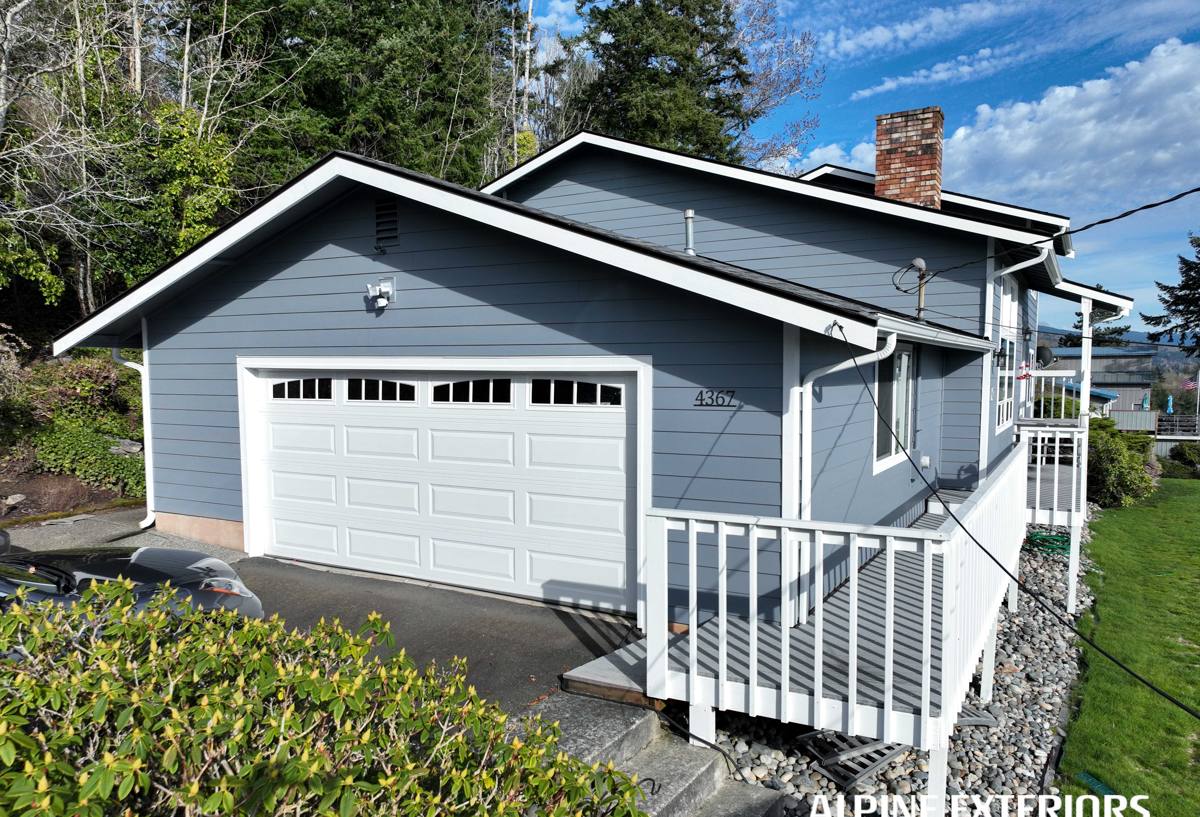
What "Deck Repair" Actually Covers
A proper deck repair isn't just swapping out a few gray, splintery boards. The decking surface is the part you see, but it's rarely the part that matters most for safety. When we take on a repair, we're looking at the whole system — the same way we'd evaluate any exterior structure that's been exposed to Skagit County weather for years.
The Ledger Board Connection
This is the board that ties the deck to the house, and it's the single most safety-critical connection on the structure. If flashing was installed wrong — or wasn't installed at all — water works its way behind the ledger and into the house's rim joist. This is the kind of damage that's invisible from a normal walk-around but can compromise the entire deck's attachment to the home.
Posts, Footings, and Ground Contact
Anywhere a post meets grade or sits in a footing is a spot where moisture collects and lingers, especially on shaded, low-lying lots. We check for soft or punky wood at the base, footing movement, and posts that were never properly isolated from standing water in the first place.
Joists and Framing
Framing failures are usually slower and quieter than surface rot, but they're the ones that actually matter for load. Undersized joist hangers, missing structural screws, and rot at joist ends where water pools against the ledger are common finds once we get underneath a deck that's been in service a while.
Surface Boards and Fasteners
Cupped, splintering, or spongy decking boards are usually the first visible symptom, and often the reason a homeowner calls in the first place. But we always ask why the boards failed before we just replace them — otherwise new boards fail the same way in a few years.
Stairs and Railings
Stair stringers and railing posts take a disproportionate amount of abuse from foot traffic, and railing post connections are a common weak point on older decks that were built to lighter code requirements than what's expected today.
Signs a Hamilton Deck Needs Repair
Most homeowners notice a problem well before they call — they just aren't sure if it's serious. Here's what tells us a deck needs more than a cleaning:
- Boards that feel soft, spongy, or flex noticeably underfoot
- Moss or black staining that comes right back within weeks of cleaning
- Visible gaps, rust streaks, or dark staining where the deck meets the house
- Railings or posts that wobble or shift when pushed
- Steps that sag, bounce, or feel uneven
- Water that pools on the surface instead of shedding off
- Rot or discoloration at the base of posts where they meet the ground
- Fasteners that are rusted, popped up, or missing their heads
Any one of these on its own might be minor. Several together usually mean the moisture problem has moved past the surface and into the structure.
Repair or Replace? What Actually Decides It
Homeowners often assume any deck issue means a full rebuild. In our experience, that's true less often than people expect — but it does depend heavily on which part of the deck is affected and how far the damage has spread.
| Component | Typical Damage We See | Usually Repairable? | Rough Cost Range |
|---|---|---|---|
| Decking boards | Cupping, splintering, isolated rot | Yes, board-by-board | Low, scales with number of boards |
| Ledger flashing | Missing or failed flashing, water intrusion | Yes, if rim joist rot is limited | Moderate |
| Posts/footings | Rot at grade, footing movement | Often, post-by-post | Moderate |
| Joist framing | Widespread rot, undersized hangers | Sometimes; extensive rot pushes toward rebuild | Moderate to high |
| Full structure | Structural rot across multiple systems | Rebuild usually makes more sense | Highest |
These ranges are broad on purpose — every deck's size, height, and access is different, and we won't quote a real number until we've actually looked at your structure.
How We Handle a Deck Repair in Hamilton
- On-site inspection. We probe the ledger board, posts, and joists — not just the decking surface — because that's where the real answer lives.
- Written scope. You get a clear breakdown of what's failing, what's still sound, and what your options are, before any work starts.
- Structural work first. Ledger flashing, post bases, and framing issues get addressed before anything cosmetic, because a nice new surface over bad framing just hides the problem again.
- Matched materials. Replacement lumber and fasteners are chosen to hold up in this climate specifically, not just whatever's cheapest.
- Proper flashing and fastening. Every connection point gets treated as the failure point it eventually would become if left alone.
- Cleanup and walkthrough. We show you what was done and what to watch for going forward.
Material Choices We Stand Behind
For framing, we use pressure-treated lumber rated for ground contact anywhere moisture exposure calls for it, along with corrosion-resistant fasteners and hangers — stainless or coated hardware, not standard-grade fasteners that will rust and stain within a couple of wet seasons out here. That upfront cost difference is small compared to the cost of redoing a connection that failed early.
For decking surfaces, both quality wood and composite have a place, and we're honest about the trade-offs of each rather than pushing one product line:
- Wood decking costs less upfront and is straightforward to repair board-by-board, but it needs regular cleaning and refinishing to hold up against moss and moisture — skip that maintenance in this climate and it shows fast.
- Composite decking resists moisture and moss better and needs less upkeep, but it costs more upfront, and not every composite product handles our shaded, damp conditions equally well — installation details like ventilation and fastening matter more than the marketing does.
We're careful about which composite lines we install for the same reason we're careful about framing hardware: a product that looks fine in a showroom can behave differently after a few wet Skagit County winters, and our name is attached to the installation either way.
Why Local, Hamilton-Familiar Experience Matters
Deck repair is one of those jobs where general contracting knowledge isn't quite enough — the right approach in a dry inland climate isn't necessarily the right approach in a shaded river valley that stays damp for weeks after a storm. A crew that already works Skagit County has seen how moss regrows on these lots, which framing details actually hold up to valley moisture, and how the local building department expects structural repairs and permits to be handled. That familiarity shows up in fewer surprises during the job and repairs that are built for the conditions you actually have, not generic conditions from a manual.
It also means someone who can get back out to your property without a long drive if a question comes up after the work is done — not a crew that treats Hamilton as an out-of-the-way stop on the way to somewhere else.
Keeping a Repaired Deck Healthy Between Visits
A good repair buys you years, but a little upkeep buys you more. This is the maintenance routine we recommend to homeowners once the work is done:
- Sweep leaves and debris off the surface regularly, especially in fall
- Clean moss with a soft wash approach rather than a high-pressure blast, which can drive water into the wood grain
- Check ledger board flashing once a year for gaps or staining
- Keep gutters and downspouts directed away from the deck structure, not onto it
- Trim back vegetation that's shading the deck and slowing airflow underneath
- Reseal or refinish wood decking on a regular schedule rather than waiting until it looks bad
None of this is complicated, but skipping it is exactly how a five-year repair turns into a two-year repair.
If your deck in Hamilton has soft spots, stubborn moss, or just doesn't feel as solid as it used to, we're happy to take a look and give you a straight answer about what it needs. Fill out the form below for a free, no-pressure estimate.